Sleep Disorder Unit, Pitie-Salpetriere University Hospital, APHP, Paris, France.
Center for Advanced Research in Sleep Medicine, Hôpital du Sacré-Coeur de Montréal, Montréal, Canada.
Sci Rep. 2022 Feb 2;12(1):1770. doi: 10.1038/s41598-022-05905-5.
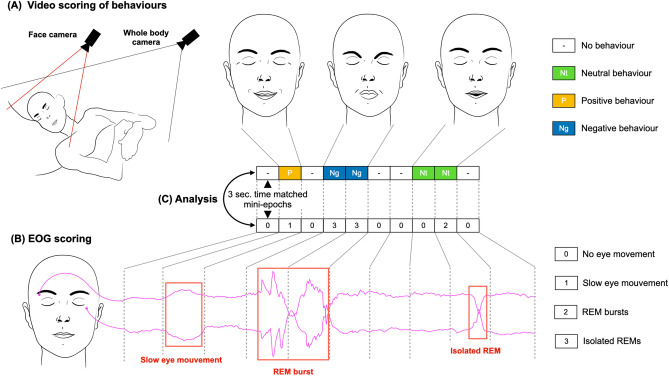
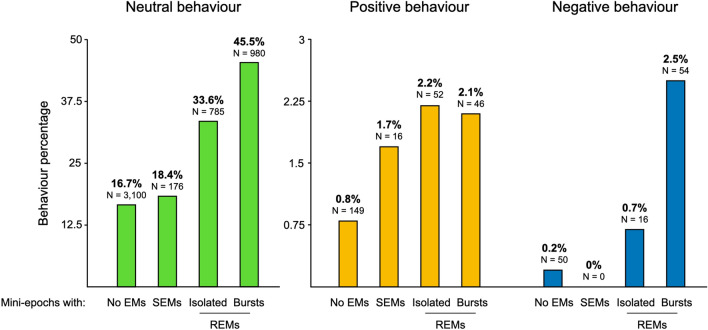
Growing evidence suggests that sleep plays a key role in regulating emotions. Rapid eye movements (REMs) in REM sleep could be associated with dreams emotions, but supporting evidence is indirect. To highlight this association, we studied the REM sleep during video-polysomnography of 20 subjects with REM sleep behaviour disorder (RBD), a model of enacted dreams offering direct access to the emotional content of the sleeper (face expression, speeches, behaviour). Video and the electro-oculography recordings were divided into 3 s time intervals and classified as non-behavioural, or behavioural (neutral, positive or negative emotions), and as containing no eye movements (EMs), slow eye movements (SEMs) or REMs (isolated or bursts). Compared to the absence of EMs, neutral behaviours successively increased in the presence of SEMs (odd ratio, OR = 1.4), then isolated REMs (OR = 2.8) and then REM bursts (OR = 4.6). Positive behaviours increased with SEMs (OR = 2.8) but did not increase further with isolated REMs (OR = 2.8) and REM bursts (OR = 3). Negative behaviours were absent with SEMs, increased with isolated REMs (OR = 2.6) and further with REM bursts (OR = 10.1). These results support an association between REMs and SEMs, and dream emotions.
越来越多的证据表明,睡眠在调节情绪方面起着关键作用。快速眼动 (REM) 睡眠中的 REM 可能与梦境情绪有关,但支持证据是间接的。为了强调这种关联,我们研究了 20 例 REM 睡眠行为障碍 (RBD) 患者视频多导睡眠图中的 REM 睡眠,RBD 是一种梦境行为模型,可直接访问睡眠者的情绪内容(面部表情、言语、行为)。视频和眼动电图记录被分为 3 秒的时间间隔,并分类为非行为、行为(中性、积极或消极情绪),以及无眼动(EMs)、慢眼动(SEMs)或 REMs(孤立或爆发)。与没有 EMs 相比,中性行为在 SEMs 存在时依次增加(优势比,OR=1.4),然后是孤立的 REMs(OR=2.8),然后是 REM 爆发(OR=4.6)。积极行为随着 SEMs 的增加而增加(OR=2.8),但进一步增加不会增加孤立的 REMs(OR=2.8)和 REM 爆发(OR=3)。SEM 无消极行为,孤立 REMs(OR=2.6)和 REM 爆发(OR=10.1)增加。这些结果支持 REMs 和 SEMs 与梦境情绪之间的关联。