Faculty of Sciences, Physics Department, Sahand University of Technology, Tabriz, Iran.
Faculty of Medicine, Department of Medical Physics, Tabriz University of Medical Sciences, Tabriz, Iran.
J Appl Clin Med Phys. 2022 Apr;23(4):e13545. doi: 10.1002/acm2.13545. Epub 2022 Feb 2.
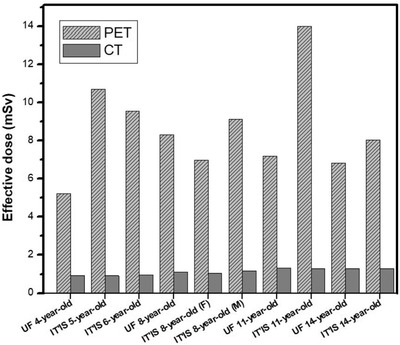
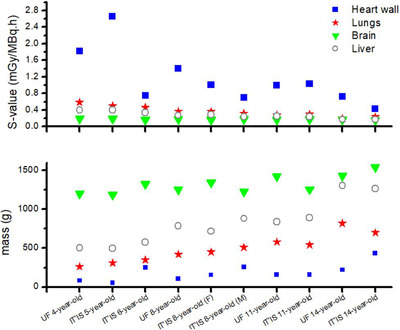
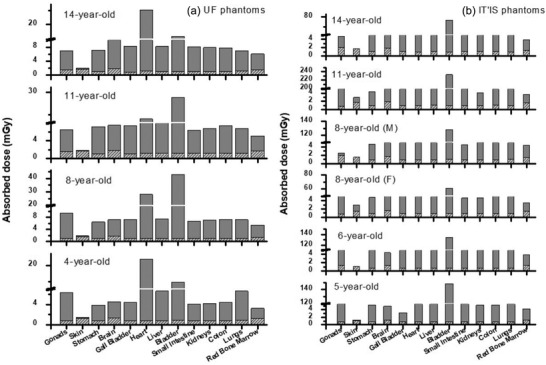
Positron emission tomography (PET)/computed tomography (CT) is a well-known modality for the diagnosis of various diseases in children and adult patients. On the other hand, younger patients are more radiosensitive than adults, so there are concerns about the level of ionizing radiation exposure in pediatric whole body PET/CT imaging. In this regard, comprehensive specific radiation dosimetry for whole body PET/CT imaging is highly desired for different ages, sizes, and shapes. Therefore, in this study, organ absorbed doses were evaluated for pediatric voxel models from 4 to 14 years old and compared with those of ICRP phantoms. Monte Carlo calculation was performed to evaluate S-value, absorbed dose, and effective dose from F-FDG radiotracers and whole body CT scan for different computational models, including 4- to 14-year-old phantoms. The results showed that the S-value and, therefore, absorbed dose of F-FDG strongly depended on the phantom anatomy. These variations were justified by the distance between source and target organs. Moreover, on average, the absorbed doses from whole body CT scans were 13.5 times lower than those from F-FDG for all organs. According to the results, various anatomies and ages should be considered for accurate dose evaluation. These data can be used for specific risk assessment of the pediatric population in clinical nuclear imaging.
正电子发射断层扫描(PET)/计算机断层扫描(CT)是一种众所周知的诊断儿童和成年患者各种疾病的方法。另一方面,年幼的患者比成年人对放射线更敏感,因此人们对儿科全身 PET/CT 成像中的电离辐射暴露水平存在担忧。在这方面,对于不同年龄、体型和形状的全身 PET/CT 成像,非常需要全面的特定辐射剂量学。因此,在这项研究中,评估了 4 至 14 岁儿科体素模型的器官吸收剂量,并将其与 ICRP 体模进行了比较。进行了蒙特卡罗计算,以评估来自 F-FDG 放射性示踪剂和全身 CT 扫描的 S 值、吸收剂量和有效剂量,用于不同的计算模型,包括 4 至 14 岁的体模。结果表明,S 值,因此, F-FDG 的吸收剂量强烈依赖于幻影解剖结构。这些变化是由源和靶器官之间的距离来解释的。此外,平均而言,全身 CT 扫描的吸收剂量对于所有器官都比 F-FDG 低 13.5 倍。根据这些结果,应考虑各种解剖结构和年龄以进行准确的剂量评估。这些数据可用于临床核成像中儿科人群的特定风险评估。