Chen Wenyu, Yan Haijiao, Li Xiaodong, Ge Kele, Wu Jun
Department of Oncology, Third Affiliated Hospital of Soochow University, Changzhou, China.
Transl Cancer Res. 2021 Jan;10(1):529-536. doi: 10.21037/tcr-20-2856.
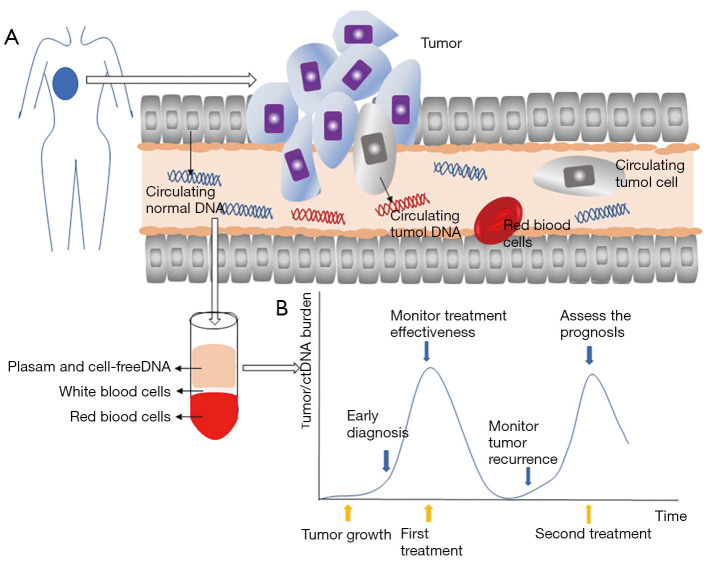
Circulating tumor DNA (ctDNA) is the small genomic fragment released by tumor cells into the circulating system, which carries the gene variation features, such as mutation, insertion, deletion, rearrangement, copy number variation (CNV) and methylation, rendering it an important biomarker. It can be used not only to diagnose certain types of solid tumors, but also to monitor the therapeutic response and explore the minimal residual disease (MRD) and resistant mutation of targeted therapy. Therefore, ctDNA detection may become the preferred non-invasive tumor screening method. For patients who cannot receive further gene detection due to insufficient or restricted sample collection with the defined pathological diagnosis, ctDNA detection can be carried out to determine the gene mutation type, with no need for repeated sampling. Gastric cancer (GC) is a malignancy with extremely high morbidity and mortality, and its genesis and development are the consequence of interactions of multiple factors, including environment, diet, heredity, helicobacter pylori infection, chronic inflammatory infiltration, and precancerous lesion. As the research on GC moves forward, the existing research mainly focuses on genetic and epigenetic changes, including DNA methylation, histone modification, non-coding RNA changes, gene mutation, gene heterozygosity loss and microsatellite instability. This paper aimed to summarize the contents of ctDNA detection, its application status in GC and clinical significance.
循环肿瘤DNA(ctDNA)是肿瘤细胞释放到循环系统中的小基因组片段,其携带基因突变、插入、缺失、重排、拷贝数变异(CNV)和甲基化等基因变异特征,使其成为一种重要的生物标志物。它不仅可用于诊断某些类型的实体瘤,还可用于监测治疗反应、探索微小残留病(MRD)和靶向治疗的耐药突变。因此,ctDNA检测可能成为首选的非侵入性肿瘤筛查方法。对于因样本采集不足或受限而无法进行进一步基因检测且已明确病理诊断的患者,可进行ctDNA检测以确定基因突变类型,无需重复采样。胃癌(GC)是一种发病率和死亡率极高的恶性肿瘤,其发生和发展是多种因素相互作用的结果,包括环境、饮食、遗传、幽门螺杆菌感染、慢性炎症浸润和癌前病变。随着对胃癌研究的推进,现有研究主要集中在基因和表观遗传变化,包括DNA甲基化、组蛋白修饰、非编码RNA变化、基因突变、基因杂合性缺失和微卫星不稳定性。本文旨在总结ctDNA检测的内容、其在胃癌中的应用现状及临床意义。