Saucedo-Orozco Huitzilihuitl, Voorrips Suzanne N, Yurista Salva R, de Boer Rudolf A, Westenbrink B Daan
Department of Cardiology, University Medical Center Groningen, University of Groningen, Groningen, The Netherlands.
Cardiology Division, Cardiovascular Research Center, Massachusetts General Hospital, Harvard Medical School, Boston, MA, USA.
J Lipid Atheroscler. 2022 Jan;11(1):1-19. doi: 10.12997/jla.2022.11.1.1. Epub 2022 Jan 13.
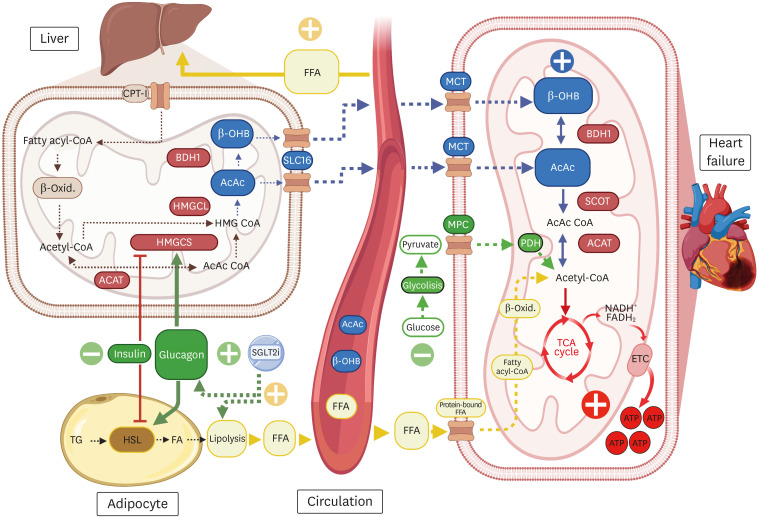
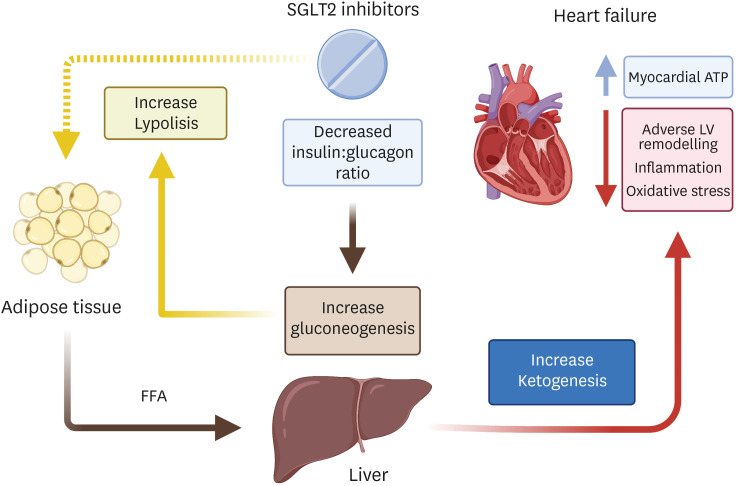
Sodium-glucose cotransporter-2 (SGLT2) inhibitors have emerged as powerful drugs that can be used to treat heart failure (HF) patients, both with preserved and reduced ejection fraction and in the presence or absence of type 2 diabetes. While the mechanisms underlying the salutary effects of SGLT2 inhibitors have not been fully elucidated, there is clear evidence for a beneficial metabolic effect of these drugs. In this review, we discuss the effects of SGLT2 inhibitors on cardiac energy provision secondary to ketone bodies, pathological ventricular remodeling, and inflammation in patients with HF. While the specific contribution of ketone bodies to the pleiotropic cardiovascular benefits of SGLT2 inhibitors requires further clarification, ketone bodies themselves may also be used as a therapy for HF.
钠-葡萄糖协同转运蛋白2(SGLT2)抑制剂已成为治疗心力衰竭(HF)患者的强效药物,无论射血分数是保留还是降低,以及是否存在2型糖尿病。虽然SGLT2抑制剂有益作用的潜在机制尚未完全阐明,但有明确证据表明这些药物具有有益的代谢作用。在本综述中,我们讨论了SGLT2抑制剂对HF患者酮体介导的心脏能量供应、病理性心室重塑和炎症的影响。虽然酮体对SGLT2抑制剂多效性心血管益处的具体贡献需要进一步阐明,但酮体本身也可作为HF的一种治疗方法。