• 文献检索
  • 文档翻译
  • 深度研究
  • 学术资讯
  • Suppr Zotero 插件Zotero 插件
  • 邀请有礼
  • 套餐&价格
  • 历史记录
应用&插件
Suppr Zotero 插件Zotero 插件浏览器插件Mac 客户端Windows 客户端微信小程序
定价
高级版会员购买积分包购买API积分包
服务
文献检索文档翻译深度研究API 文档MCP 服务
关于我们
关于 Suppr公司介绍联系我们用户协议隐私条款
关注我们

Suppr 超能文献

核心技术专利:CN118964589B侵权必究
粤ICP备2023148730 号-1Suppr @ 2026

文献检索

告别复杂PubMed语法,用中文像聊天一样搜索,搜遍4000万医学文献。AI智能推荐,让科研检索更轻松。

立即免费搜索

文件翻译

保留排版,准确专业,支持PDF/Word/PPT等文件格式,支持 12+语言互译。

免费翻译文档

深度研究

AI帮你快速写综述,25分钟生成高质量综述,智能提取关键信息,辅助科研写作。

立即免费体验

视觉宣传活动和叙事小插曲对医疗卫生专业人员成瘾污名的影响:一项随机临床试验。

Effect of Exposure to Visual Campaigns and Narrative Vignettes on Addiction Stigma Among Health Care Professionals: A Randomized Clinical Trial.

机构信息

Department of Health Policy and Management, Johns Hopkins Bloomberg School of Public Health, Baltimore, Maryland.

Johns Hopkins Center for Mental Health and Addiction Policy, Baltimore, Maryland.

出版信息

JAMA Netw Open. 2022 Feb 1;5(2):e2146971. doi: 10.1001/jamanetworkopen.2021.46971.

DOI:10.1001/jamanetworkopen.2021.46971
PMID:35119460
原文链接:https://pmc.ncbi.nlm.nih.gov/articles/PMC8817201/
Abstract

IMPORTANCE

Stigma toward people with opioid use disorder (OUD) is pervasive in clinical settings, impeding delivery of high-quality care. To date, no study has evaluated the effect of different stigma-reduction messages or messengers among health care professionals.

OBJECTIVE

To evaluate the effect of OUD-related messages delivered by different messengers on stigma and attitudes toward people with OUD among health care professionals.

DESIGN, SETTING, AND PARTICIPANTS: This randomized clinical trial examined the effects of OUD-related messages delivered by a visual campaign alone or in combination with a written narrative vignette from the perspective of 1 of 3 messengers. Health care professionals in the US were recruited from 2 national online survey panels (Ipsos KnowledgePanel and SurveyHealthcareGlobus). A total of 1842 participants completed a web-based survey measuring stigma toward people with OUD from November 13 to 30, 2020.

INTERVENTIONS

Eight groups were exposed to 1 of 2 message frames. One frame (Words Matter) emphasized the harm of stigmatizing language, and the other (Medication Treatment Works) focused on the effectiveness of medications approved by the US Food and Drug Administration for the treatment of OUD. Message frames were communicated through either a visual campaign alone or a visual campaign in combination with a written narrative vignette from the perspective of a simulated patient with OUD, a clinician, or a health care system administrator.

MAIN OUTCOMES AND MEASURES

Dimensions of stigma toward people with OUD were measured on 5-point Likert scales that included items about desire for social distance from people with OUD, perception of individual blame for OUD, perspective of OUD as a medical condition, and support for increased governmental spending on OUD treatment. The level of warmth felt toward people with OUD was measured by a feeling thermometer (range, 0-100 points).

RESULTS

Among 1842 participants, the mean (SD) age was 47 (13) years; 1324 participants (71.9%) were female, 145 (7.9%) were Hispanic, 140 (7.6%) were non-Hispanic Black, 1344 (73.0%) were non-Hispanic White, and 213 (11.6%) were of other non-Hispanic race (ie, individuals who did not self-report race as Black or White and did not self-report ethnicity as Hispanic). Compared with nonexposure, exposure to the combination of visual campaign and narrative vignette communicating the importance of nonstigmatizing language from the perspective of a patient with OUD was associated with a lower probability (difference, -16.8 percentage points, 95% CI, -26.1 to -7.4; P < .001) of unwillingness to have a person with OUD marry into the family (a measure of social distance preference) and a 7.2-point (95% CI, 3.2-11.1; P < .001) higher warmth rating. Participants exposed to the combined visual campaign and patient vignette about the value of medication treatment for OUD also had significantly lower levels of stigma compared with those in the nonexposed control group (eg, unwillingness to have a person with OUD as a neighbor: difference, -15.3 percentage points; 95% CI, -24.6 to -6.0; P = .001).

CONCLUSIONS AND RELEVANCE

In this study, messages about nonstigmatizing language and effective medication for OUD reduced stigma among health care professionals. Stigma-reduction efforts targeting health care professionals may improve health care system capacity to serve people with OUD.

TRIAL REGISTRATION

ClinicalTrials.gov Identifier: NCT05127707.
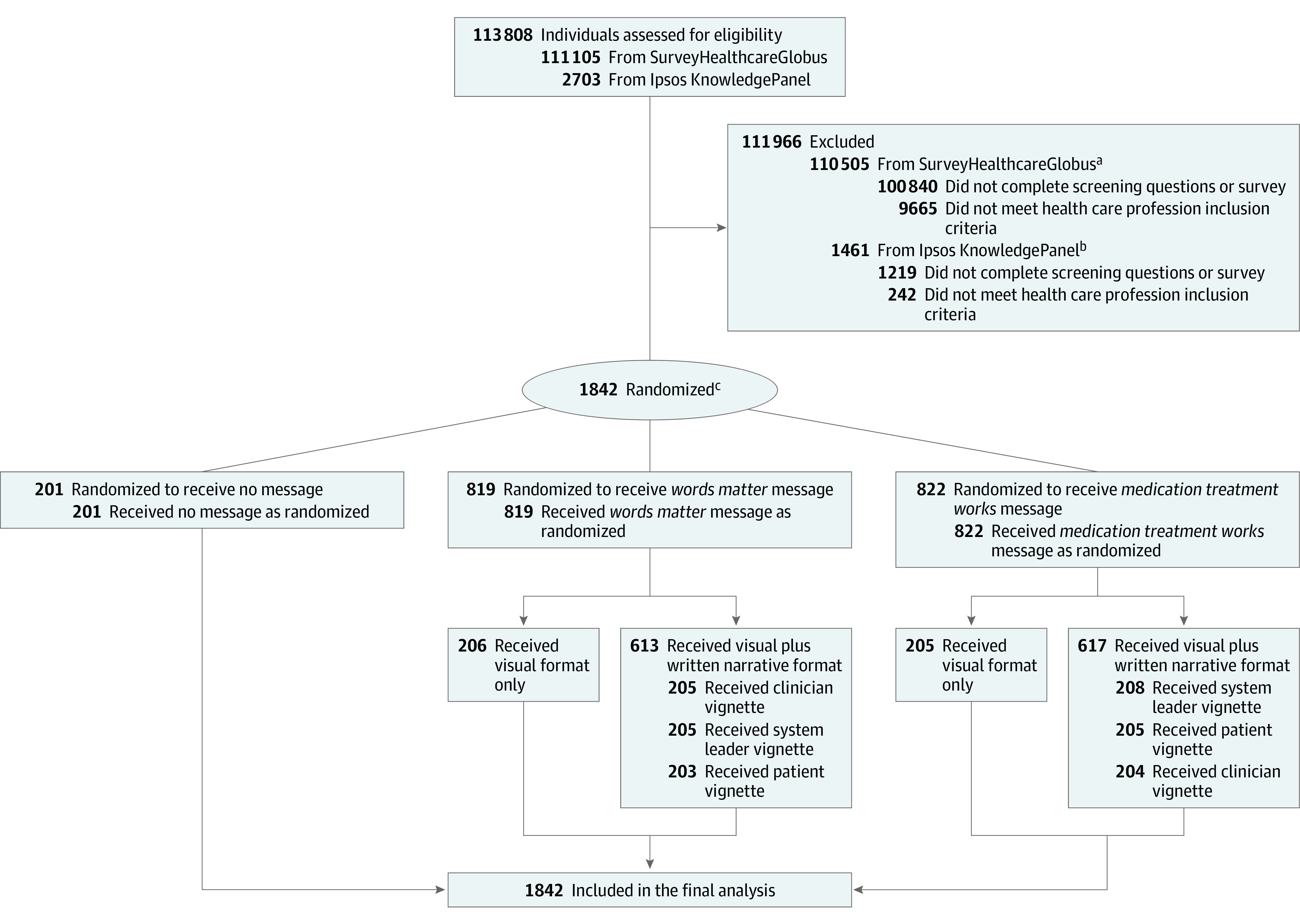
https://cdn.ncbi.nlm.nih.gov/pmc/blobs/3df6/8817201/1e5cee9326bc/jamanetwopen-e2146971-g001.jpg
摘要

重要性:在临床环境中,人们普遍对阿片类药物使用障碍(OUD)患者存在污名化现象,这阻碍了高质量护理的提供。迄今为止,尚无研究评估在卫生保健专业人员中使用不同的减少污名化信息或信息传递者对 OUD 相关污名和态度的影响。

目的:评估由不同信息传递者传递的 OUD 相关信息对卫生保健专业人员的 OUD 相关污名和态度的影响。

设计、地点和参与者:这项随机临床试验从 3 个信息传递者中的 1 个角度评估了仅通过视觉运动或结合来自 OUD 患者的书面叙述小插曲的 OUD 相关信息对 OUD 相关污名的影响。美国的卫生保健专业人员是从两个全国在线调查小组(益普索知识面板和 SurveyHealthcareGlobus)招募的。共有 1842 名参与者于 2020 年 11 月 13 日至 30 日完成了一项基于网络的调查,调查内容是他们对 OUD 患者的污名态度。

干预措施:8 个组暴露于 2 个信息框架中的 1 个。一个框架(“言语很重要”)强调了污名化语言的危害,另一个框架(“药物治疗有效”)则侧重于美国食品和药物管理局批准的治疗 OUD 的药物的有效性。信息框架通过视觉运动或结合来自 OUD 患者、临床医生或卫生保健系统管理员的模拟患者的书面叙述小插曲来传达。

主要结果和测量:使用包含与 OUD 患者保持社会距离的愿望、对 OUD 的个人归咎感、将 OUD 视为医学状况的观点以及对增加 OUD 治疗政府支出的支持等方面的 5 点李克特量表来衡量对 OUD 患者的污名程度。对 OUD 患者的温暖感受是通过感觉温度计(范围为 0-100 分)来衡量的。

结果:在 1842 名参与者中,平均(SD)年龄为 47(13)岁;1324 名参与者(71.9%)为女性,145 名(7.9%)为西班牙裔,140 名(7.6%)为非西班牙裔黑人,1344 名(73.0%)为非西班牙裔白人,213 名(11.6%)为其他非西班牙裔种族(即,不自我报告为黑人或白人种族,也不自我报告为西班牙裔的个体)。与无暴露相比,暴露于视觉运动与叙事小插曲相结合,从 OUD 患者的角度传达非污名化语言的重要性,与不愿意让 OUD 患者与家人结婚(一种社会距离偏好的衡量标准)的可能性较低相关(差异,-16.8 个百分点,95%CI,-26.1 至-7.4;P<.001),且温暖评分高 7.2 分(95%CI,3.2-11.1;P<.001)。与未暴露于对照组相比,暴露于关于 OUD 药物治疗价值的视觉运动和患者小插曲的参与者的污名程度也显著降低(例如,不愿意让 OUD 患者作为邻居:差异,-15.3 个百分点;95%CI,-24.6 至-6.0;P=.001)。

结论和相关性:在这项研究中,关于非污名化语言和 OUD 有效药物的信息减少了卫生保健专业人员的污名。针对卫生保健专业人员的减少污名化努力可能会提高卫生保健系统服务 OUD 患者的能力。

试验注册:ClinicalTrials.gov 标识符:NCT05127707。

相似文献

1
Effect of Exposure to Visual Campaigns and Narrative Vignettes on Addiction Stigma Among Health Care Professionals: A Randomized Clinical Trial.视觉宣传活动和叙事小插曲对医疗卫生专业人员成瘾污名的影响:一项随机临床试验。
JAMA Netw Open. 2022 Feb 1;5(2):e2146971. doi: 10.1001/jamanetworkopen.2021.46971.
2
Does a Survivorship Model of Opioid Use Disorder Improve Public Stigma or Policy Support? A General Population Randomized Experiment.阿片类药物使用障碍的生存模式是否能改善公众污名或政策支持?一项普通人群随机实验。
J Gen Intern Med. 2023 May;38(7):1638-1646. doi: 10.1007/s11606-022-07865-y. Epub 2022 Nov 17.
3
The role of stigma in U.S. primary care physicians' treatment of opioid use disorder.耻辱感在美国初级保健医生治疗阿片类药物使用障碍中的作用。
Drug Alcohol Depend. 2021 Apr 1;221:108627. doi: 10.1016/j.drugalcdep.2021.108627. Epub 2021 Feb 16.
4
The unique nature of public stigma toward non-medical prescription opioid use and dependence: a national study.公众对非医疗处方类阿片类药物使用和依赖的污名化具有独特性:一项全国性研究。
Addiction. 2020 Dec;115(12):2317-2326. doi: 10.1111/add.15069. Epub 2020 Apr 20.
5
Addressing Bias and Stigma in the Language We Use With Persons With Opioid Use Disorder: A Narrative Review.解决阿片类药物使用障碍患者语言中的偏见和污名问题:叙事评论。
J Am Psychiatr Nurses Assoc. 2022 Jan-Feb;28(1):9-22. doi: 10.1177/10783903211050121. Epub 2021 Nov 18.
6
A randomized controlled trial of an intervention to reduce stigma toward people with opioid use disorder among primary care clinicians.一项旨在减少初级保健临床医生对阿片类药物使用障碍患者污名化的干预措施的随机对照试验。
Addict Sci Clin Pract. 2023 Feb 11;18(1):10. doi: 10.1186/s13722-023-00366-1.
7
Perceived stigma, barriers, and facilitators experienced by members of the opioid use disorder community when seeking healthcare.阿片类使用障碍患者在寻求医疗保健时所经历的污名化、障碍和促进因素的感知。
J Nurs Scholarsh. 2023 May;55(3):701-710. doi: 10.1111/jnu.12837. Epub 2022 Nov 1.
8
Perspectives About Emergency Department Care Encounters Among Adults With Opioid Use Disorder.阿片类药物使用障碍成人对急诊科就诊体验的看法。
JAMA Netw Open. 2022 Jan 4;5(1):e2144955. doi: 10.1001/jamanetworkopen.2021.44955.
9
Pharmacists' stigma toward patients engaged in opioid misuse: When "social distance" does not mean disease prevention.药剂师对阿片类药物滥用患者的污名化:当“社会距离”并不意味着预防疾病时。
Subst Abus. 2021;42(4):919-926. doi: 10.1080/08897077.2021.1900988. Epub 2021 Mar 22.
10
Portrayals of mental illness, treatment, and relapse and their effects on the stigma of mental illness: Population-based, randomized survey experiment in rural Uganda.精神疾病的描绘、治疗和复发及其对精神疾病污名化的影响:乌干达农村基于人群的随机调查实验。
PLoS Med. 2019 Sep 20;16(9):e1002908. doi: 10.1371/journal.pmed.1002908. eCollection 2019 Sep.

引用本文的文献

1
A Hand to Hold.一只可握的手。
J Gen Intern Med. 2025 Aug 27. doi: 10.1007/s11606-025-09678-1.
2
Between Love and Exhaustion: A Qualitative Study of Greek Parents' Lived Experiences Supporting Adult Children with Substance Use Disorders.在爱与疲惫之间:一项关于希腊父母支持患有物质使用障碍成年子女的生活经历的定性研究。
Nurs Rep. 2025 Aug 20;15(8):306. doi: 10.3390/nursrep15080306.
3
Improving Data Integrity in Samples Obtained From Web-Based Recruitment: Protocol for the Development of a Novel System for Assessing Participant Authenticity in a Remote Longitudinal Cohort Study of Polysubstance Use.

本文引用的文献

1
The role of stigma in U.S. primary care physicians' treatment of opioid use disorder.耻辱感在美国初级保健医生治疗阿片类药物使用障碍中的作用。
Drug Alcohol Depend. 2021 Apr 1;221:108627. doi: 10.1016/j.drugalcdep.2021.108627. Epub 2021 Feb 16.
2
Overdose-Related Cardiac Arrests Observed by Emergency Medical Services During the US COVID-19 Epidemic.美国 COVID-19 疫情期间,急救医疗服务中心观察到的与过量用药相关的心脏骤停事件。
JAMA Psychiatry. 2021 May 1;78(5):562-564. doi: 10.1001/jamapsychiatry.2020.4218.
3
Comparing perspectives on medication treatment for opioid use disorder between national samples of primary care trainee physicians and attending physicians.
提高基于网络招募的样本的数据完整性:开发一种新型系统以评估多物质使用远程纵向队列研究中参与者真实性的方案。
JMIR Res Protoc. 2025 Aug 14;14:e69956. doi: 10.2196/69956.
4
Decoding strategies for stigma reduction in substance use disorder: A qualitative synthesis utilizing the theoretical domain and behavior change wheel frameworks.减少物质使用障碍中污名化的解码策略:一项利用理论领域和行为改变轮框架的定性综合研究
Indian J Psychiatry. 2025 Jun;67(6):560-573. doi: 10.4103/indianjpsychiatry_149_25. Epub 2025 Jun 11.
5
Receipt of Buprenorphine and Naltrexone for Opioid Use Disorder by Race and Ethnicity and Insurance Type.按种族、民族和保险类型划分的丁丙诺啡和纳曲酮用于阿片类物质使用障碍的情况
JAMA Netw Open. 2025 Jun 2;8(6):e2518493. doi: 10.1001/jamanetworkopen.2025.18493.
6
Barriers to Buprenorphine Treatment Among People Experiencing Homelessness: A Qualitative Study from the Provider Perspective.从提供者角度看无家可归者中丁丙诺啡治疗的障碍:一项定性研究
J Urban Health. 2025 Apr;102(2):465-475. doi: 10.1007/s11524-025-00967-y. Epub 2025 Mar 27.
7
The Strength of a Story: Partnering With a Community Organization to Destigmatize Substance Use Disorder.一个故事的力量:与社区组织合作消除物质使用障碍的污名化
MedEdPORTAL. 2025 Jan 24;21:11487. doi: 10.15766/mep_2374-8265.11487. eCollection 2025.
8
Unveiling the landscape of antistigma interventions for individuals with substance use disorders: A scoping review.揭示针对物质使用障碍患者的反污名化干预措施的全貌:一项范围综述。
Indian J Psychiatry. 2024 Dec;66(12):1101-1123. doi: 10.4103/indianjpsychiatry.indianjpsychiatry_770_24. Epub 2024 Dec 12.
9
Patient perceptions of and experiences with stigma using telehealth for opioid use disorder treatment: a qualitative analysis.患者对使用 telehealth 治疗阿片类药物使用障碍的污名化的看法和体验:一项定性分析。
Harm Reduct J. 2024 Jun 27;21(1):125. doi: 10.1186/s12954-024-01043-5.
10
Impact of Perceived Access and Treatment Knowledge on Medication Preferences for Opioid Use Disorder.感知可及性和治疗知识对阿片类药物使用障碍药物治疗偏好的影响。
Subst Use Addctn J. 2024 Oct;45(4):706-715. doi: 10.1177/29767342241254591. Epub 2024 Jun 3.
比较初级保健实习医生和主治医生两个国家样本对阿片类药物使用障碍药物治疗观点。
Drug Alcohol Depend. 2020 Nov 1;216:108217. doi: 10.1016/j.drugalcdep.2020.108217. Epub 2020 Aug 6.
4
Medication for Opioid Use Disorder: A National Survey of Primary Care Physicians.阿片类物质使用障碍的药物治疗:一项针对基层医疗医生的全国性调查。
Ann Intern Med. 2020 Jul 21;173(2):160-162. doi: 10.7326/M19-3975. Epub 2020 Apr 21.
5
Stigma Reduction to Combat the Addiction Crisis - Developing an Evidence Base.减少污名以应对成瘾危机——建立证据基础。
N Engl J Med. 2020 Apr 2;382(14):1291-1292. doi: 10.1056/NEJMp2000227.
6
Stigma and the Toll of Addiction.成瘾的污名与代价
N Engl J Med. 2020 Apr 2;382(14):1289-1290. doi: 10.1056/NEJMp1917360.
7
Treatment versus Punishment: Understanding Racial Inequalities in Drug Policy.治疗与惩罚:理解毒品政策中的种族不平等。
J Health Polit Policy Law. 2020 Apr 1;45(2):177-209. doi: 10.1215/03616878-8004850.
8
Stigma as a fundamental hindrance to the United States opioid overdose crisis response.污名化是美国阿片类药物过量危机应对的根本障碍。
PLoS Med. 2019 Nov 26;16(11):e1002969. doi: 10.1371/journal.pmed.1002969. eCollection 2019 Nov.
9
Understanding why patients with substance use disorders leave the hospital against medical advice: A qualitative study.理解为什么患有物质使用障碍的患者违背医嘱离开医院:一项定性研究。
Subst Abus. 2020;41(4):519-525. doi: 10.1080/08897077.2019.1671942. Epub 2019 Oct 22.
10
Underutilization of medications to treat opioid use disorder: What role does stigma play?阿片类药物使用障碍治疗药物的未充分利用:污名化起了什么作用?
Subst Abus. 2019;40(4):459-465. doi: 10.1080/08897077.2019.1640833. Epub 2019 Sep 24.