Department of Anesthesiology, American University of Beirut, Beirut, Lebanon.
Department of Internal Medicine, American University of Beirut, Beirut, Lebanon.
BMC Med Educ. 2022 Feb 4;22(1):77. doi: 10.1186/s12909-022-03145-9.
Evidence on the effectiveness of team-based learning in teaching critical appraisal to large classes of preclinical medical students is scarce. This study investigated whether team-based learning is effective in teaching critical appraisal to large classes of preclinical medical students.
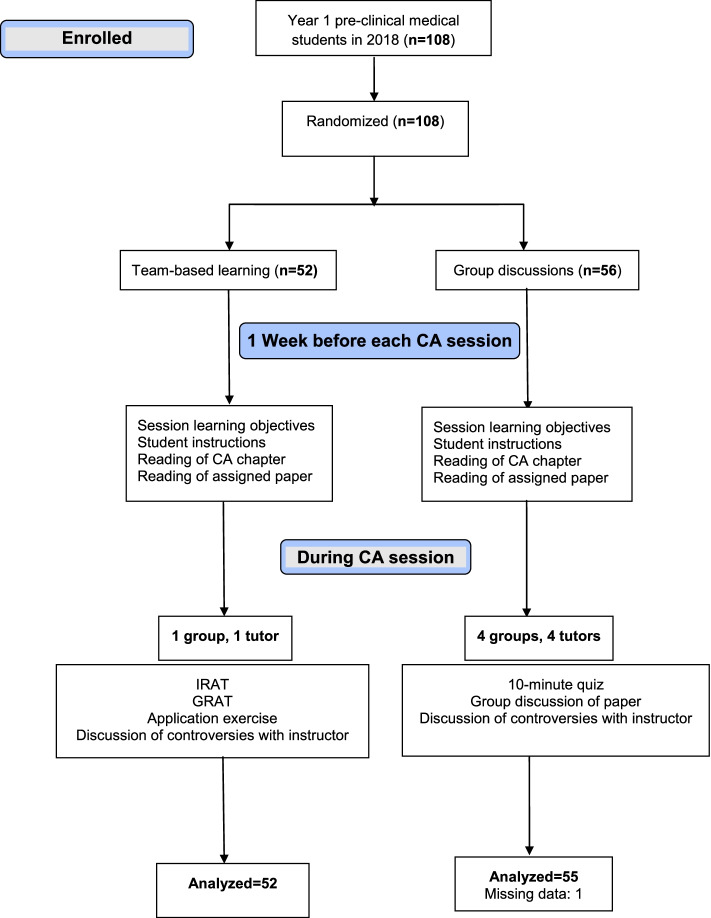
Between April 2018 and May 2019, 107 first-year medical students were randomly allocated to receive instruction in critical appraisal using team-based learning or traditional group discussions as teaching methods. The primary outcome was students' performance on the Berlin Questionnaire administered at the end of second year.
Students' mean (SD) age was 22.0 (0.7) years. Baseline characteristics of the two groups were similar (all p values > 0.05). The mean (SD) Berlin scores of both groups were 80.4 (11.6) and 80.1 (12.1) for team-based learning and group discussions, respectively. Multivariate stepwise linear regression analysis revealed that the student's academic achievement in medical school was the sole predictor of performance on the Berlin Questionnaire (ß = 1.079, p < 0.001), adjusting for gender, Medical College Admission Test score, student's self-reported preferred teaching method, rank upon admission to medical school, score on the Epidemiology and Biostatistics course, and teaching method (team-based learning versus group discussions).
Team-based learning and group discussions were equally effective instructional strategies to teach critical appraisal to large classes of undergraduate medical students. Replication of our findings is needed in other educational settings.
Current Controlled Trials ISRCTN15430424 , retrospectively registered on December 30, 2021.
关于团队学习在教授临床前医学生批判性评价方面的有效性的证据很少。本研究旨在探讨团队学习是否能有效地教授临床前医学生批判性评价。
2018 年 4 月至 2019 年 5 月,将 107 名一年级医学生随机分为两组,分别采用团队学习或传统小组讨论的方法进行批判性评价教学。主要结局是在第二年结束时使用柏林问卷对学生进行评估。
学生的平均(SD)年龄为 22.0(0.7)岁。两组的基线特征相似(所有 p 值均>0.05)。两组的柏林量表平均(SD)分数分别为 80.4(11.6)和 80.1(12.1),分别为团队学习和小组讨论。多元逐步线性回归分析显示,学生在校的学业成绩是影响柏林问卷得分的唯一预测因素(β=1.079,p<0.001),调整了性别、医学院入学考试成绩、学生自我报告的首选教学方法、入学时的排名、流行病学和生物统计学课程的分数以及教学方法(团队学习与小组讨论)。
团队学习和小组讨论是教授临床前医学生批判性评价的两种同等有效的教学策略。在其他教育环境中需要复制我们的研究结果。
当前对照试验 ISRCTN83424647,于 2021 年 12 月 30 日回顾性注册。