Department of Haematology, Aalborg University Hospital, Forskningens Hus, Søndre Skovvej 15, DK-9000, Aalborg, Denmark.
Clinical Cancer Research Center, Aalborg University Hospital, Aalborg, Denmark.
BMC Cancer. 2022 Feb 5;22(1):147. doi: 10.1186/s12885-022-09184-1.
Multiple myeloma remains an incurable disease with multiple relapses due to residual myeloma cells in the bone marrow of patients after therapy. Presence of small number of cancer cells in the body after cancer treatment, called minimal residual disease, has been shown to be prognostic for progression-free and overall survival. However, for multiple myeloma, it is unclear whether patients attaining minimal residual disease negativity may be candidates for treatment discontinuation. We investigated, if longitudinal flow cytometry-based monitoring of minimal residual disease (flow-MRD) may predict disease progression earlier and with higher sensitivity compared to biochemical assessments.
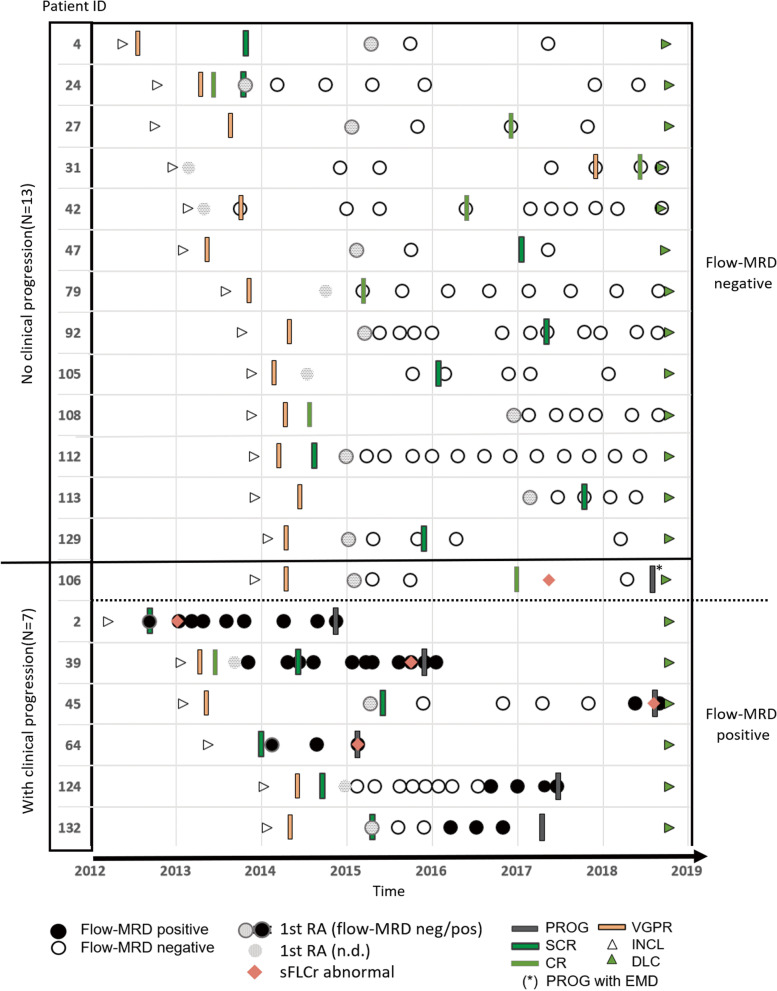
Patients from the Nordic countries with newly diagnosed multiple myeloma enrolled in the European-Myeloma-Network-02/Hovon-95 (EMN02/HO95) trial and undergoing bone marrow aspiration confirmation of complete response, were eligible for this Nordic Myeloma Study Group (NMSG) substudy. Longitdudinal flow-MRD assessment of bone marrow samples was performed to identify and enumerate residual malignant plasma cells until observed clinical progression.
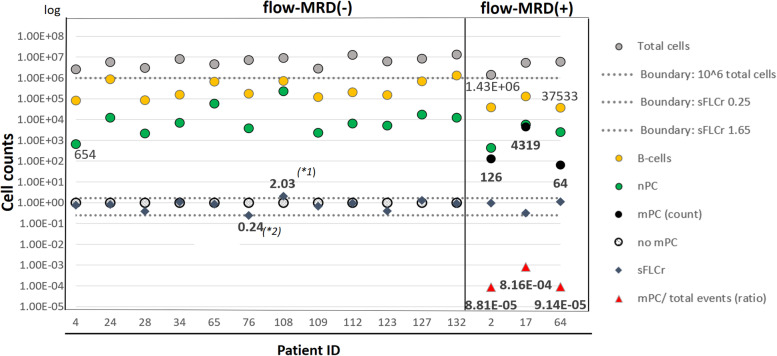
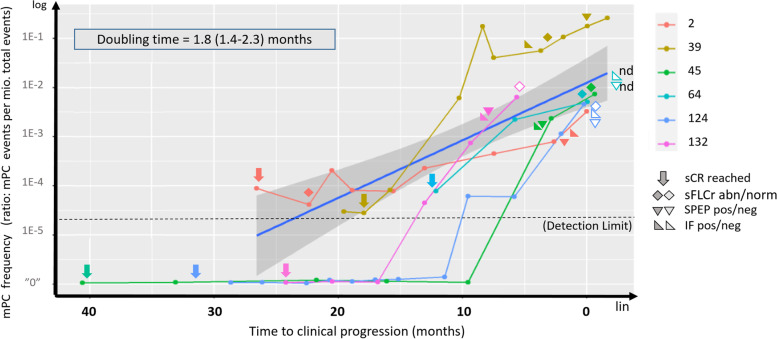
Minimal residual disease dynamics were compared to biochemically assessed changes in serum free light chain and M-component. Among 20 patients, reaching complete response or stringent complete response during the observation period, and with ≥3 sequential flow-MRD assessments analysed over time, increasing levels of minimal residual disease in the bone marrow were observed in six cases, preceding biochemically assessed disease and clinical progression by 5.5 months and 12.6 months (mean values), respectively. Mean malignant plasma cells doubling time for the six patients was 1.8 months (95% CI, 1.4-2.3 months). Minimal malignant plasma cells detection limit was 4 × 10⁻⁵.
Flow-MRD is a sensitive method for longitudinal monitoring of minimal residual disease dynamics in multiple myeloma patients in complete response. Increasing minimal residual disease levels precedes biochemically assessed changes and is an early indicator of subsequent clinical progression.
NCT01208766.
多发性骨髓瘤是一种不可治愈的疾病,由于治疗后患者骨髓中仍存在骨髓瘤细胞,因此会多次复发。癌症治疗后体内少量癌细胞的存在,称为微小残留病,已被证明对无进展生存期和总生存期具有预后意义。然而,对于多发性骨髓瘤,尚不清楚达到微小残留病阴性的患者是否可以作为停药的候选者。我们研究了纵向流式细胞术监测微小残留病(流式细胞术-MRD)是否可以更早且更敏感地预测疾病进展,与生化评估相比。
符合欧洲骨髓瘤网络-02/HO95(EMN02/HO95)试验新诊断多发性骨髓瘤的北欧国家患者,在骨髓抽吸以确认完全缓解后,有资格参加北欧骨髓瘤研究小组(NMSG)的子研究。对骨髓样本进行纵向流式细胞术-MRD 评估,以识别和计数残留的恶性浆细胞,直到观察到临床进展。
将微小残留病动力学与血清游离轻链和 M 成分的生化评估变化进行了比较。在 20 名患者中,在观察期间达到完全缓解或严格完全缓解,并且≥3 次随时间进行的流式细胞术-MRD 评估分析中,在 6 例中观察到骨髓中微小残留病水平增加,在生化评估疾病和临床进展之前分别为 5.5 个月和 12.6 个月(平均值)。这 6 名患者的恶性浆细胞倍增时间平均值为 1.8 个月(95%CI,1.4-2.3 个月)。最小恶性浆细胞检测限为 4×10⁻⁵。
流式细胞术-MRD 是一种敏感的方法,可用于监测完全缓解的多发性骨髓瘤患者的微小残留病动力学的纵向监测。微小残留病水平的增加先于生化评估的变化,是随后临床进展的早期指标。
NCT01208766。