Giles Jason B, Miller Elise C, Steiner Heidi E, Karnes Jason H
Department of Pharmacy Practice and Science, University of Arizona College of Pharmacy, Tucson, AZ, United States.
Department of Biomedical Informatics, Vanderbilt University Medical Center, Nashville, TN, United States.
Front Pharmacol. 2022 Jan 21;12:812830. doi: 10.3389/fphar.2021.812830. eCollection 2021.
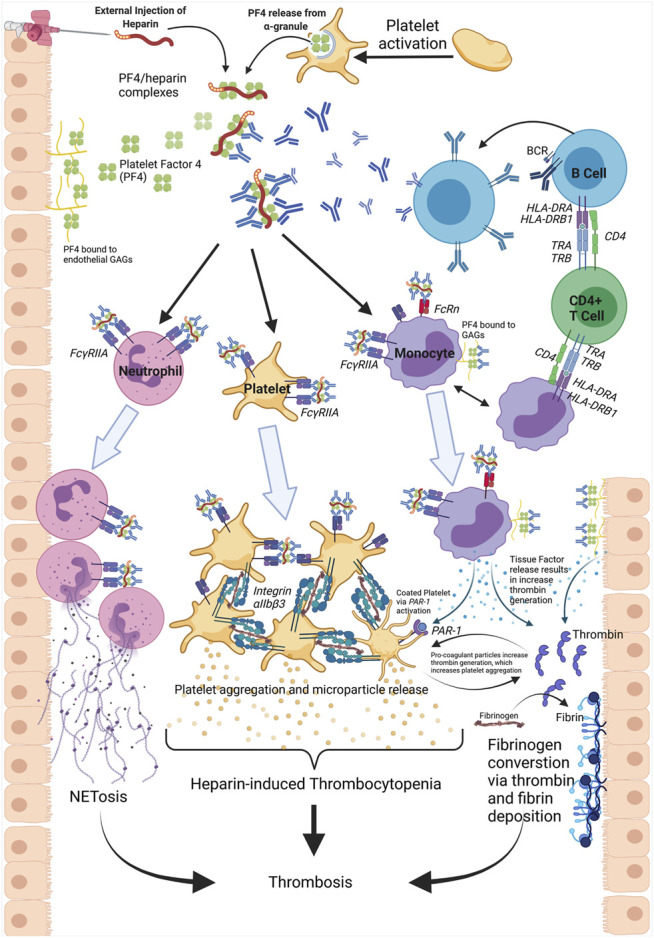
Heparin-induced thrombocytopenia (HIT) is an unpredictable, complex, immune-mediated adverse drug reaction associated with a high mortality. Despite decades of research into HIT, fundamental knowledge gaps persist regarding HIT likely due to the complex and unusual nature of the HIT immune response. Such knowledge gaps include the identity of a HIT immunogen, the intrinsic roles of various cell types and their interactions, and the molecular basis that distinguishes pathogenic and non-pathogenic PF4/heparin antibodies. While a key feature of HIT, thrombocytopenia, implicates platelets as a seminal cell fragment in HIT pathogenesis, strong evidence exists for critical roles of multiple cell types. The rise in omic technologies over the last decade has resulted in a number of agnostic, whole system approaches for biological research that may be especially informative for complex phenotypes. Applying multi-omics techniques to HIT has the potential to bring new insights into HIT pathophysiology and identify biomarkers with clinical utility. In this review, we review the clinical, immunological, and molecular features of HIT with emphasis on key cell types and their roles. We then address the applicability of several omic techniques underutilized in HIT, which have the potential to fill knowledge gaps related to HIT biology.
肝素诱导的血小板减少症(HIT)是一种不可预测的、复杂的、免疫介导的药物不良反应,死亡率很高。尽管对HIT进行了数十年的研究,但由于HIT免疫反应的复杂性和特殊性,关于HIT的基础知识空白仍然存在。这些知识空白包括HIT免疫原的身份、各种细胞类型的内在作用及其相互作用,以及区分致病性和非致病性PF4/肝素抗体的分子基础。虽然HIT的一个关键特征——血小板减少症,表明血小板是HIT发病机制中的一个重要细胞片段,但有强有力的证据表明多种细胞类型也起着关键作用。在过去十年中,组学技术的兴起催生了许多用于生物学研究的无假设、全系统方法,这些方法对于复杂表型可能特别有参考价值。将多组学技术应用于HIT有可能为HIT的病理生理学带来新的见解,并识别具有临床应用价值的生物标志物。在这篇综述中,我们回顾了HIT的临床、免疫和分子特征,重点关注关键细胞类型及其作用。然后,我们讨论了几种在HIT中未充分利用的组学技术的适用性,这些技术有可能填补与HIT生物学相关的知识空白。