Department of Medicine, Division of Hematology-Oncology, University of California-San Francisco, San Francisco, CA.
Hematology Department, Sidney Kimmel Comprehensive Cancer Center, Johns Hopkins University, Baltimore, MD.
Blood Adv. 2022 Apr 12;6(7):2144-2155. doi: 10.1182/bloodadvances.2021006489.
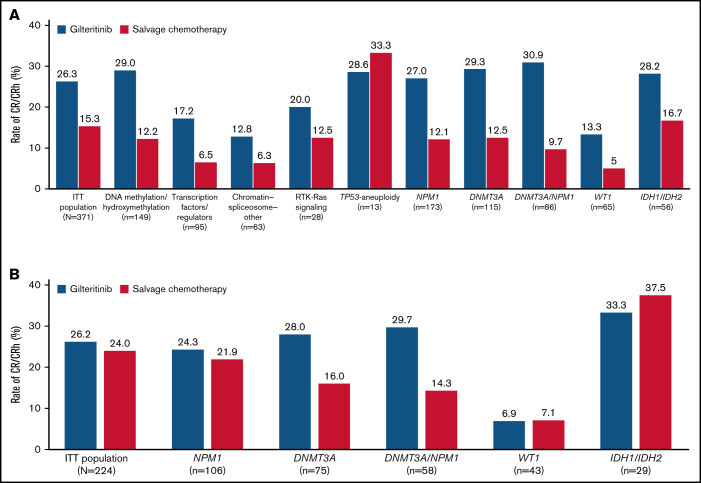
The phase 3 Study of ASP2215 Versus Salvage Chemotherapy in Patients With Relapsed or Refractory Acute Myeloid Leukemia (AML) With FMS-like Tyrosine Kinase (FLT3) Mutation (ADMIRAL) trial demonstrated the superiority of the FLT3 inhibitor, gilteritinib, to salvage chemotherapy (SC) in patients with FLT3-mutated relapsed or refractory (R/R) AML. Baseline comutations, FLT3-internal tandem duplication (ITD) allelic ratio and length, and treatment-emergent mutations were analyzed in patients in the ADMIRAL trial. Baseline comutations were grouped according to gene subgroups (DNA methylation/hydroxymethylation, transcription, chromatin-spliceosome, receptor tyrosine kinase-Ras signaling, TP53-aneuploidy, NPM1, DNMT3A, DNMT3A/NPM1, WT-1, and IDH1/IDH2). Across all but 1 gene subgroup (TP53-aneuploidy), higher pretransplant response rates and a trend toward longer overall survival were observed with gilteritinib vs SC. Patients with DNMT3A/NPM1 comutations who received gilteritinib had the most favorable outcomes of any molecular subgroup analyzed. Survival outcomes with gilteritinib were not adversely affected by FLT3-ITD allelic ratio, FLT3-ITD length, or multiple FLT3-ITD mutations. Among patients who relapsed on gilteritinib, Ras/mitogen-activated protein kinase (MAPK) pathway and FLT3 F691L gene mutations were the most common mutational events associated with treatment resistance. However, the occurrence of Ras/MAPK pathway gene mutations at baseline did not preclude a clinical benefit from gilteritinib. Acquisition of multiple Ras/MAPK pathway gene mutations at relapse suggests a high level of pathway reactivation is needed to overcome the gilteritinib treatment effect. These findings provide insight into the R/R AML molecular profile and the impact of FLT3 inhibitors on mutational evolution associated with treatment resistance and benefit of gilteritinib across a wide spectrum of molecular and genetic subgroups in FLT3-mutated R/R AML. This trial was registered at www.clinicaltrials.gov as #NCT02421939.
ADMIRAL 研究表明,FLT3 抑制剂吉特替尼在伴有 FLT3 突变的复发/难治性(R/R)急性髓系白血病(AML)患者中的疗效优于挽救化疗(SC)。在 ADMIRAL 试验中分析了患者的基线共突变、FLT3 内部串联重复(ITD)等位基因比和长度以及治疗后出现的突变。根据基因亚组(DNA 甲基化/羟甲基化、转录、染色质-剪接体、受体酪氨酸激酶-Ras 信号、TP53-非整倍体、NPM1、DNMT3A、DNMT3A/NPM1、WT-1 和 IDH1/IDH2)对基线共突变进行分组。除了 1 个基因亚组(TP53-非整倍体)之外,吉特替尼与 SC 相比,更高的移植前反应率和更长的总生存趋势。接受吉特替尼治疗的 DNMT3A/NPM1 共突变患者是分析的任何分子亚组中最有利的结局。吉特替尼的生存结果不受 FLT3-ITD 等位基因比、FLT3-ITD 长度或多个 FLT3-ITD 突变的影响。在吉特替尼复发的患者中,Ras/丝裂原活化蛋白激酶(MAPK)途径和 FLT3 F691L 基因突变是与治疗耐药相关的最常见突变事件。然而,Ras/MAPK 途径基因突变在基线时的发生并不能排除吉特替尼的临床获益。在复发时获得多个 Ras/MAPK 途径基因突变表明需要高水平的途径再激活来克服吉特替尼的治疗效果。这些发现为 R/R AML 分子谱以及 FLT3 抑制剂对与治疗耐药相关的突变进化以及吉特替尼在广泛的 FLT3 突变 R/R AML 分子和遗传亚组中的获益提供了深入了解。该试验在 www.clinicaltrials.gov 上注册,编号为 #NCT02421939。