Department of Physics and Astronomy, University of Padua, Via Marzolo 8, Padova, 35131, Italy.
INFN-Padova, National Institute of Nuclear Physics, Via Marzolo 8, Padova, 35131, Italy.
Med Phys. 2022 Apr;49(4):2709-2724. doi: 10.1002/mp.15524. Epub 2022 Feb 20.
Cu and Cu radioisotopes have nuclear characteristics suitable for nuclear medicine applications. The production of Cu is already well established. However, the production of Cu in quantities suitable to conduct clinical trials is more challenging as it leads to the coproduction of other Cu isotopes, in particular Cu. The aim of this study is to investigate the possibility of using a CuCl solution with a mixture of Cu radioisotopes for therapeutic purposes, providing an alternative solution for the cyclotron production problem.
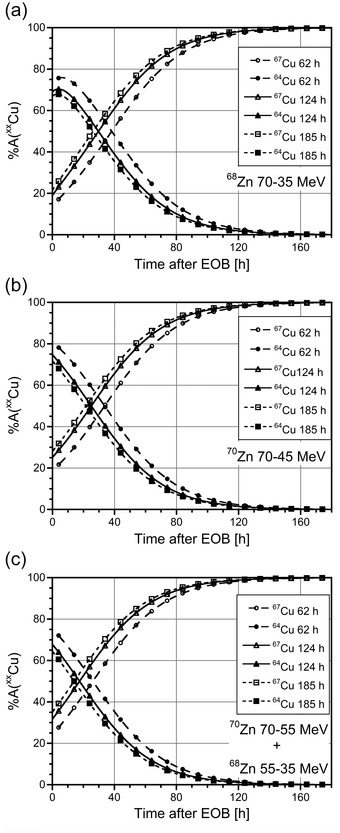
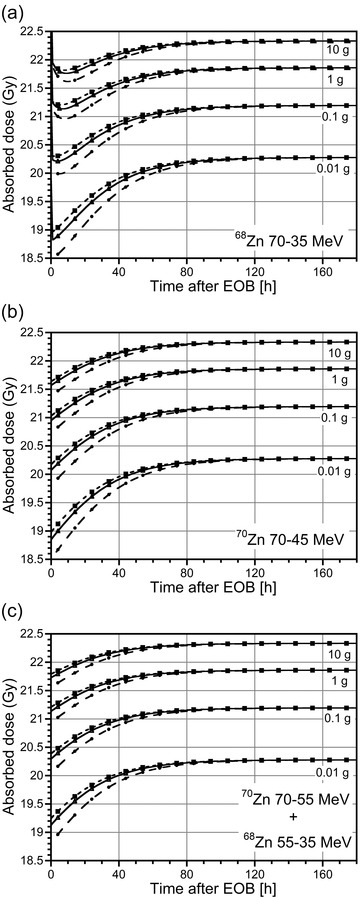
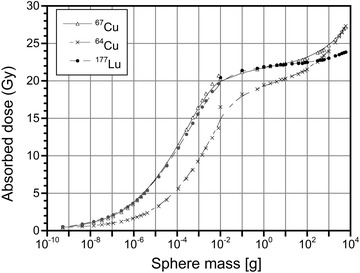
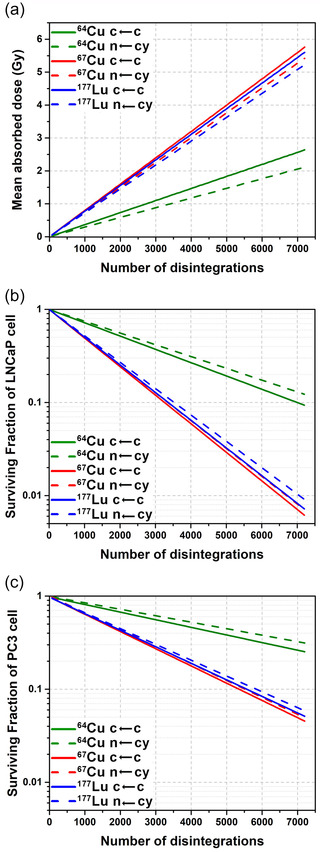
Copper radioisotopes activities were calculated by considering proton beam irradiation of the following targets: (i) Zn in the energy range 70-45 MeV; (ii) Zn in the energy range 70-35 MeV; (iii) a combination of Zn (70-55 MeV) and Zn (55-35 MeV). The contribution of each copper radioisotope to the human-absorbed dose was estimated with OLINDA/EXM software using the biokinetic model for CuCl published by ICRP 53. The total absorbed dose generated by the CuCl mixture, obtained through different production routes, was calculated at different times after the end of the bombardment (EOB). A simple spherical model was used to simulate tumors of different sizes containing uniformly distributed Cu mixture and to calculate the absorbed dose of self-irradiation. The biological damage produced by Cu and Cu was also evaluated through cellular dosimetry and cell surviving fraction assessment using the MIRDcell code, considering two prostate cancer cell lines with different radiosensitivity.
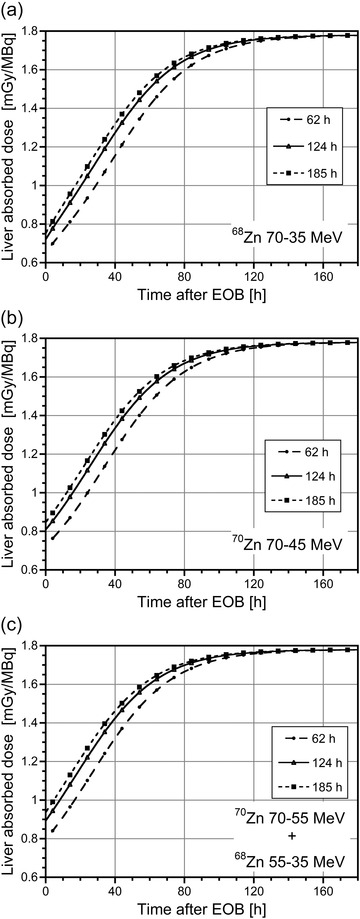
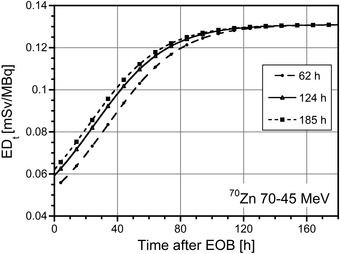
The absorbed dose to healthy organs and the effective dose (ED) per unit of administered activity of CuCl are higher than those of CuCl . Absorbed dose values per unit of administered activity of CuCl mixture increase with time after the EOB because the amount of Cu in the mixture increases. Survival data showed that the biological damage caused per each decay of Cu is greater than that of Cu, assuming that radionuclides remain accumulated in the cell cytoplasm. Sphere model calculations demonstrated that Cu administered activity must be about five times higher than that of Cu to obtain the same absorbed dose for tumor mass between 0.01 and 10 g and about 10 times higher for very small spheres. Consequently, the CuCl -absorbed dose to healthy organs will reach higher values than those of CuCl . The supplemental activity of the CuCl mixture, required to get the same tumor-absorbed dose produced by CuCl , triggers a dose increment (DI) in healthy organs. The waiting time post-EOB necessary to keep this DI below 10% (t ) depends on the irradiation methods employed for the production of the CuCl mixture.
A mixture of cyclotron produced Cu radioisotopes proved to be an alternative solution for the therapeutic use of CuCl with minimal DI to healthy organs compared with pure Cu. Irradiation of a Zn+ Zn target in the 70-35 MeV proton energy range for 185 h appears to be the best option from among all the production routes investigated, as it gives the maximum amount of activity, the shortest t (10 h), and less than 1% of Cu and Cu impurities.
Cu 和 Cu 放射性同位素具有适合核医学应用的核特性。 已经很好地确立了 Cu 的生产。 然而,生产数量足以进行临床试验的 Cu 更具挑战性,因为它会导致其他 Cu 同位素的共生产,特别是 Cu。 本研究的目的是研究使用含有 Cu 放射性同位素混合物的 CuCl 溶液用于治疗的可能性,为回旋加速器生产问题提供替代解决方案。
通过考虑质子束辐照以下靶标来计算铜放射性同位素的活度:(i) 在 70-45 MeV 的能量范围内的 Zn;(ii) 在 70-35 MeV 的能量范围内的 Zn;(iii) Zn(70-55 MeV)和 Zn(55-35 MeV)的组合。 使用 ICRP 53 发布的用于 CuCl 的生物动力学模型,通过 OLINDA/EXM 软件估算每个铜放射性同位素对人体吸收剂量的贡献。 通过不同的生产途径获得的 CuCl 混合物在辐照结束(EOB)后的不同时间产生的总吸收剂量进行了计算。 使用简单的球形模型模拟含有均匀分布的 Cu 混合物的不同大小的肿瘤,并计算自照射的吸收剂量。 通过使用 MIRDcell 代码进行细胞剂量学和细胞存活分数评估,还评估了 Cu 和 Cu 产生的生物损伤,考虑了两种具有不同放射敏感性的前列腺癌细胞系。
与 CuCl 相比,CuCl 对健康器官的吸收剂量和每单位给予活性的有效剂量(ED)更高。 辐照结束后(EOB)后,随着混合物中 Cu 量的增加,CuCl 混合物每单位给予活性的吸收剂量值会增加。 生存数据表明,假设放射性核素在细胞质中积累,每衰变一个 Cu 引起的生物损伤大于 Cu。 球体模型计算表明,为了获得 0.01 到 10 克肿瘤质量的相同吸收剂量,必须将 Cu 的给予活性提高约五倍,对于非常小的球体,则需要提高约十倍。 因此,CuCl 对健康器官的吸收剂量将达到高于 CuCl 的值。 为了获得与 CuCl 相同的肿瘤吸收剂量,所需的 CuCl 混合物的补充活性会引发健康器官的剂量增量(DI)。 保持 EOB 后使这种 DI 保持在 10%以下(t)的时间(t)取决于用于生产 CuCl 混合物的辐照方法。
与纯 Cu 相比,证明回旋加速器生产的 Cu 放射性同位素混合物是使用 CuCl 进行治疗的一种替代方法,对健康器官的 DI 最小。 在 70-35 MeV 质子能量范围内辐照 Zn+ Zn 靶 185 小时似乎是所有研究的生产途径中最好的选择,因为它提供了最大量的活性,最短的 t(10 小时),并且少于 1%的 Cu 和 Cu 杂质。