Department of Epidemiology of Microbial Diseases, Yale School of Public Health, New Haven, Connecticut, USA.
German National Reference Center for Streptococci, Department of Medical Microbiology, University Hospital RWTH Aachen, Aachen, Germany.
Clin Infect Dis. 2022 Sep 30;75(7):1149-1153. doi: 10.1093/cid/ciac100.
The incidence of invasive pneumococcal disease (IPD) decreased worldwide in 2020 and the first quarter of 2021, concurrent with nonpharmaceutical interventions (NPIs) intended to stymie transmission of SARS-CoV-2. In 2021, the stringency of these NPI strategies has varied. We investigated age- and serotype-specific variations in IPD case counts in Germany in 2020-2021.
IPD cases through 30 November 2021 were stratified by age group, serotype, or geographic location. IPD surveillance data in 2020-2021 were compared with (1) IPD surveillance data from 2015-2019, (2) mobility data during 2020 and 2021, and (3) NPI stringency data in 2020 and 2021.
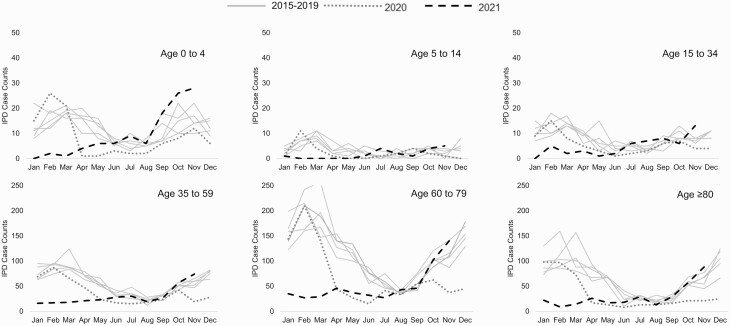
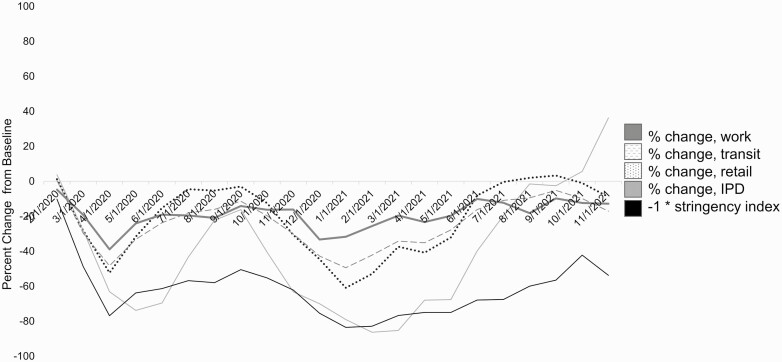
IPD incidence began to return toward baseline among children 0-4 years old in April 2021 and exceeded baseline by June 2021 (a 9% increase over the average monthly values for 2015-2019). Children aged 5-14 years and adults aged 15-34 or ≥80 years showed increases in IPD cases that exceeded baseline values starting in July 2021, with increases also starting in spring 2021. The age distribution and proportion of vaccine-serotype IPD remained comparable to those in previous years, despite lower overall case counts in 2020 and 2021. The percentage change in IPD incidence compared with the previous 5 years was correlated with changes in mobility and with NPI stringency.
IPD levels began to return to and exceed seasonal levels in spring and summer 2021 in Germany, following sharp declines in 2020 that coincided with NPIs related to the coronavirus disease 2019 pandemic. Proportions of vaccine serotypes remained largely consistent throughout 2020-2021.
2020 年及 2021 年第一季度,全球侵袭性肺炎球菌病(IPD)发病率下降,与此同时,旨在阻止严重急性呼吸综合征冠状病毒 2 型(SARS-CoV-2)传播的非药物干预措施(NPI)也在实施。2021 年,这些 NPI 策略的严格程度有所不同。我们调查了德国 2020-2021 年 IPD 病例数量的年龄和血清型特异性变化。
通过年龄组、血清型或地理位置对 2021 年 11 月 30 日前的 IPD 病例进行分层。将 2020-2021 年的 IPD 监测数据与(1)2015-2019 年的 IPD 监测数据、(2)2020 年和 2021 年的流动数据以及(3)2020 年和 2021 年的 NPI 严格程度数据进行了比较。
2021 年 4 月,0-4 岁儿童的 IPD 发病率开始恢复到基线水平,2021 年 6 月超过基线(比 2015-2019 年的平均每月值高 9%)。2021 年 7 月,5-14 岁儿童和 15-34 岁或≥80 岁的成年人的 IPD 病例开始超过基线值,2021 年春季也开始出现这种情况。尽管 2020 年和 2021 年的总病例数较低,但年龄分布和疫苗血清型 IPD 的比例与前几年相似。与前 5 年相比,IPD 发病率的变化百分比与流动变化和 NPI 严格程度相关。
德国的 IPD 水平在 2020 年急剧下降后,于 2021 年春季和夏季开始回升并超过季节性水平,这与 2019 年冠状病毒病(COVID-19)大流行期间与 NPI 相关的下降趋势一致。2020-2021 年期间,疫苗血清型的比例基本保持一致。