Department of Orthopedics, E-Da Hospital, No. 1 E-Da Rd, Yuan-Chau District, Kaohsiung, Taiwan.
Department of Industrial and Systems Engineering, Chung Yuan Christian University, Chung Li, Taiwan.
BMC Musculoskelet Disord. 2022 Feb 9;23(1):131. doi: 10.1186/s12891-022-05068-4.
Repetitive exertion in supination/pronation could increase the risk of forearm diseases due to fatigue. Kinesio taping (KT) is a physical therapy technique that decreases muscle tone and musculoskeletal disorders (MSDs) risk. Many assumptions about taping have been made and several studies have considered the taping applications; however, the effect of KT on strength and fatigue of the forearm supination/pronation remains unclear. The purpose of this study was to evaluate the effect of KT on forearm performance fatigability.
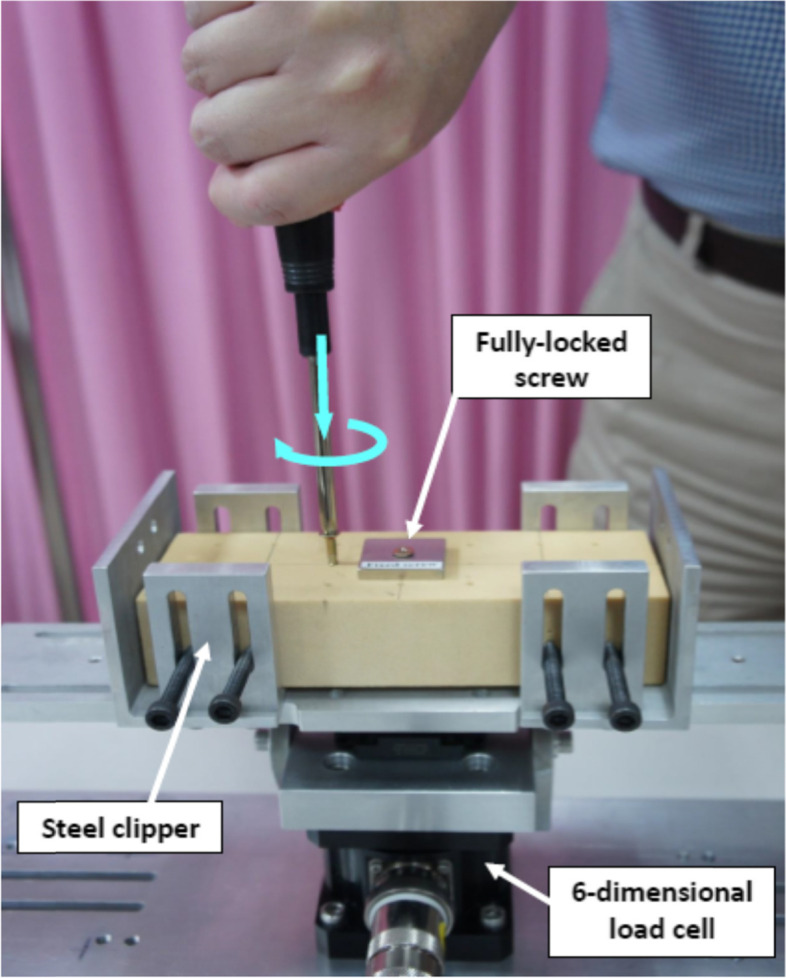
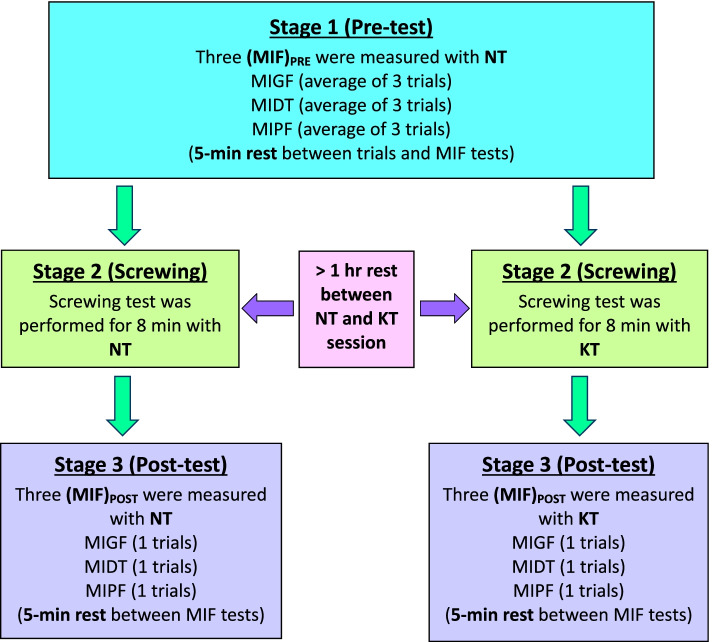
A screwing test was constructed to measure the forearm force loss and screwing efficiency during repetitive supination/pronation. Data from 18 healthy adults who underwent both KT and no taping (NT) sessions were used to investigate the forearm strength change in terms of grip force (GF), driving torque (DT), and push force (PF). The maximal isometric forces before and after the screwing test and force decreasing rate (efficiency) during screwing were evaluated to assess the performance fatigability in KT and NT conditions.
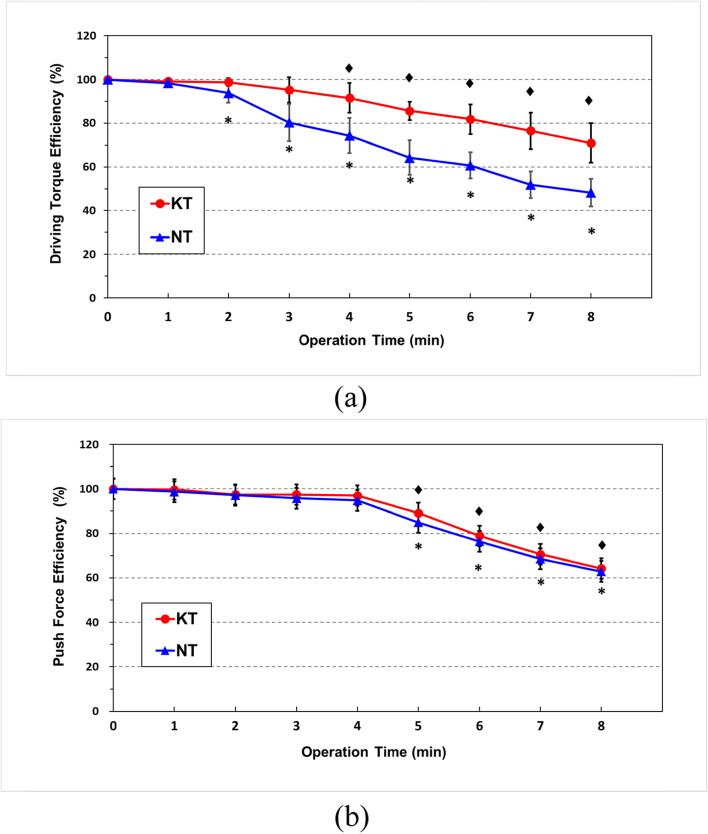
A statistically significant force loss (FL) in maximal isometric GF (p = 0.039) and maximal isometric DT (p = 0.044); however, no significant difference was observed in maximal isometric PF (p = 0.426) between NT and KT. KT provides greater screwing efficiency than NT.
KT could not improve FL in the maximal muscle strength of the forearm in healthy subjects. KT on the forearm was associated with a lesser decline in DT efficiency than NT, implying that KT could decrease the loss rate of muscle strength and delay the development of fatigue; however, the KT did not yield improvements in PF while performing screwing tasks.
前臂在旋前/旋后时反复用力会增加因疲劳而导致前臂疾病的风险。肌内效贴布(Kinesio taping,KT)是一种降低肌肉张力和减少肌肉骨骼疾病(MSDs)风险的物理治疗技术。人们对贴扎有很多假设,也有几项研究考虑了贴扎的应用;然而,KT 对前臂旋前/旋后力量和疲劳的影响仍不清楚。本研究旨在评估 KT 对前臂运动疲劳性的影响。
构建了一个拧螺丝测试,以测量前臂在反复旋前/旋后时的握力损失和拧螺丝效率。使用 18 名健康成年人的数据,这些人接受了 KT 和无贴扎(no taping,NT)治疗,以研究前臂力量在握力(grip force,GF)、驱动力矩(driving torque,DT)和推力(push force,PF)方面的变化。通过拧螺丝前后的最大等长力量和拧螺丝过程中的力量下降率(效率)评估来评估 KT 和 NT 条件下的性能疲劳性。
在最大等长 GF(p=0.039)和最大等长 DT(p=0.044)方面,NT 和 KT 之间存在统计学上显著的力量损失(force loss,FL);然而,在最大等长 PF 方面(p=0.426),NT 和 KT 之间没有显著差异。KT 提供了比 NT 更高的拧螺丝效率。
KT 不能改善健康受试者前臂最大肌肉力量的 FL。KT 在前臂上与 NT 相比,DT 效率下降幅度较小,这表明 KT 可以降低肌肉力量的损失率并延迟疲劳的发展;然而,KT 在进行拧螺丝任务时并没有提高 PF。