Department of Obstetrics and Gynecology, New Taipei Municipal Tu Cheng Hospital, 6, Sec. 2, Jincheng Road, Tu Cheng, New Taipei City, 236, Taiwan.
Department of Obstetrics and Gynecology, Linkou Chang Gung Memorial Hospital and Chang Gung University, 5, Fu-Shin Street, Kwei-Shan, Taoyüan, 333, Taiwan.
Sci Rep. 2022 Feb 9;12(1):2215. doi: 10.1038/s41598-022-06024-x.
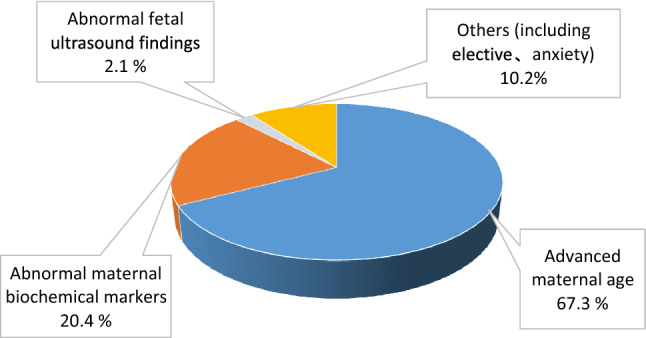
To compare the frequency and clinical significance of familial and de novo chromosomal inversions during prenatal diagnosis. This was a retrospective study of inversions diagnosed prenatally in an Asian population by applying conventional GTG-banding to amniocyte cultures. Data from 2005 to 2019 were extracted from a single-center laboratory database. The types, frequencies, and inheritance patterns of multiple inversions were analyzed. Pericentric variant inversions of chromosome 9 or Y were excluded. In total, 56 (0.27%) fetuses with inversions were identified in the 15-year database of 21,120 confirmative diagnostic procedures. Pericentric and paracentric inversions accounted for 62.5% (35/56) and 37.5% of the inversions, respectively. Familial inversions accounted for nearly 90% of cases, and de novo mutation was identified in two pericentric and two paracentric cases. Inversions were most frequently identified on chromosomes 1 and 2 (16.1% of all inversions), followed by chromosomes 6, 7, and 10 (8.9% of all cases). The indications for invasive testing were as follows: advanced maternal age (67.3%), abnormal ultrasound findings (2.1%), abnormal serum aneuploidy screening (20.4%), and other indications (10.2%). The mode of inheritance was available for 67.9% of cases (38/56), with 89.5% of inversions being inherited (34/38). A slight preponderance of inheritance in female fetuses was observed. Three patients with inherited inversions opted for termination (two had severe central nervous system lesions and one had thalassemia major). Gestation continued for 53 fetuses, who exhibited no structural defects at birth or significant developmental problems a year after birth. Our study indicates that approximately 90% of prenatally diagnosed inversions involve familial inheritance, are spreading, and behave like founder effect mutations in this isolated population on an island. This finding can help to alleviate anxiety during prenatal counseling, which further underscores the importance of parental chromosomal analysis, further genetic studies, and appropriate counseling in cases where a nonfamilial inversion is diagnosed.
比较家族性和新生染色体倒位在产前诊断中的频率和临床意义。这是一项回顾性研究,应用常规 GTG 带型分析亚洲人群的羊水细胞培养物,以诊断产前倒位。从 2005 年至 2019 年的数据从单个中心实验室数据库中提取。分析了多种倒位的类型、频率和遗传模式。排除了 9 号或 Y 染色体的近端变异倒位。在 21120 例确诊诊断程序的 15 年数据库中,共发现 56 例(0.27%)胎儿存在倒位。近 62.5%(35/56)和 37.5%的倒位为中央和旁中央倒位。家族性倒位占近 90%,两个中央和两个旁中央病例发现新生突变。最常见的倒位发生在 1 号和 2 号染色体上(所有倒位的 16.1%),其次是 6 号、7 号和 10 号染色体(所有病例的 8.9%)。侵入性检测的指征如下:高龄产妇(67.3%)、超声异常(2.1%)、血清非整倍体筛查异常(20.4%)和其他指征(10.2%)。67.9%(38/56)的病例可提供遗传方式,89.5%的倒位为遗传(34/38)。在女性胎儿中观察到轻微的遗传优势。3 例遗传倒位的患者选择终止妊娠(2 例有严重中枢神经系统病变,1 例有重型地中海贫血)。53 例胎儿继续妊娠,出生时无结构缺陷,出生后一年无明显发育问题。我们的研究表明,约 90%的产前诊断倒位涉及家族遗传,在这个孤立的岛屿人群中,呈扩展性,表现为奠基者效应突变。这一发现有助于减轻产前咨询时的焦虑,进一步强调了对非家族性倒位病例进行父母染色体分析、进一步遗传研究和适当咨询的重要性。