
针对 COVID-19 空气传播的口罩预防效果的数值评估。
Numerical evaluation of face masks for prevention of COVID-19 airborne transmission.
机构信息
School of Mechanical Engineering and Automation, Northeastern University, Shenyang, Liaoning, People's Republic of China.
Department of Ophthalmology, Renmin Hospital of Wuhan University, Wuhan, Hubei, People's Republic of China.
出版信息
Environ Sci Pollut Res Int. 2022 Jun;29(29):44939-44953. doi: 10.1007/s11356-022-18587-3. Epub 2022 Feb 9.
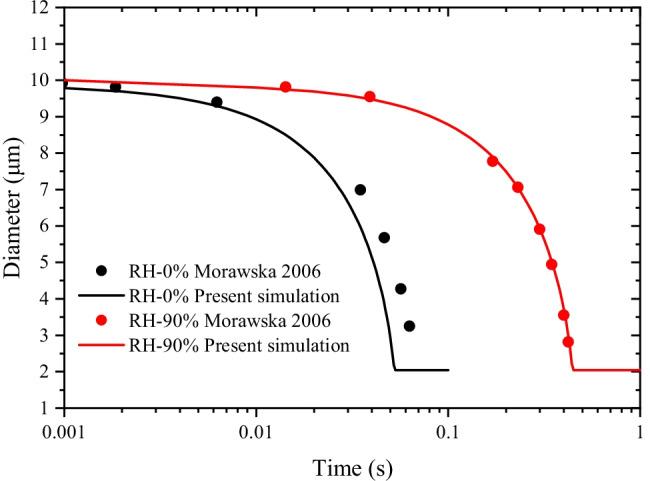
The COVID-19 pandemic has forced governments around the globe to apply various preventive measures for public health. One of the most effective measures is wearing face masks, which plays a vital role in blocking the transmission of droplets and aerosols. To understand the protective mechanism of face masks, especially in indoor environments, we apply a computational fluid dynamics technique to predict the lifetime of cough droplets. Therefore, we can assess the exposure risk in a ventilated room where an infected individual wears a face mask or not. We focus on the dynamic evaporation and diffusion of droplets in a human-cough process, which is a major cause for the spread of the virus. We find that wearing a face mask can effectively reduce the total mass and Sauter mean diameter of the residual droplets after a single cough. The mass concentration of virus-carrying droplets in the ventilated room decreases by 201, 43,786, and 307,060 times, corresponding to wearing cotton face masks, surgical face masks, and N95 face masks, respectively. However, the maximum travel distance of 80% droplets is insensitive to wearing a face mask or not. Therefore, the residual droplets are widely distributed due to the influence of indoor airflow. Furthermore, we study aerosol exposure risks in different areas of the room and find that high concentrations of aerosols occur in the streamline through an infected individual, especially next to the individual within 1.5 m. This strongly suggests a social distance despite the fact that the majority of droplets are filtered by face masks. This study explains the impact of face masks and airflow on indoor exposure risks and further inspires potential measures for public health, for example, no individuals should sit near the air supply opening.
新冠疫情迫使全球各国政府采取各种公共卫生预防措施。其中最有效的措施之一是佩戴口罩,口罩在阻止飞沫和气溶胶传播方面发挥着至关重要的作用。为了了解口罩的保护机制,特别是在室内环境中,我们应用计算流体动力学技术来预测咳嗽飞沫的寿命。因此,我们可以评估在通风室内感染个体佩戴口罩或不佩戴口罩时的暴露风险。我们专注于人体咳嗽过程中飞沫的动态蒸发和扩散,这是病毒传播的主要原因。我们发现,佩戴口罩可以有效减少单次咳嗽后残留飞沫的总质量和索特平均直径。佩戴棉质口罩、医用口罩和 N95 口罩时,通风室内携带病毒的飞沫的质量浓度分别降低了 201、43786 和 307060 倍。然而,80%飞沫的最大行进距离对佩戴口罩与否并不敏感。因此,由于室内气流的影响,残留飞沫广泛分布。此外,我们研究了不同房间区域的气溶胶暴露风险,发现流线中(特别是距离感染者 1.5 米以内)的气溶胶浓度很高。这强烈表明尽管大多数飞沫被口罩过滤,但仍应保持社交距离。本研究解释了口罩和气流对室内暴露风险的影响,并进一步为公共卫生提供了潜在措施的启示,例如,任何人都不应坐在送风口附近。




 Zotero 插件