Department of Endocrinology, National Health Commission (NHC) Key Laboratory of Endocrinology, Peking Union Medical College Hospital, Peking Union Medical College and Chinese Academy of Medical Sciences, Beijing, China.
Department of Endocrinology, Beijing Chaoyang Hospital, Capital Medical University, Beijing, China.
Front Endocrinol (Lausanne). 2022 Jan 25;12:788549. doi: 10.3389/fendo.2021.788549. eCollection 2021.
The link between excess adiposity and left ventricular hypertrophy is multifaceted with sparse data among youths. Given that adipokines/hepatokines may influence lipid metabolism in myocardium, we aimed to investigate the relation of the novel hepatokine angiopoietin-like protein 8 (ANGPTL8) and other adipokines with cardiac structure in a cohort of youths and explore to what extent these adipokines/hepatokines affect cardiac structure through lipids.
A total of 551 participants (aged 15-28 years) from the Beijing Child and Adolescent Metabolic Syndrome Study (BCAMS) cohort underwent echocardiographic measurements plus a blood draw assayed for five adipokines/hepatokines including adiponectin, leptin, retinol binding protein 4, fibroblast growth protein 21 and ANGPTL8.
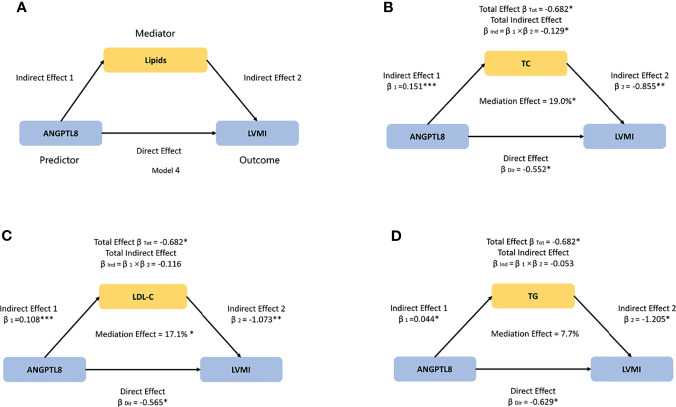
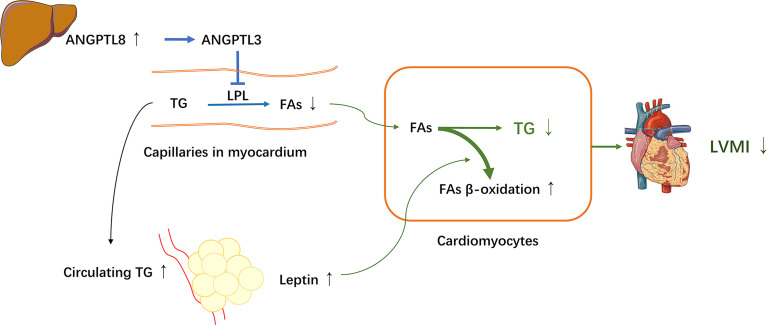
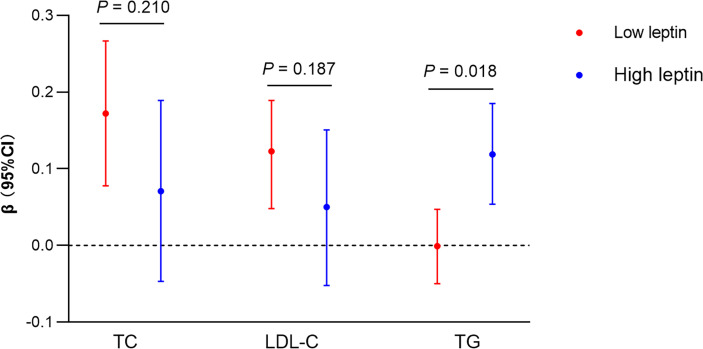
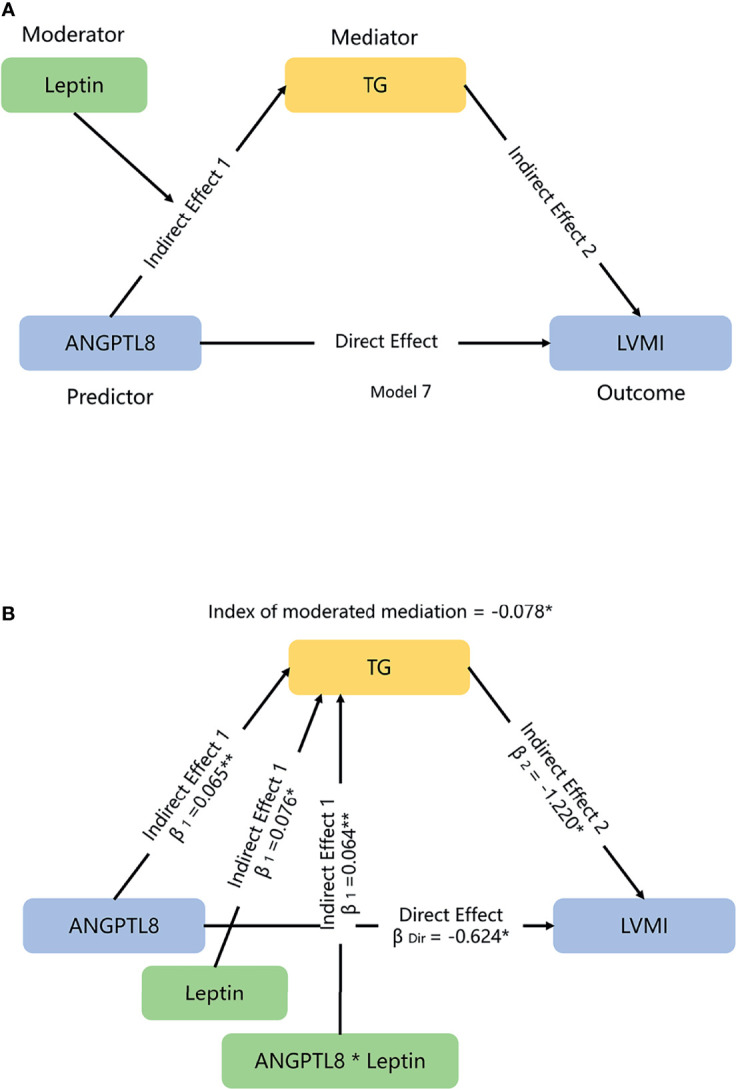
Both ANGPTL8 (β = -0.68 g/m per z-score, = 0.015) and leptin (β = -1.04 g/m per z-score, = 0.036) were significantly inversely associated with left ventricular mass index (LVMI) independent of classical risk factors. Total cholesterol and low-density lipoprotein cholesterol significantly mediated the ANGPTL8-LVMI association (proportion: 19.0% and 17.1%, respectively), while the mediation effect of triglyceride on the ANGPTL8-LVMI relationship was strongly moderated by leptin levels, significantly accounting for 20% of the total effect among participants with higher leptin levels. Other adipokines/hepatokines showed no significant association with LVMI after adjustment for body mass index.
Our findings suggest ANGPTL8, particularly interacting with leptin, might have a protective role in cardiac remodeling among youths with risk for metabolic syndrome. Our results offer insights into the pathogenesis of the cardiomyopathy and the potential importance of tissue-tissue crosstalk in these effects.
过多的脂肪与左心室肥厚之间存在多方面的联系,而年轻人的相关数据却很少。鉴于脂肪因子/肝因子可能影响心肌中的脂质代谢,我们旨在研究新型肝因子血管生成素样蛋白 8(ANGPTL8)和其他脂肪因子与年轻人心脏结构之间的关系,并探讨这些脂肪因子/肝因子通过脂质影响心脏结构的程度。
共有 551 名来自北京儿童和青少年代谢综合征研究(BCAMS)队列的参与者(年龄 15-28 岁)接受了超声心动图测量,并进行了血液抽取以检测五种脂肪因子/肝因子,包括脂联素、瘦素、视黄醇结合蛋白 4、成纤维细胞生长因子 21 和 ANGPTL8。
ANGPTL8(每 Z 分数 -0.68g/m,=0.015)和瘦素(每 Z 分数 -1.04g/m,=0.036)与左心室质量指数(LVMI)独立于经典危险因素呈显著负相关。总胆固醇和低密度脂蛋白胆固醇显著介导了 ANGPTL8-LVMI 关联(比例分别为 19.0%和 17.1%),而瘦素水平强烈调节了甘油三酯对 ANGPTL8-LVMI 关系的中介作用,在瘦素水平较高的参与者中,占总效应的 20%。在调整体重指数后,其他脂肪因子/肝因子与 LVMI 无显著相关性。
我们的研究结果表明,ANGPTL8 尤其是与瘦素相互作用,可能在代谢综合征风险人群的心脏重构中具有保护作用。我们的研究结果为心肌病的发病机制提供了新的认识,也为这些效应中组织-组织相互作用的潜在重要性提供了新的认识。