Department of Electrical Engineering, University of Engineering and Technology Taxila, Taxila, 47050, Pakistan.
Department of Electrical Engineering, Pakistan Institute of Engineering & Applied Sciences, Islamabad, 45651, Pakistan.
Sci Rep. 2022 Feb 11;12(1):2384. doi: 10.1038/s41598-022-06381-7.
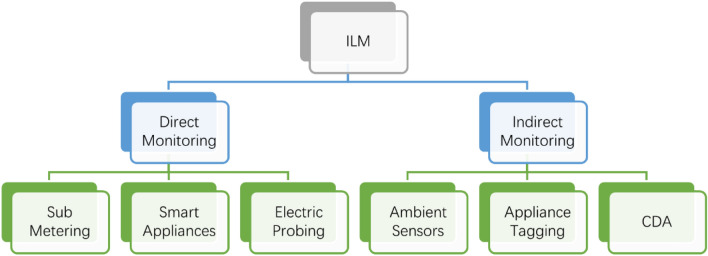
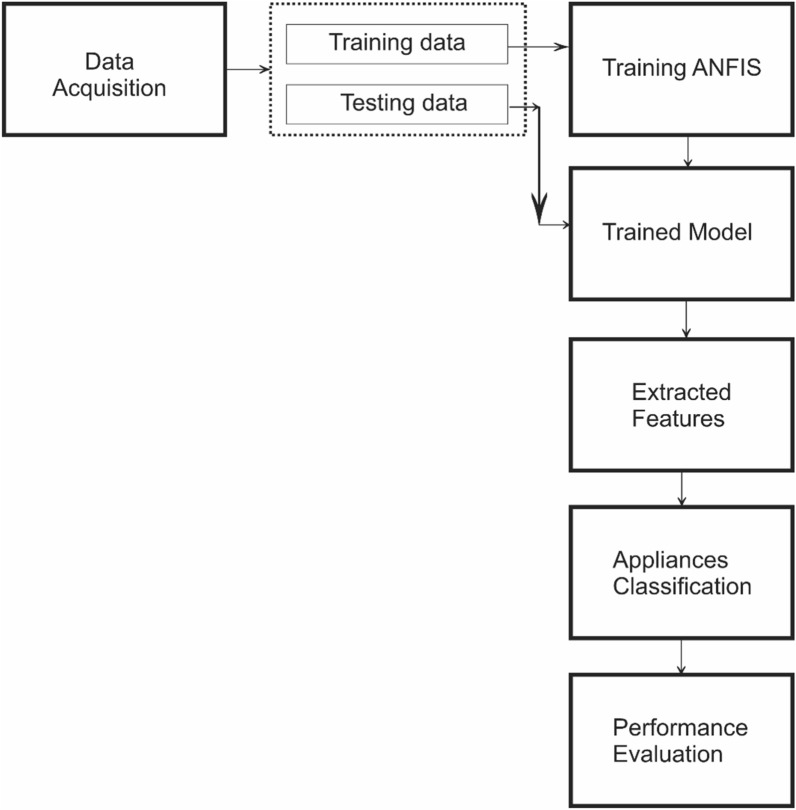
Effective and efficient use of energy is key to sustainable industrial and economic growth in modern times. Demand-side management (DSM) is a relatively new concept for ensuring efficient energy use at the consumer level. It involves the active participation of consumers in load management through different incentives. To enable the consumers for efficient energy management, it is important to provide them information about the energy consumption patterns of their appliances. Appliance load monitoring (ALM) is a feedback system used for providing feedback to customers about their power consumption of individual appliances. For accessing appliance power consumption, the determination of the operating status of various appliances through feedback systems is necessary. Two major approaches used for ALM are intrusive load monitoring (ILM) and non-intrusive load monitoring (NILM). In this paper, a hybrid adaptive-neuro fuzzy inference system (ANFIS) is used as an application for NILM. ANFIS model being sophisticated was difficult to work with, but ANFIS model helps to achieve better results than other competent approaches. An ANFIS system is developed for extracting appliance features and then a fine tree classifier is used for classifying appliances having more than 1 kW power rating based on the extracted feature. Several case studies have been performed using ANFIS on a publicly available United Kingdom Domestic Appliance Level Electricity (UK-Dale dataset). The simulation results obtained from the ANFIS for NILM are compared with relevant literature to show the performance of the proposed technique. The results prove that the novel application of ANFIS gives better performance for solving the NILM problem as compared to the other existing techniques.
有效和高效地利用能源是现代工业和经济可持续增长的关键。需求侧管理(DSM)是确保消费者层面能源高效利用的一个相对较新的概念。它涉及通过不同的激励措施让消费者积极参与到负荷管理中来。为了使消费者能够进行有效的能源管理,向他们提供有关其家电能源消耗模式的信息非常重要。家电负荷监测(ALM)是一种反馈系统,用于向客户提供有关其个别家电用电情况的反馈。为了获取家电用电情况,需要通过反馈系统确定各种家电的运行状态。用于 ALM 的两种主要方法是侵入式负荷监测(ILM)和非侵入式负荷监测(NILM)。在本文中,混合自适应神经模糊推理系统(ANFIS)被用作 NILM 的应用。由于 ANFIS 模型很复杂,因此难以使用,但 ANFIS 模型有助于获得比其他同类方法更好的结果。本文开发了一个用于提取家电特征的 ANFIS 系统,然后使用一个精细的树分类器对功率超过 1kW 的家电进行分类,该分类器基于提取的特征。使用 ANFIS 对英国国内电器级电力数据集(UK-Dale 数据集)进行了多项案例研究。将从 ANFIS 获得的 NILM 仿真结果与相关文献进行比较,以展示所提出技术的性能。结果证明,与其他现有技术相比,ANFIS 的新颖应用在解决 NILM 问题方面具有更好的性能。