College of Health Professions, Medical University of South Carolina, Charleston, SC, USA.
Arnold School of Public Health, University of South Carolina, Columbia, SC, USA.
Spinal Cord. 2022 Jun;60(6):574-579. doi: 10.1038/s41393-022-00750-9. Epub 2022 Feb 11.
Cohort study. Retrospective analysis of uniform billing discharge data (UB-04).
To compare and contrast the primary and secondary causes of hospitalization by type of admission, emergency department (ED) versus inpatient only (IP), during the first five years after the traumatic spinal cord injury (SCI).
Academic Medical University in the Southeastern USA.
At total of 2569 adults with traumatic SCI were identified from a population-based registry and matched to billing data. The main outcome measures were primary and secondary diagnoses associated with hospital admissions in non-federal, state hospitals.
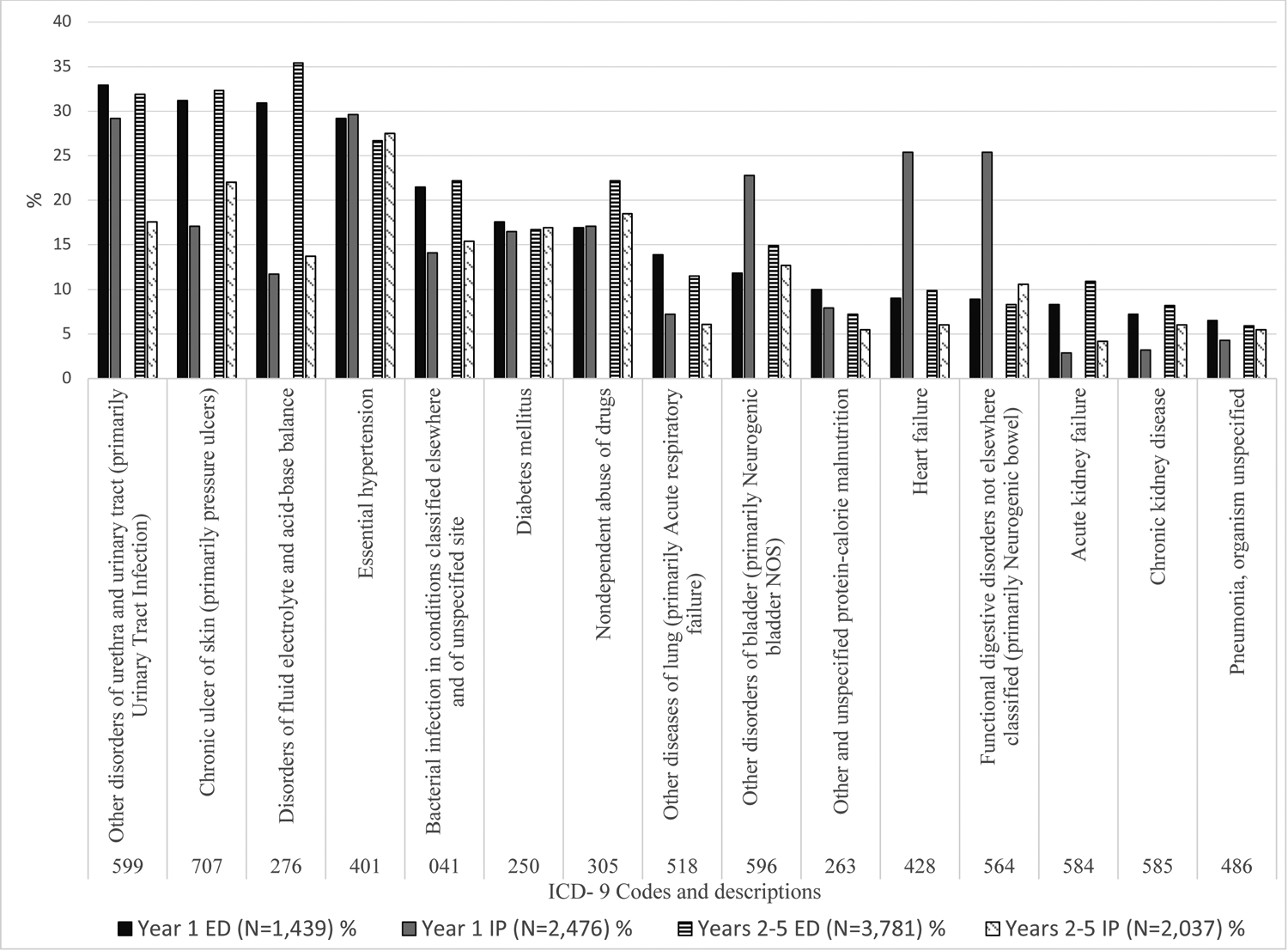
Overall, there were 9733 hospital admissions in the five years after SCI onset, not including the initial hospitalization; 53% were admissions through the ED. The primary causes of hospitalizations after SCI varied by year post injury and admission type (ED versus IP). The top 15 secondary diagnoses included several secondary health conditions associated with SCI, as well as chronic health conditions.
Rehabilitation diagnoses were much more prominent during the first year, compared with subsequent years. Septicemia was the leading cause of admissions through the ED, whereas chronic ulcers of the skin were prominent for IP only admissions. This is consistent with the acute nature of septicemia compared with more planned hospitalization for rehabilitation and skin ulcers. These conditions should be targeted for prevention strategies that include patient/family education and early and appropriate access to primary care.
队列研究。对统一计费出院数据(UB-04)进行回顾性分析。
比较和对比创伤性脊髓损伤(SCI)后五年内,不同入院类型(急诊部[ED]与仅住院[IP])的住院的主要和次要原因。
美国东南部的一所学术医学大学。
从基于人群的登记处共确定了 2569 名创伤性 SCI 成人患者,并与计费数据相匹配。主要观察指标是与非联邦、州立医院住院相关的主要和次要诊断。
总体而言,SCI 发病后五年内共有 9733 次住院,不包括初始住院;53%是通过 ED 入院。SCI 后住院的主要原因因受伤后年份和入院类型(ED 与 IP)而异。排名前 15 的次要诊断包括与 SCI 相关的几种次要健康状况以及慢性健康状况。
与随后几年相比,康复诊断在第一年更为突出。败血症是 ED 入院的主要原因,而慢性皮肤溃疡则是 IP 入院的主要原因。这与败血症的急性性质一致,而康复和皮肤溃疡的计划性住院更多。应针对这些情况制定预防策略,包括患者/家属教育以及早期和适当获得初级保健。