Respiratory Group, The George Institute for Global Health, Sydney, NSW 2042, Australia.
West China Hospital, Sichuan University, Chengdu, People's Republic of China.
Int J Chron Obstruct Pulmon Dis. 2022 Feb 5;17:273-282. doi: 10.2147/COPD.S339889. eCollection 2022.
The burden of chronic obstructive pulmonary disease (COPD) disproportionately affects patients in low to middle-income countries. Although the Theophylline and Steroids in COPD Study (TASCS) showed no clinical benefit from administering low-dose theophylline and prednisone in COPD patients compared to placebo, it was hypothesized that those with elevated blood eosinophil counts would receive clinical benefit from the intervention.
This was a post-hoc analysis of the TASCS dataset - a double-blinded, placebo-controlled trial conducted in patients with moderate-severe COPD in China. Participants were allocated 1:1:1 to low-dose oral theophylline (100mg bd) and prednisone (5mg qd; PrT), theophylline (100mg bd) and prednisone-matched placebo (TP), or double-matched placebo (DP) groups and followed-up for 48 weeks. A baseline count of ≥300 eosinophils/µL blood was categorized as elevated/eosinophilic, and the primary outcome was the annualized moderate-severe exacerbation rate.
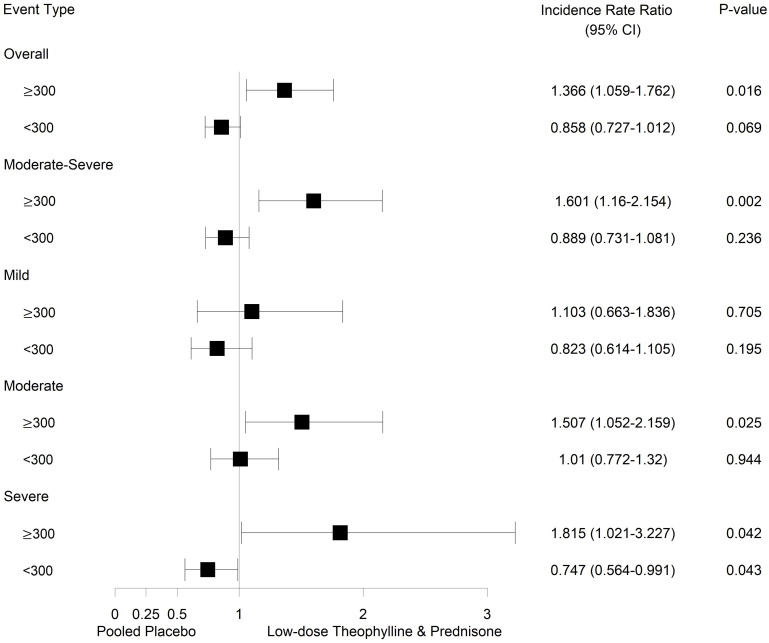
Of 1487 participants eligible for analysis, 325 (22%) were eosinophilic. These participants were predominantly male (82%), had a mean (SD) age of 64 (±8) years and a predicted forced expiratory volume in 1s (FEV) of 43% (±16). The annualized moderate-severe exacerbation rate was significantly higher in the PrT group compared to the pooled results of the TP and DP groups (incidence rate ratio = 1.6; ([95% CI 1.06-1.76]) p = 0.016). Changes in spirometry values and reported disease impact scores (St. George's Respiratory Questionnaire and COPD Assessment Test) at week 48 were not significantly different between groups.
Combination low-dose theophylline and prednisone was associated with a significant increase in the annual moderate-severe exacerbation rate in participants with a blood eosinophil count ≥300 cells/µL compared to placebo.
慢性阻塞性肺疾病(COPD)的负担不成比例地影响中低收入国家的患者。尽管茶碱和 COPD 中的类固醇研究(TASCS)表明,与安慰剂相比,给予低剂量茶碱和泼尼松龙治疗 COPD 患者并没有临床益处,但有人假设那些血液嗜酸性粒细胞计数升高的患者将从干预中获得临床益处。
这是 TASCS 数据集的事后分析 - 在中国进行的一项双盲、安慰剂对照试验,纳入了中重度 COPD 患者。参与者以 1:1:1 的比例随机分配至低剂量口服茶碱(100mg,每日 2 次)和泼尼松龙(5mg,每日 1 次;PrT)、茶碱(100mg,每日 2 次)和泼尼松龙匹配安慰剂(TP)或双匹配安慰剂(DP)组,并随访 48 周。血液嗜酸性粒细胞计数≥300 个/µL 被归类为升高/嗜酸性粒细胞,主要结局是每年中重度加重的发生率。
在 1487 名符合分析条件的参与者中,325 名(22%)为嗜酸性粒细胞。这些参与者主要为男性(82%),平均(SD)年龄为 64(±8)岁,预计用力呼气量 1 秒(FEV)为 43%(±16%)。与 TP 和 DP 组的汇总结果相比,PrT 组的每年中重度加重发生率显著更高(发生率比=1.6;[95%置信区间 1.06-1.76];p=0.016)。在第 48 周时,肺量测定值和报告的疾病影响评分(圣乔治呼吸问卷和 COPD 评估测试)的变化在各组之间没有显著差异。
与安慰剂相比,血液嗜酸性粒细胞计数≥300 个/µL 的患者接受低剂量茶碱和泼尼松龙联合治疗与每年中重度加重发生率的显著增加相关。