Department of Pathology and Medical Biology, University Medical Center Groningen, University of Groningen, Groningen, Netherlands.
Department of Epidemiology, University Medical Center Groningen, University of Groningen, Groningen, Netherlands.
Front Immunol. 2022 Jan 27;13:829943. doi: 10.3389/fimmu.2022.829943. eCollection 2022.
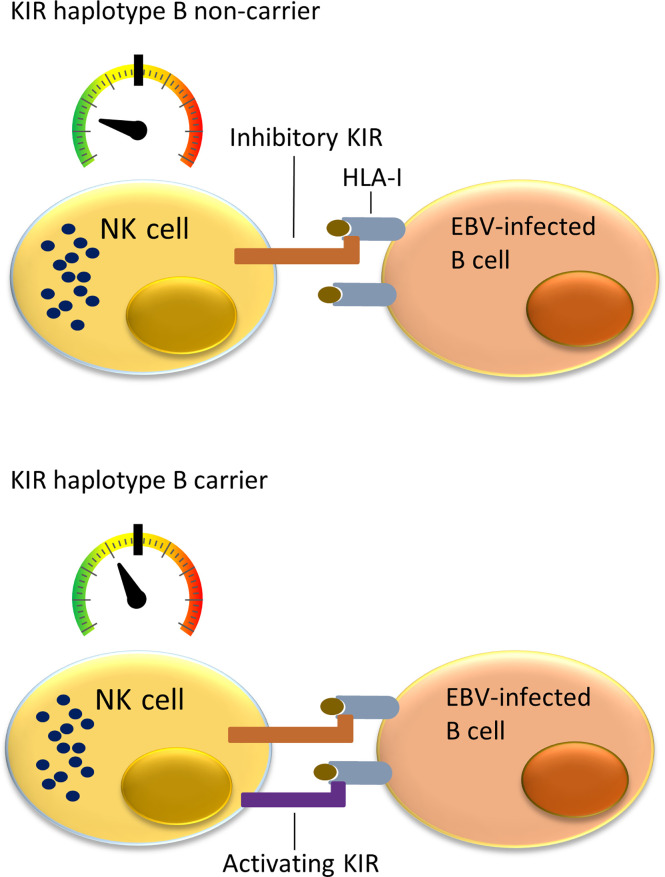
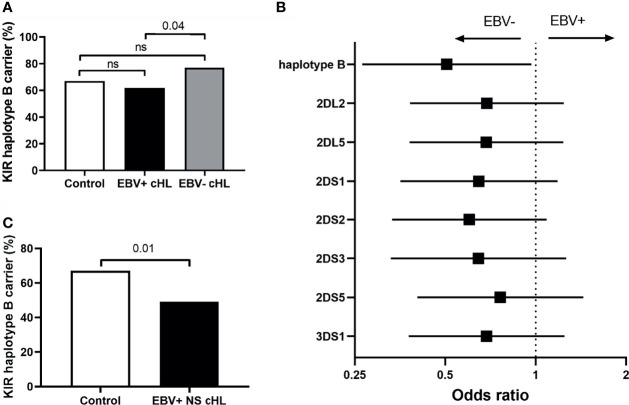
Tumor cells of classic Hodgkin lymphoma (cHL) are derived from antigen presenting B cells that are infected by Epstein Barr virus (EBV) in ~30% of patients. Polymorphic Killer cell immunoglobulin-like receptors (KIRs) expressed on NK cells interact with human leukocyte antigen (HLA) class I and play a key role in immune surveillance against virally infected cells and tumor cells. We investigated the effect of KIR types on cHL susceptibility overall (n=211) and in EBV-stratified subgroups using the Dutch GoNL cohort as controls (n=498). The frequency of the KIR haplotype B subgroup was significantly different between EBV+ and EBV- cHL patients (62% vs. 77%, p=0.04) and this difference was more pronounced in nodular sclerosis (NS) cHL (49% vs. 79%, p=0.0003). The frequency of KIR haplotype B subgroup was significantly lower in EBV+ NS cHL compared to controls (49% vs. 67%, p=0.01). Analyses of known KIR - HLA interaction pairs revealed lower carrier frequencies of - HLA-C1 (29% vs. 46%, p=0.03) and - HLA-C1 (29% vs. 45%, p=0.04) in EBV+ NS cHL patients compared to controls. Carriers of the KIR haplotype B subgroup are less likely to develop EBV+ NS cHL, probably because of a more efficient control over EBV-infected B cells.
经典型霍奇金淋巴瘤 (cHL) 的肿瘤细胞源自抗原呈递 B 细胞,约 30%的患者被 EBV 感染。表达在 NK 细胞上的多态性杀伤细胞免疫球蛋白样受体 (KIR) 与人类白细胞抗原 (HLA) Ⅰ类相互作用,在针对病毒感染细胞和肿瘤细胞的免疫监视中发挥关键作用。我们使用荷兰 GoNL 队列作为对照(n=498),研究了 KIR 类型对 cHL 易感性的总体影响(n=211)和 EBV 分层亚组的影响。EBV+和 EBV- cHL 患者的 KIR 单倍型 B 亚组频率存在显著差异(62%比 77%,p=0.04),结节性硬化型(NS)cHL 的差异更为显著(49%比 79%,p=0.0003)。与对照组相比(49%比 67%,p=0.01),EBV+ NS cHL 中 KIR 单倍型 B 亚组的频率明显更低。对已知 KIR-HLA 相互作用对的分析显示,与对照组相比,EBV+ NS cHL 患者的 -HLA-C1(29%比 46%,p=0.03)和 -HLA-C1(29%比 45%,p=0.04)的携带频率更低。KIR 单倍型 B 亚组的携带者不太可能发展为 EBV+ NS cHL,可能是因为对 EBV 感染的 B 细胞有更有效的控制。