Kuka Werimo Pascal, Shah Jasmit, Alam Uazman, Shah Reena, Sokhi Dilraj Singh
Department of Medicine, Aga Khan University Medical College East Africa, 4th Floor East Tower Block, Third Avenue Parklands, P.O. Box 30270, Nairobi, 00100, GPO, Kenya.
Division of Endocrinology, Diabetes and Gastroenterology, University of Manchester, Manchester, UK.
Diabetes Ther. 2022 Mar;13(3):441-451. doi: 10.1007/s13300-022-01205-3. Epub 2022 Feb 14.
Persons living with human immunodeficiency virus (HIV) are living longer and at risk of non-communicable diseases, including diabetes mellitus (DM). Both HIV and DM place patients at risk of peripheral neuropathy (PN). Our aim was to demonstrate the prevalence and characteristics of PN in our population of patients with HIV infection compared with concomitant HIV and DM.
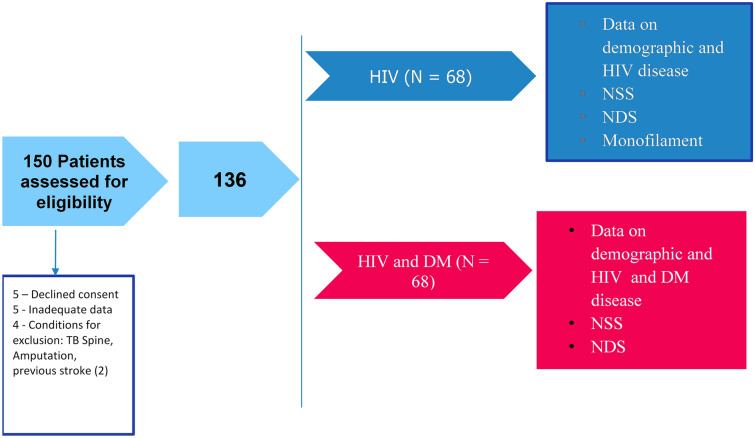
A prospective cross-sectional study was performed at the Aga Khan Hospital in Nairobi, Kenya. Data were collected on demographics and characteristics of DM and HIV. Symptoms and signs of PN were evaluated by Neuropathy Symptom Score, Neuropathy Disability Score, and 10 g monofilament testing.
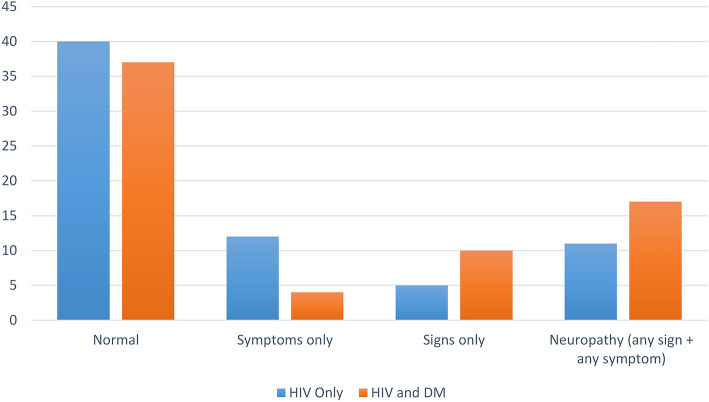
Two groups were recruited, each consisting of 68 patients: (1) HIV only, (2) HIV and DM. The median age of patients was 51 years (IQR 42.8-58.6) and 55% were male. Median duration for HIV was 10 years (IQR 5-12) with a median CD4 count of 524 cells/mm (IQR 369-731). Median duration for DM was 1 year with a median glycosylated hemoglobin of 6.7% (IQR 6.6-7.6). Sixty-nine percent of patients with HIV had suppressed viral loads, and 9 patients (6.6%) had a history neurotoxic antiretroviral therapy use. PN was detected in 11 (16%) HIV-only patients, and in 17 (25%) participants who had both HIV and DM (Fisher exact test chi-square = 0.4). Univariate analysis demonstrated older age, high body mass index, and long duration of HIV were associated with an OR of 1.07 (95% CI 1.02-1.11), 1.21 (95% CI 0.46-3.11), and 1.07 (95% CI 0.99-1.15) in the overall group, respectively.
Our study demonstrates a higher but non-significant prevalence of PN in patients with both HIV and DM when compared to HIV alone. HIV disease control had no association with PN presence.
感染人类免疫缺陷病毒(HIV)的人群寿命延长,面临包括糖尿病(DM)在内的非传染性疾病风险。HIV和DM都会使患者面临周围神经病变(PN)的风险。我们的目的是证明与合并HIV和DM的患者相比,我们的HIV感染患者群体中PN的患病率和特征。
在肯尼亚内罗毕的阿迦汗医院进行了一项前瞻性横断面研究。收集了有关DM和HIV的人口统计学和特征数据。通过神经病变症状评分、神经病变残疾评分和10克单丝试验评估PN的症状和体征。
招募了两组,每组68名患者:(1)仅感染HIV,(2)感染HIV和DM。患者的中位年龄为51岁(四分位间距42.8 - 58.6),55%为男性。HIV感染的中位持续时间为10年(四分位间距5 - 12),CD4细胞计数中位数为524个/mm³(四分位间距369 - 731)。DM的中位持续时间为1年,糖化血红蛋白中位数为6.7%(四分位间距6.6 - 7.6)。69%的HIV患者病毒载量得到抑制,9名患者(6.6%)有神经毒性抗逆转录病毒治疗史。在仅感染HIV的11名患者(16%)和同时感染HIV和DM的17名参与者(25%)中检测到PN(Fisher精确检验卡方值 = 0.4)。单因素分析表明,在整个组中,年龄较大、体重指数较高和HIV感染持续时间较长与比值比分别为1.07(95%置信区间1.02 - 1.11)、1.21(95%置信区间0.46 - 3.11)和1.07(95%置信区间0.99 - 1.15)相关。
我们的研究表明,与仅感染HIV的患者相比,同时感染HIV和DM的患者中PN的患病率较高,但无显著差异。HIV疾病控制与PN的存在无关。