Department of Pharmaceutical Sciences, Division of Pharmacology and Toxicology, University of Vienna, UZA II, Althanstr. 14, Vienna 1090, Austria.
School of Life Sciences, Physiology, Pharmacology, and Neuroscience Division, Medical School, University of Nottingham, Nottingham NG7 2UH, UK.
EBioMedicine. 2022 Feb;76:103880. doi: 10.1016/j.ebiom.2022.103880. Epub 2022 Feb 12.
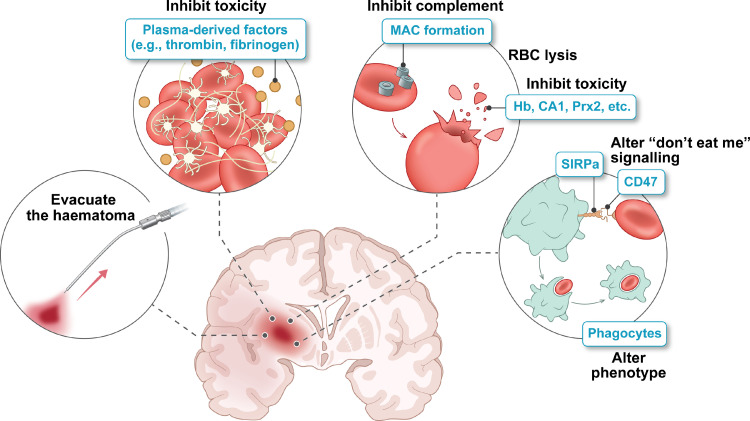
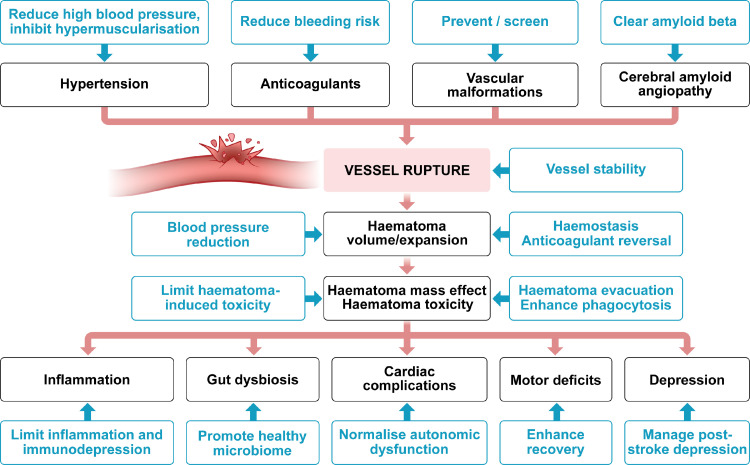
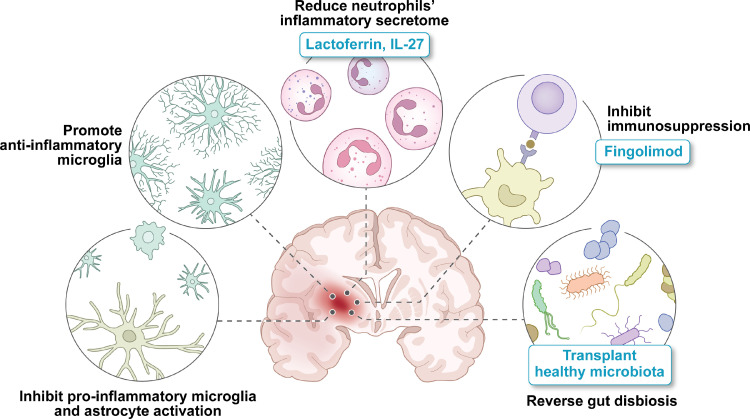
Intracerebral haemorrhage (ICH) is the second most common type of stroke and a major cause of mortality and disability worldwide. Despite advances in surgical interventions and acute ICH management, there is currently no effective therapy to improve functional outcomes in patients. Recently, there has been tremendous progress uncovering new pathophysiological mechanisms underlying ICH that may pave the way for the development of therapeutic interventions. Here, we highlight emerging targets, but also existing gaps in preclinical animal modelling that prevent their exploitation. We particularly focus on (1) ICH aetiology, (2) the haematoma, (3) inflammation, and (4) post-ICH pathology. It is important to recognize that beyond neurons and the brain, other cell types and organs are crucially involved in ICH pathophysiology and successful interventions likely will need to address the entire organism. This review will spur the development of successful therapeutic interventions for ICH and advanced animal models that better reflect its aetiology and pathophysiology.
脑出血(ICH)是第二常见的中风类型,也是全球范围内死亡率和残疾的主要原因。尽管手术干预和急性 ICH 管理取得了进展,但目前尚无有效的治疗方法来改善患者的功能预后。最近,在揭示脑出血潜在病理生理机制方面取得了巨大进展,这可能为治疗干预的发展铺平道路。在这里,我们重点介绍新兴靶点,但也存在临床前动物模型中的空白,这阻碍了它们的开发。我们特别关注(1)ICH 病因,(2)血肿,(3)炎症,和(4)ICH 后病理学。重要的是要认识到,除了神经元和大脑,其他细胞类型和器官在 ICH 病理生理学中也起着至关重要的作用,成功的干预措施可能需要针对整个机体。这篇综述将促进针对 ICH 的成功治疗干预措施和更好地反映其病因和病理生理学的先进动物模型的发展。