Marvin-Peek Jennifer, Savani Bipin N, Olalekan Oluwole O, Dholaria Bhagirathbhai
Department of Medicine, Vanderbilt University Medical Center, Nashville, TN 37232, USA.
Cancers (Basel). 2022 Jan 19;14(3):497. doi: 10.3390/cancers14030497.
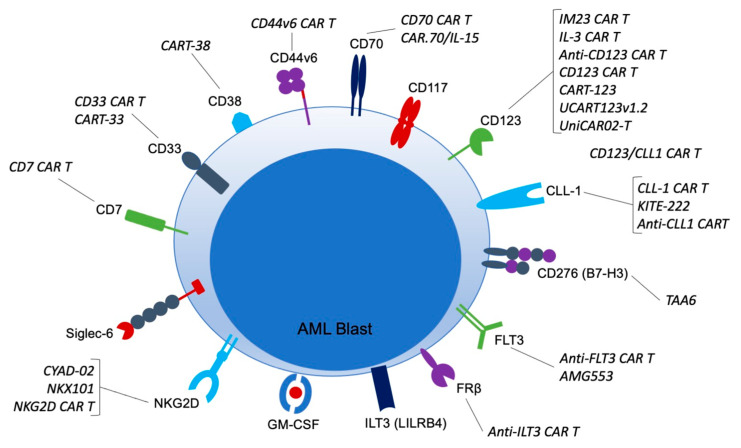
The advent of chimeric antigen receptor (CAR) T-cell therapy has led to dramatic remission rates in multiple relapsed/refractory hematologic malignancies. While CAR T-cell therapy has been particularly successful as a treatment for B-cell malignancies, effectively treating acute myeloid leukemia (AML) with CARs has posed a larger challenge. AML not only creates an immunosuppressive tumor microenvironment that dampens CAR T-cell responses, but it also lacks many unique tumor-associated antigens, making leukemic-specific targeting difficult. One advantage of CAR T-cell therapy compared to alternative treatment options is the ability to provide prolonged antigen-specific immune effector and surveillance functions. Since many AML CAR targets under investigation including CD33, CD117, and CD123 are also expressed on hematopoietic stem cells, CAR T-cell therapy can lead to severe and potentially lethal myeloablation. Novel strategies to combat these issues include creation of bispecific CARs, CAR T-cell "safety switches", TCR-like CARs, NK CARs, and universal CARs, but all vary in their ability to provide a sustained remission, and consolidation with an allogeneic hematopoietic cell transplantation (allo-HCT) will be necessary in most cases This review highlights the delicate balance between effectively eliminating AML blasts and leukemic stem cells, while preserving the ability for bone marrow to regenerate. The impact of CAR therapy on treatment landscape of AML and changing scope of allo-HCT is discussed. Continued advances in AML CAR therapy would be of great benefit to a disease that still has high morbidity and mortality.
嵌合抗原受体(CAR)T细胞疗法的出现,已使多种复发/难治性血液系统恶性肿瘤的缓解率显著提高。虽然CAR T细胞疗法作为B细胞恶性肿瘤的治疗方法特别成功,但用CAR有效治疗急性髓系白血病(AML)则面临更大挑战。AML不仅会产生抑制CAR T细胞反应的免疫抑制性肿瘤微环境,而且还缺乏许多独特的肿瘤相关抗原,使得白血病特异性靶向治疗变得困难。与其他治疗选择相比,CAR T细胞疗法的一个优势是能够提供持久的抗原特异性免疫效应和监测功能。由于许多正在研究的AML CAR靶点,包括CD33、CD117和CD123,也在造血干细胞上表达,CAR T细胞疗法可能导致严重且潜在致命的骨髓消融。应对这些问题的新策略包括创建双特异性CAR、CAR T细胞“安全开关”、TCR样CAR、NK CAR和通用CAR,但它们在提供持续缓解的能力方面各不相同,并且在大多数情况下都需要与异基因造血细胞移植(allo-HCT)巩固治疗。本综述强调了在有效消除AML原始细胞和白血病干细胞的同时,保留骨髓再生能力之间的微妙平衡。讨论了CAR疗法对AML治疗格局的影响以及allo-HCT范围的变化。AML CAR疗法的持续进展将对这种发病率和死亡率仍然很高的疾病大有裨益。