Casadei Beatrice, Argnani Lisa, Broccoli Alessandro, Patti Caterina, Stefani Piero Maria, Cuneo Antonio, Margiotta Casaluci Gloria, Visco Carlo, Gini Guido, Pane Fabrizio, D'Alò Francesco, Luzi Debora, Cantonetti Maria, Pozzi Samantha, Musuraca Gerardo, Rosignoli Chiara, Arcari Annalisa, Kovalchuk Sofya, Tani Monica, Tisi Maria Chiara, Petrini Mario, Stefoni Vittorio, Zinzani Pier Luigi
IRCCS Azienda Ospedaliero, Universitaria di Bologna, Istituto di Ematologia "Seràgnoli", 40138 Bologna, Italy.
Dipartimento di Medicina Specialistica, Diagnostica e Sperimentale, Università di Bologna, Via Massarenti 9, 40138 Bologna, Italy.
Cancers (Basel). 2022 Jan 27;14(3):654. doi: 10.3390/cancers14030654.
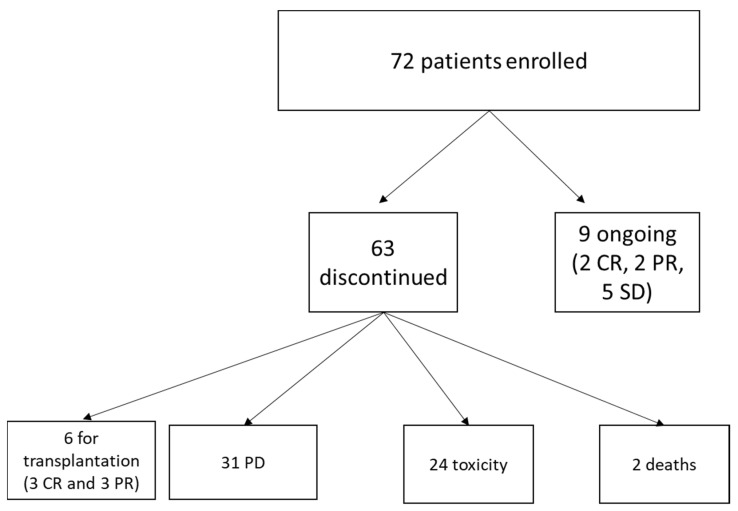
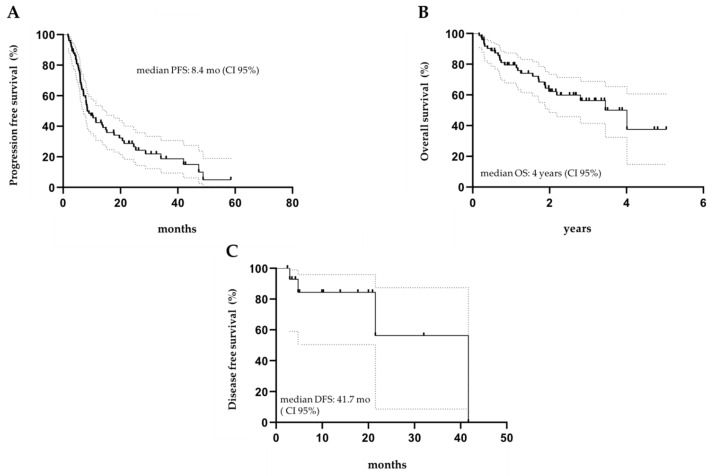
Follicular lymphoma (FL) is an indolent hematological disease, often responsive to the first line of treatment, but characterized by repeated relapses. The therapeutic algorithm for relapsed/refractory FL patients comprises phosphatidylinositol 3-kinase inhibitors. Idelalisib showed anticancer activity, while inducing a significant rate of toxicities. Since the evidence in the literature on its use in normal clinical practice is scarce, a retrospective multicenter study was conducted to evaluate effectiveness and tolerability in a real-life context. Seventy-two patients with a median age at diagnosis of 57.2 years-mostly with an advanced stage (88.9%) and relapsed to the most recent therapy (79.1%)-were enrolled. The median number of prior therapies was three (20.8% refractory to the last therapy before idelalisib). With a median number of 4 months of treatment, the overall response rate was 41.7% (20.8% complete responses). Median disease-free survival and overall survival were achieved at 8.4 months and at 4 years, respectively. Forty-four percent of patients experienced at least one drug-related toxicity: 6.9% hematological ones and 43% non-hematological. The study confirmed that idelalisib has anticancer effectiveness and an acceptable safety profile in relapsed/refractory FL with unfavorable prognostic characteristics, even in the context of normal clinical practice.
滤泡性淋巴瘤(FL)是一种惰性血液系统疾病,通常对一线治疗有反应,但具有反复复发的特点。复发/难治性FL患者的治疗方案包括磷脂酰肌醇3激酶抑制剂。idelalisib显示出抗癌活性,但会引发显著比例的毒性反应。由于文献中关于其在正常临床实践中使用的证据较少,因此开展了一项回顾性多中心研究,以评估其在实际临床环境中的有效性和耐受性。纳入了72例患者,诊断时的中位年龄为57.2岁,大多数处于晚期(88.9%)且对最近一次治疗复发(79.1%)。既往治疗的中位次数为3次(20.8%对idelalisib之前的最后一次治疗难治)。中位治疗时间为4个月,总缓解率为41.7%(完全缓解率为20.8%)。无进展生存期和总生存期的中位数分别为8.4个月和4年。44%的患者经历了至少一种与药物相关的毒性反应:血液学毒性反应占6.9%,非血液学毒性反应占43%。该研究证实,即使在正常临床实践中,idelalisib对于具有不良预后特征的复发/难治性FL也具有抗癌有效性和可接受的安全性。