Department of Genetics, University Medical Center Utrecht, 3584 Utrecht, The Netherlands.
Department of Neurology & Neurosurgery, University Medical Centre Utrecht, 3584 Utrecht, The Netherlands.
Cells. 2022 Jan 28;11(3):454. doi: 10.3390/cells11030454.
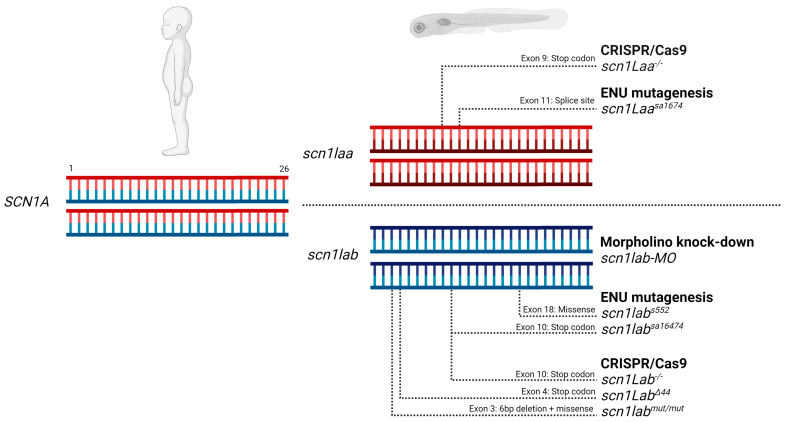
There are currently seven different zebrafish strains that model Dravet Syndrome, a severe childhood form of epilepsy. These models are based on a set of duplicated genes, and , which are the homologs for human . Disrupting one of the genes would mimic a heterozygous disease state in humans, as the paralog gene is still present. While this 'disease-state model' is widely accepted, there is also evidence that the function of these genes might not be completely the same. By analyzing the functional domains, we discovered several hotspots in the protein that are not conserved, indicating a functional difference. Based on this, we generated knockout zebrafish and compared their phenotype to knockouts. The genetic and functional differences we discovered can have implications for the use of zebrafish as a model for Dravet Syndrome.
目前有七种不同的斑马鱼品系可用于模拟德拉维特综合征,这是一种严重的儿童期癫痫形式。这些模型基于一组重复的基因,和,它们是人类的同源物。破坏其中一个基因会模拟人类的杂合疾病状态,因为另一个基因仍然存在。虽然这种“疾病状态模型”被广泛接受,但也有证据表明这些基因的功能可能不完全相同。通过分析功能域,我们发现蛋白质中有几个热点是非保守的,这表明存在功能差异。基于此,我们生成了 基因敲除斑马鱼,并将其表型与 基因敲除斑马鱼进行了比较。我们发现的遗传和功能差异可能会影响将斑马鱼作为德拉维特综合征模型的应用。