Scales Martin, Anderson Joel, Kornuta Jeffrey A, Switzner Nathan, Gonzalez Ramon, Veloo Peter
Exponent, Inc., Houston, TX 77042, USA.
RSI Pipeline Solutions, New Albany, OH 43054, USA.
Materials (Basel). 2022 Jan 22;15(3):832. doi: 10.3390/ma15030832.
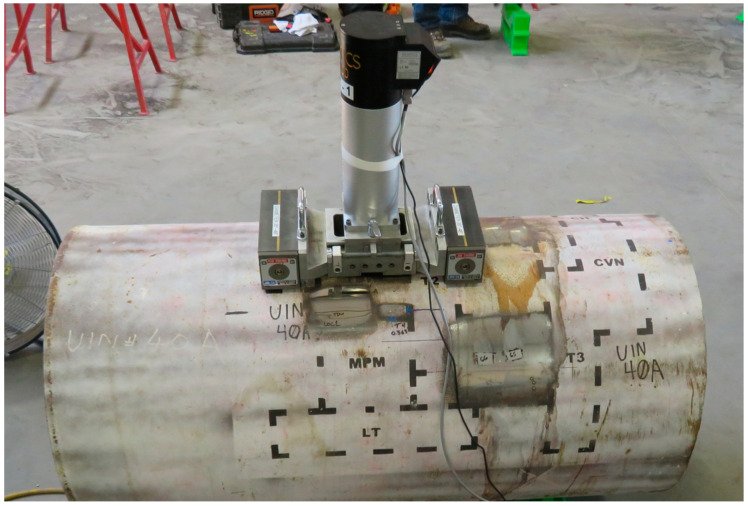
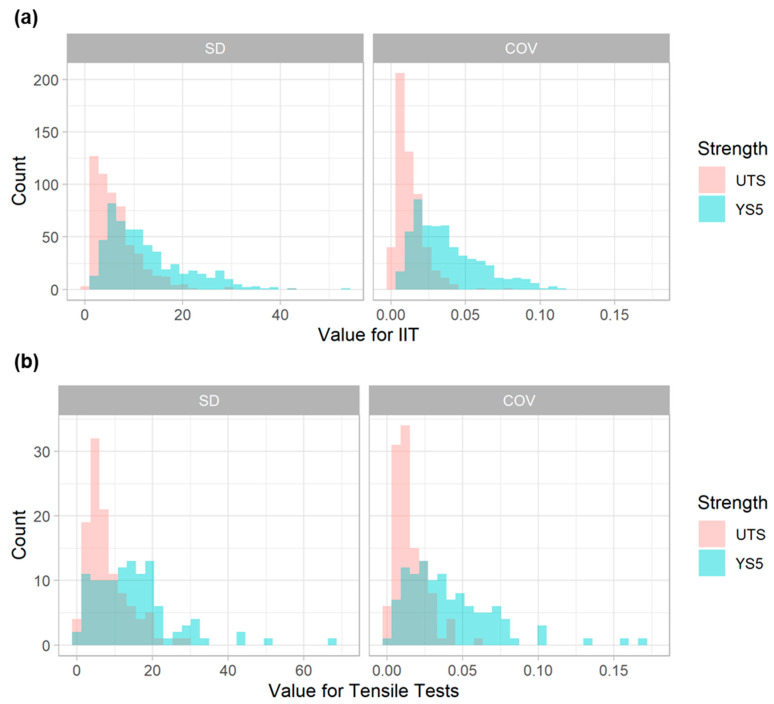
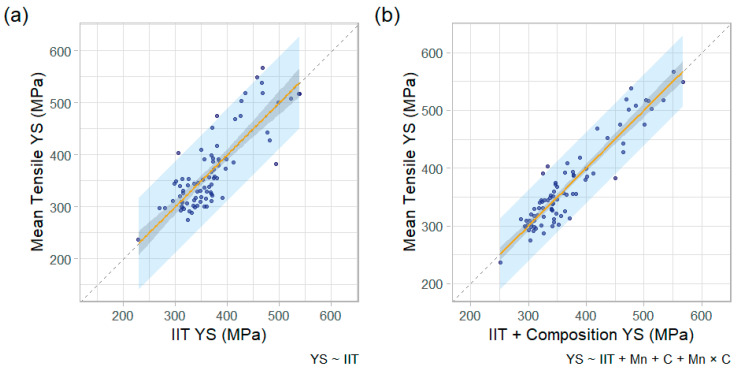
Federal rule changes governing natural gas pipelines have made non-destructive techniques, such as instrumented indentation testing (IIT), an attractive alternative to destructive tests for verifying properties of steel pipeline segments that lack traceable records. Ongoing work from Pacific Gas and Electric Company's (PG&E) materials verification program indicates that IIT measurements may be enhanced by incorporating chemical composition data. This paper presents data from PG&E's large-scale IIT program that demonstrates the predictive capabilities of IIT and chemical composition data, with particular emphasis given to differences between ultimate tensile strength (UTS) and yield strength (YS). For this study, over 80 segments of line pipe were evaluated through tensile testing, IIT, and compositional testing by optical emission spectroscopy (OES) and laboratory combustion. IIT measurements of UTS were, generally, in better agreement with destructive tensile data than YS and exhibited about half as much variability as YS measurements on the same sample. The root-mean squared error for IIT measurements of UTS and YS, respectively, were 27 MPa (3.9 ksi) and 43 MPa (6.2 ksi). Next, a machine learning model was trained to estimate YS and UTS by combining IIT with chemical composition data. The agreement between the model's estimated UTS and tensile UTS values was only slightly better than the IIT-only measurements, with an RMSE of 21 MPa (3.1 ksi). However, the YS estimates showed much greater improvement with an improved RMSE of 27 MPa (3.9 ksi). The experimental, mechanical, and metallurgical factors that contributed to IIT's ability to consistently determine destructive UTS, and the differences in its interaction with composition as compared to YS, are discussed herein.
联邦政府对天然气管道管理规定的变更,使得诸如仪器化压痕测试(IIT)等无损检测技术,成为了一种有吸引力的替代破坏性测试的方法,用于验证缺乏可追溯记录的钢管管道段的性能。太平洋天然气和电力公司(PG&E)材料验证计划正在进行的工作表明,通过纳入化学成分数据,IIT测量可能会得到增强。本文展示了PG&E大规模IIT计划的数据,这些数据证明了IIT和化学成分数据的预测能力,特别强调了极限抗拉强度(UTS)和屈服强度(YS)之间的差异。在本研究中,通过拉伸试验、IIT以及光发射光谱(OES)和实验室燃烧的成分测试,对80多个管线管段进行了评估。一般来说,IIT对UTS的测量与破坏性拉伸数据的一致性比YS更好,并且在同一样品上,其变异性约为YS测量的一半。IIT对UTS和YS测量的均方根误差分别为27兆帕(3.9千磅力/平方英寸)和43兆帕(6.2千磅力/平方英寸)。接下来,通过将IIT与化学成分数据相结合,训练了一个机器学习模型来估计YS和UTS。该模型估计的UTS与拉伸UTS值之间的一致性仅略优于仅使用IIT的测量,均方根误差为21兆帕(3.1千磅力/平方英寸)。然而,YS估计值有了更大的改进,均方根误差提高到了27兆帕(3.9千磅力/平方英寸)。本文讨论了有助于IIT始终如一地确定破坏性UTS的实验、力学和冶金因素,以及与YS相比,其与成分相互作用的差异。