Chen Zhiyong, Xu Yingqiang, Li Miaoling, Li Bin, Song Weizhi, Xiao Li, Cheng Yulong, Jia Songyan
School of Mechanical Engineering, Northwestern Polytechnical University, Xi'an 710072, China.
School of Intelligent Manufacturing, Luoyang Institute of Science and Technology, Luoyang 471023, China.
Materials (Basel). 2022 Jan 25;15(3):901. doi: 10.3390/ma15030901.
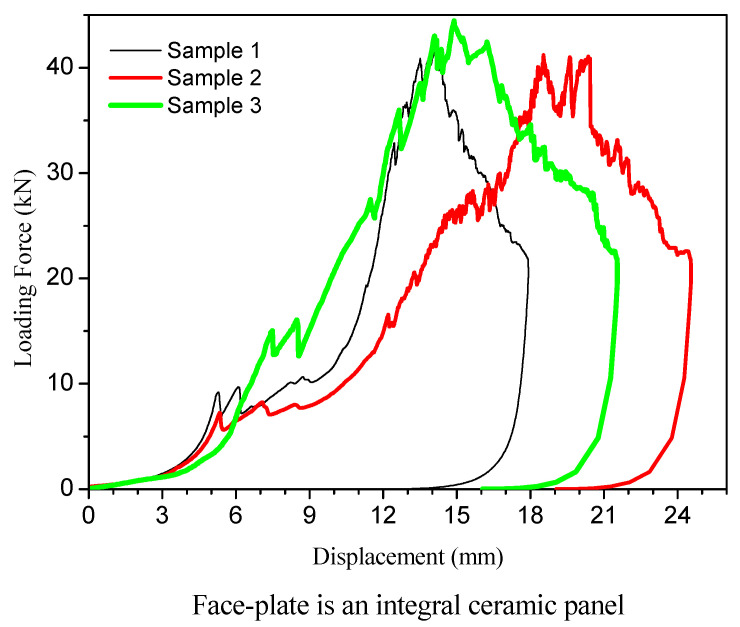
In this paper, the ballistic damage mechanism and residual bearing capacity of ceramic/backing plate armor were investigated. First, a series of lightweight armors were prepared, consisting of ceramic and ultra-high molecular weight polyethylene fiber-reinforced resin matrix composite (UHMWPE) plates, and were wrapped in a high-strength fabric. Then, the ceramic/UHMWPE armors were hit by one or two bullets, and finally subjected to compression testing. The results showed that the main failure mode of integral ceramic/UHMWPE armors was ceramic brittle fracture. Many zigzag patterns on the compression curve indicated that the specimens had undergone the stages of crack propagation, ceramic fragment reorganization, plastic deformation of UHMWPE backing plate, interlaminar tearing, and overall fracture. The failure of spliced ceramic/UHMWPE armors was mainly due to the dislocation between ceramic sheets; the smooth compression curves indicated that there was no recombination of ceramic fragments and obvious interlayer debonding during the compression. Under the maximum load, each ceramic/UHMWPE armor with ballistic damage did not suddenly break and fail. The structure and thickness of ceramic plates all had an impact on residual strength: under the same structure, the greater the thickness, the greater the residual strength, but the relationship between them was not linear; under the same thickness, the residual strength of the spliced ceramic/UHMWPE armor was higher. The residual strength was also related to the number of shots: after two bullets hit, its value was only one-third of that after one bullet hit.
本文研究了陶瓷/背板装甲的弹道损伤机理和剩余承载能力。首先,制备了一系列轻质装甲,其由陶瓷和超高分子量聚乙烯纤维增强树脂基复合材料(UHMWPE)板组成,并用高强度织物包裹。然后,用一到两颗子弹撞击陶瓷/UHMWPE装甲,最后进行压缩测试。结果表明,整体陶瓷/UHMWPE装甲的主要失效模式是陶瓷脆性断裂。压缩曲线上的许多锯齿形图案表明,试样经历了裂纹扩展、陶瓷碎片重组、UHMWPE背板的塑性变形、层间撕裂和整体断裂阶段。拼接陶瓷/UHMWPE装甲的失效主要是由于陶瓷片之间的错位;平滑的压缩曲线表明,压缩过程中陶瓷碎片没有重组且没有明显的层间脱粘。在最大载荷下,每块受弹道损伤的陶瓷/UHMWPE装甲都不会突然断裂失效。陶瓷板的结构和厚度均对剩余强度有影响:在相同结构下,厚度越大,剩余强度越大,但二者关系并非线性;在相同厚度下,拼接陶瓷/UHMWPE装甲的剩余强度更高。剩余强度还与射击次数有关:两颗子弹撞击后,其值仅为一颗子弹撞击后的三分之一。