School of Medicine, European University Cyprus, Nicosia 2404, Cyprus.
Institute of Medical Biometry, University of Heidelberg, 69120 Heidelberg, Germany.
Int J Mol Sci. 2022 Jan 31;23(3):1650. doi: 10.3390/ijms23031650.
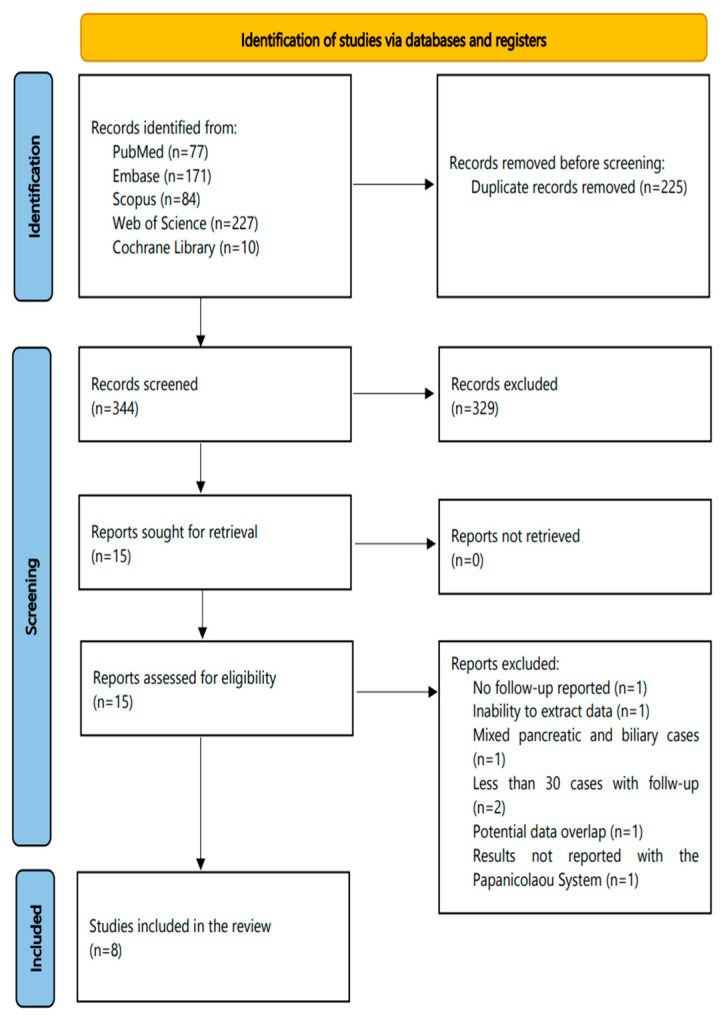
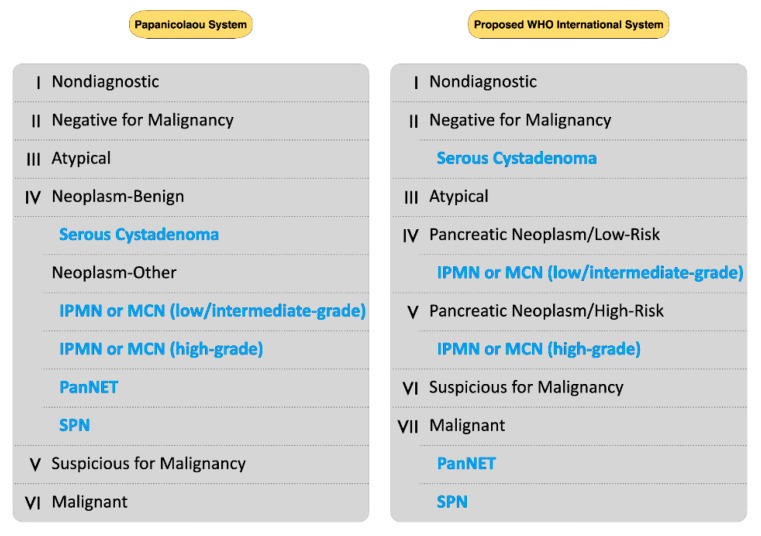
The Papanicolaou Society of Cytopathology (PSC) reporting system classifies pancreatobiliary samples into six categories (I-VI), providing guidance for personalized management. As the World Health Organization (WHO) has been preparing an updated reporting system for pancreatobiliary cytopathology, this systematic review aimed to evaluate the risk of malignancy (ROM) of each PSC category, also the sensitivity and specificity of pancreatic FNA cytology using the current PSC system. Five databases were investigated with a predefined search algorithm. Inclusion and exclusion criteria were applied to select the eligible studies for subsequent data extraction. A study quality assessment was also performed. Eight studies were included in the qualitative analysis. The ROM of the PSC categories I, II, III, IV, V, VI were in the ranges of 8-50%, 0-40%, 28-100%, 0-31%, 82-100%, and 97-100%, respectively. Notably, the ROM IVB ("neoplastic-benign") subcategory showed a 0% ROM. Four of the included studies reported separately the ROMs for the IVO subcategory ("neoplastic-other"; its overall ROM ranged from 0 to 34%) with low (LGA) and high-grade atypia (HGA). ROM for LGA ranged from 4.3 to 19%, whereas ROM for HGA from 64 to 95.2%. When the subcategory IVO with HGA was considered as cytologically positive, together with the categories V and VI, there was a higher sensitivity of pancreatic cytology, at minimal expense of the specificity. Evidence suggests the proposed WHO international system changes-shifting the IVB entities into the "benign/negative for malignancy" category and establishing two new categories, the "pancreatic neoplasm, low-risk/grade" and "pancreatic neoplasm, high-risk/grade"-could stratify pancreatic neoplasms more effectively than the current PSC system.
巴氏细胞学学会(PSC)报告系统将胰胆样本分为六类(I-VI),为个性化管理提供指导。由于世界卫生组织(WHO)一直在准备更新的胰胆细胞学报告系统,本系统评价旨在评估每个 PSC 类别的恶性肿瘤风险(ROM),以及当前 PSC 系统下胰腺细针抽吸细胞学的敏感性和特异性。使用预定义的搜索算法调查了五个数据库。应用纳入和排除标准选择合格的研究进行后续数据提取。还进行了研究质量评估。八项研究纳入定性分析。PSC 类别 I、II、III、IV、V、VI 的 ROM 范围分别为 8-50%、0-40%、28-100%、0-31%、82-100%和 97-100%。值得注意的是,IVB 亚类(“肿瘤-良性”)的 ROM 为 0%。纳入的四项研究分别报告了 IVO 亚类(“肿瘤-其他”)的 ROM(其总体 ROM 范围为 0 至 34%),其低级别不典型增生(LGA)和高级别不典型增生(HGA)的 ROM 分别为 4.3%至 19%,而 HGA 的 ROM 为 64%至 95.2%。当考虑到具有 HGA 的亚类 IVO 作为细胞学阳性,并与类别 V 和 VI 一起时,胰腺细胞学的敏感性更高,特异性损失最小。证据表明,拟议的 WHO 国际系统变化——将 IVB 实体转移到“良性/无恶性肿瘤”类别,并建立两个新类别,即“胰腺肿瘤,低风险/低级别”和“胰腺肿瘤,高风险/高级别”——可以比当前的 PSC 系统更有效地对胰腺肿瘤进行分层。