• 文献检索
  • 文档翻译
  • 深度研究
  • 学术资讯
  • Suppr Zotero 插件Zotero 插件
  • 邀请有礼
  • 套餐&价格
  • 历史记录
应用&插件
Suppr Zotero 插件Zotero 插件浏览器插件Mac 客户端Windows 客户端微信小程序
定价
高级版会员购买积分包购买API积分包
服务
文献检索文档翻译深度研究API 文档MCP 服务
关于我们
关于 Suppr公司介绍联系我们用户协议隐私条款
关注我们

Suppr 超能文献

核心技术专利:CN118964589B侵权必究
粤ICP备2023148730 号-1Suppr @ 2026

文献检索

告别复杂PubMed语法,用中文像聊天一样搜索,搜遍4000万医学文献。AI智能推荐,让科研检索更轻松。

立即免费搜索

文件翻译

保留排版,准确专业,支持PDF/Word/PPT等文件格式,支持 12+语言互译。

免费翻译文档

深度研究

AI帮你快速写综述,25分钟生成高质量综述,智能提取关键信息,辅助科研写作。

立即免费体验

PredictPTB:一种使用基于注意力的循环神经网络的可解释早产预测模型。

PredictPTB: an interpretable preterm birth prediction model using attention-based recurrent neural networks.

作者信息

AlSaad Rawan, Malluhi Qutaibah, Boughorbel Sabri

机构信息

College of Engineering, Qatar University, Doha, Qatar.

Qatar Computing Research Institute, Hamad Bin Khalifa University, Doha, Qatar.

出版信息

BioData Min. 2022 Feb 14;15(1):6. doi: 10.1186/s13040-022-00289-8.

DOI:10.1186/s13040-022-00289-8
PMID:35164820
原文链接:https://pmc.ncbi.nlm.nih.gov/articles/PMC8842907/
Abstract

BACKGROUND

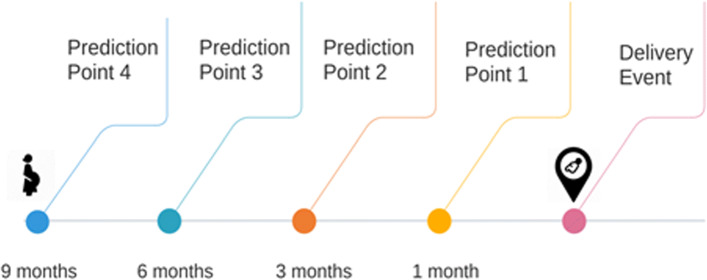
Early identification of pregnant women at risk for preterm birth (PTB), a major cause of infant mortality and morbidity, has a significant potential to improve prenatal care. However, we lack effective predictive models which can accurately forecast PTB and complement these predictions with appropriate interpretations for clinicians. In this work, we introduce a clinical prediction model (PredictPTB) which combines variables (medical codes) readily accessible through electronic health record (EHR) to accurately predict the risk of preterm birth at 1, 3, 6, and 9 months prior to delivery.

METHODS

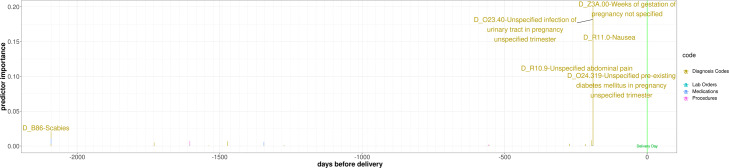
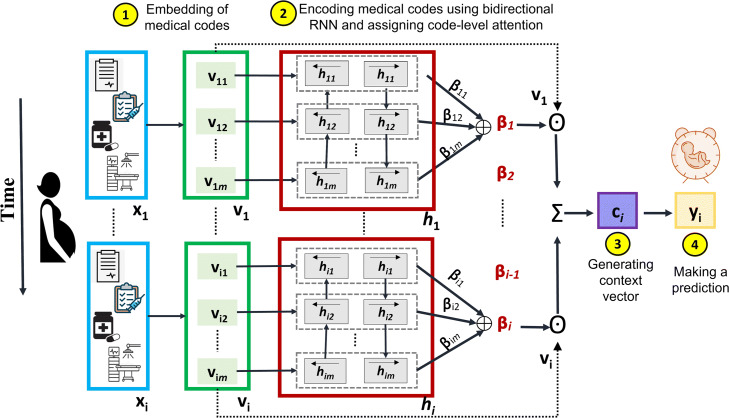
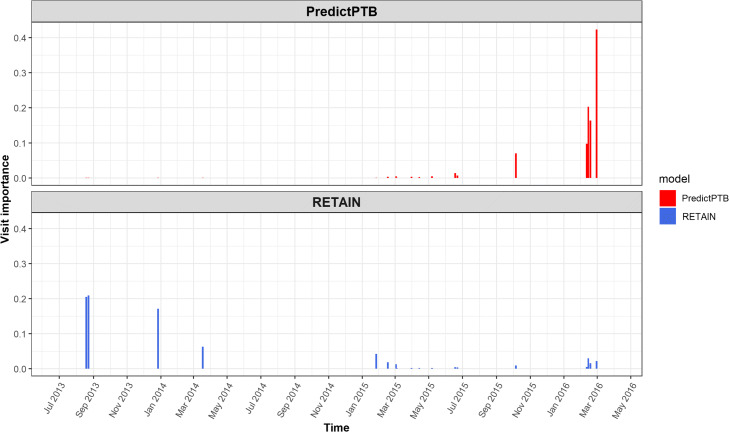
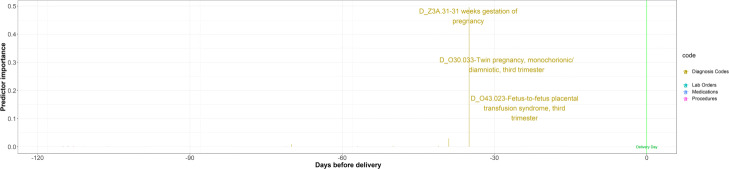
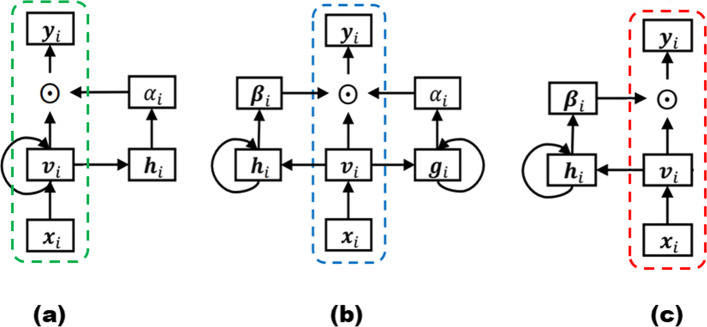
The architecture of PredictPTB employs recurrent neural networks (RNNs) to model the longitudinal patient's EHR visits and exploits a single code-level attention mechanism to improve the predictive performance, while providing temporal code-level and visit-level explanations for the prediction results. We compare the performance of different combinations of prediction time-points, data modalities, and data windows. We also present a case-study of our model's interpretability illustrating how clinicians can gain some transparency into the predictions.

RESULTS

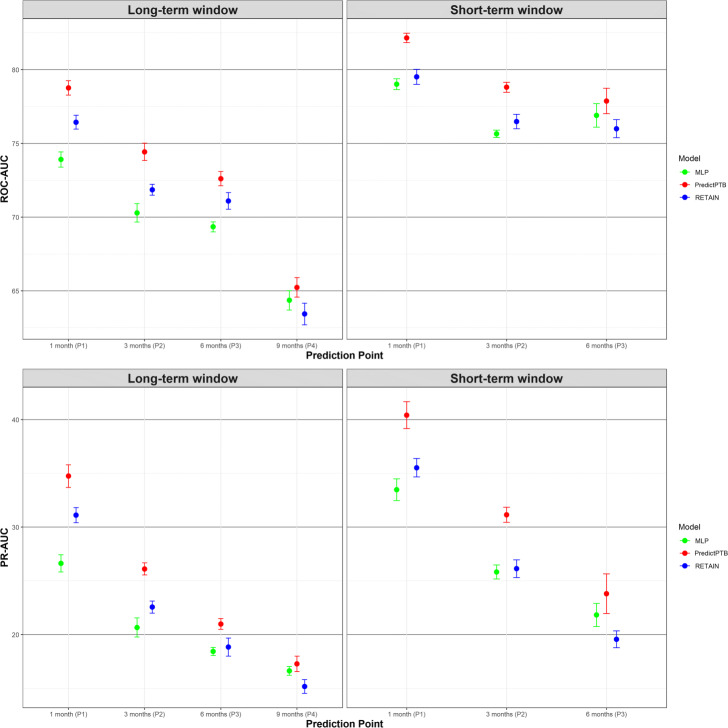
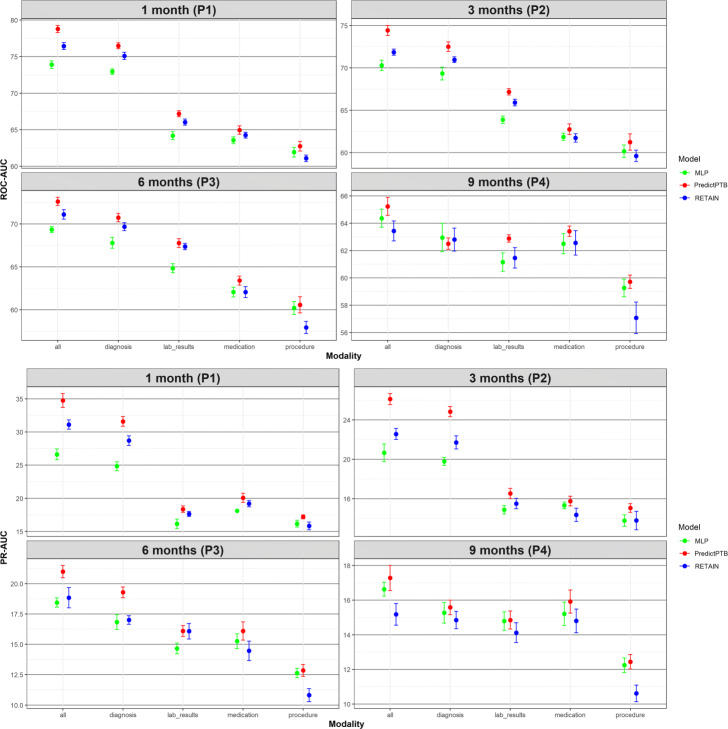
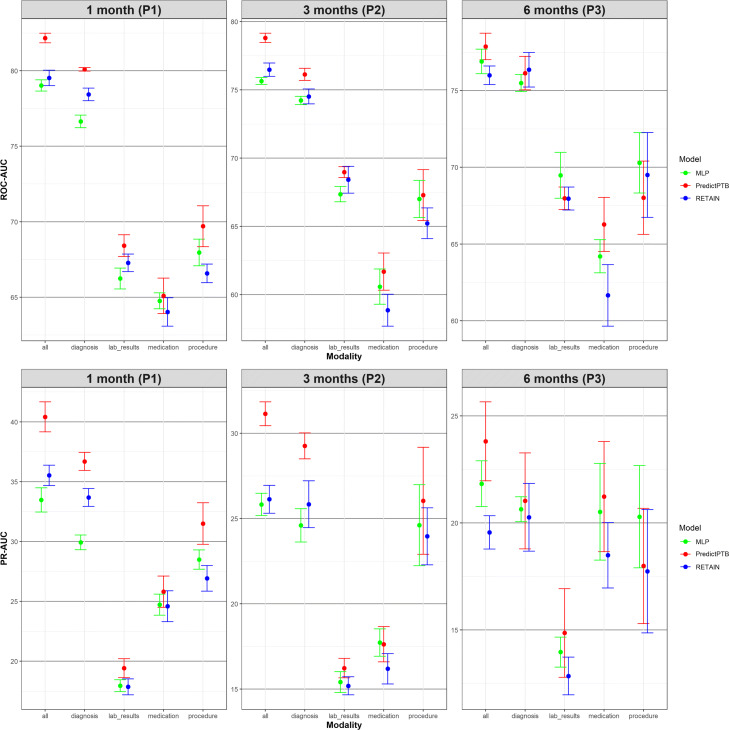
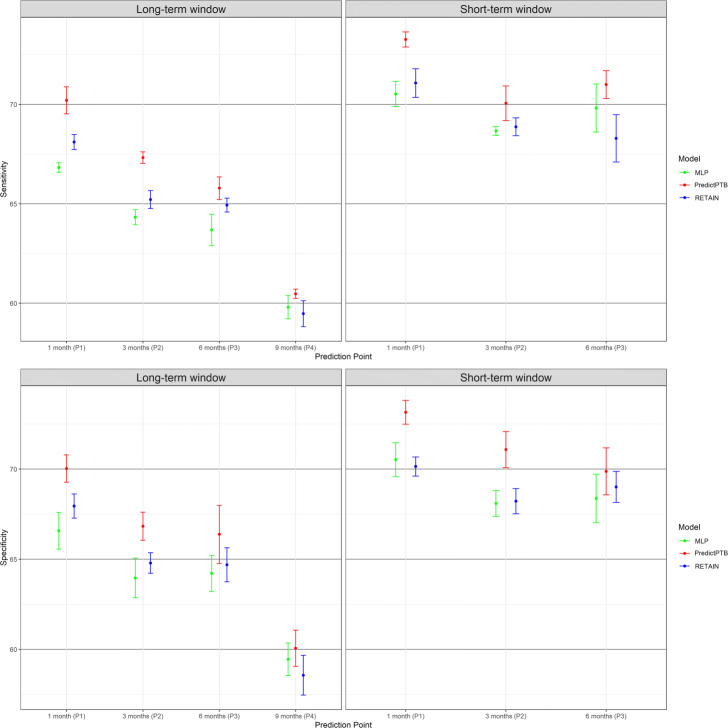
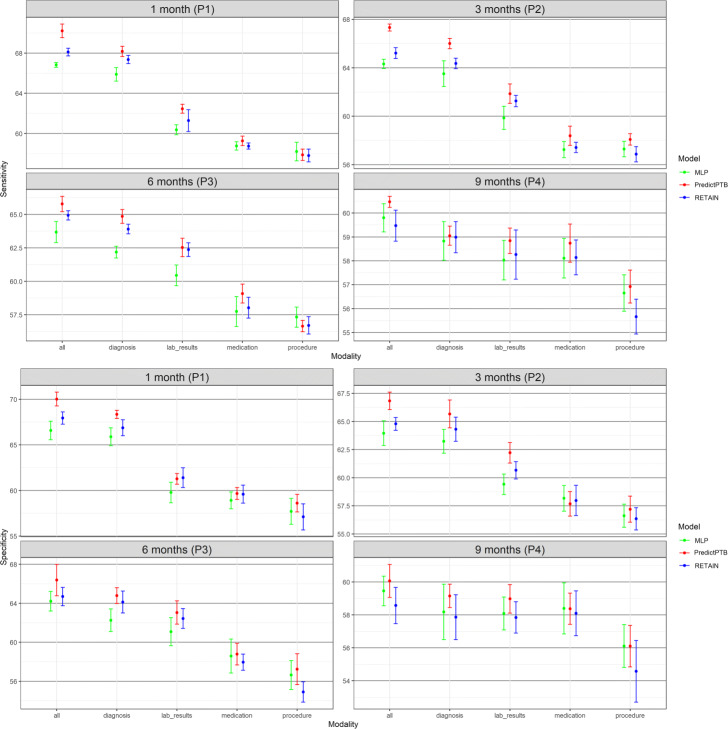
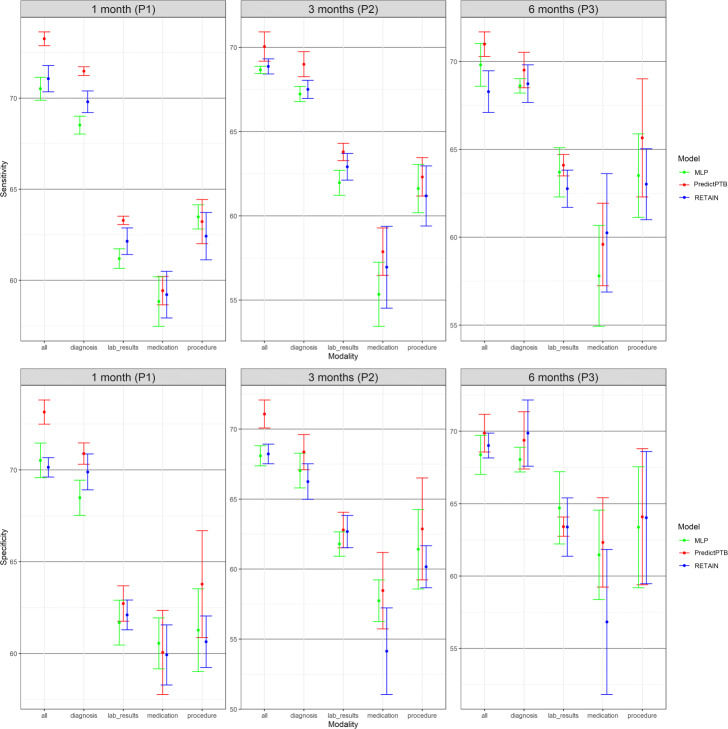
Leveraging a large cohort of 222,436 deliveries, comprising a total of 27,100 unique clinical concepts, our model was able to predict preterm birth with an ROC-AUC of 0.82, 0.79, 0.78, and PR-AUC of 0.40, 0.31, 0.24, at 1, 3, and 6 months prior to delivery, respectively. Results also confirm that observational data modalities (such as diagnoses) are more predictive for preterm birth than interventional data modalities (e.g., medications and procedures).

CONCLUSIONS

Our results demonstrate that PredictPTB can be utilized to achieve accurate and scalable predictions for preterm birth, complemented by explanations that directly highlight evidence in the patient's EHR timeline.

摘要

背景

早产是婴儿死亡和发病的主要原因,早期识别有早产风险的孕妇对于改善产前护理具有巨大潜力。然而,我们缺乏能够准确预测早产并为临床医生提供适当解释以辅助这些预测的有效预测模型。在这项工作中,我们引入了一种临床预测模型(PredictPTB),该模型结合了通过电子健康记录(EHR)易于获取的变量(医学编码),以准确预测分娩前1、3、6和9个月的早产风险。

方法

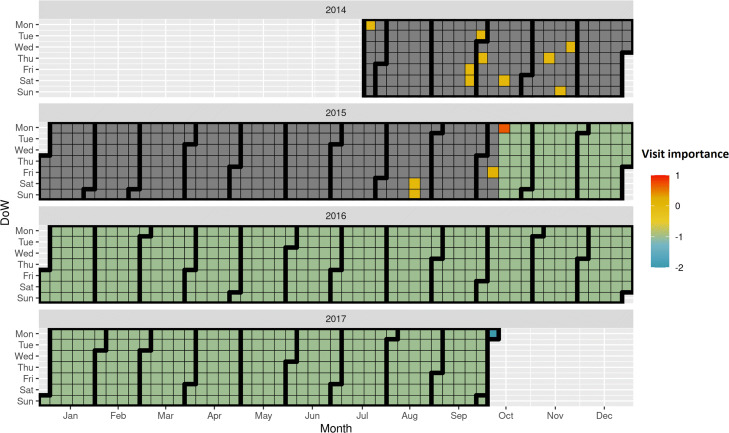
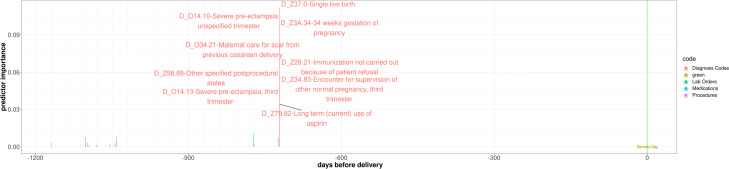
PredictPTB的架构采用循环神经网络(RNN)对患者的纵向EHR就诊情况进行建模,并利用单一的编码级注意力机制来提高预测性能,同时为预测结果提供时间编码级和就诊级的解释。我们比较了不同预测时间点、数据模态和数据窗口组合的性能。我们还展示了一个关于我们模型可解释性的案例研究,说明临床医生如何能够对预测有一定的透明度。

结果

利用包含总共27,100个独特临床概念的222,436例分娩的大型队列,我们的模型能够分别在分娩前1、3和6个月预测早产,其ROC-AUC分别为0.82、0.79、0.78,PR-AUC分别为0.40、0.31、0.24。结果还证实,观察性数据模态(如诊断)比干预性数据模态(如药物和手术)对早产的预测性更强。

结论

我们的结果表明,PredictPTB可用于实现对早产的准确且可扩展的预测,并辅以直接突出患者EHR时间线中证据的解释。
https://cdn.ncbi.nlm.nih.gov/pmc/blobs/f363/8842907/f1c5bdda2d0d/13040_2022_289_Fig14_HTML.jpg
https://cdn.ncbi.nlm.nih.gov/pmc/blobs/f363/8842907/2a47600d7a21/13040_2022_289_Fig1_HTML.jpg
https://cdn.ncbi.nlm.nih.gov/pmc/blobs/f363/8842907/5e0a7e39be49/13040_2022_289_Fig2_HTML.jpg
https://cdn.ncbi.nlm.nih.gov/pmc/blobs/f363/8842907/533052bb43e5/13040_2022_289_Fig3_HTML.jpg
https://cdn.ncbi.nlm.nih.gov/pmc/blobs/f363/8842907/86033eb716ae/13040_2022_289_Fig4_HTML.jpg
https://cdn.ncbi.nlm.nih.gov/pmc/blobs/f363/8842907/da8243e0b10b/13040_2022_289_Fig5_HTML.jpg
https://cdn.ncbi.nlm.nih.gov/pmc/blobs/f363/8842907/274cf6b26fa0/13040_2022_289_Fig6_HTML.jpg
https://cdn.ncbi.nlm.nih.gov/pmc/blobs/f363/8842907/8c9172ec4bad/13040_2022_289_Fig7_HTML.jpg
https://cdn.ncbi.nlm.nih.gov/pmc/blobs/f363/8842907/62bc5cf2c613/13040_2022_289_Fig8_HTML.jpg
https://cdn.ncbi.nlm.nih.gov/pmc/blobs/f363/8842907/fa3c0a6be002/13040_2022_289_Fig9_HTML.jpg
https://cdn.ncbi.nlm.nih.gov/pmc/blobs/f363/8842907/a13d89d7d97b/13040_2022_289_Fig10_HTML.jpg
https://cdn.ncbi.nlm.nih.gov/pmc/blobs/f363/8842907/badf46ba306c/13040_2022_289_Fig11_HTML.jpg
https://cdn.ncbi.nlm.nih.gov/pmc/blobs/f363/8842907/4da6890c6baf/13040_2022_289_Fig12_HTML.jpg
https://cdn.ncbi.nlm.nih.gov/pmc/blobs/f363/8842907/3320af918150/13040_2022_289_Fig13_HTML.jpg
https://cdn.ncbi.nlm.nih.gov/pmc/blobs/f363/8842907/f1c5bdda2d0d/13040_2022_289_Fig14_HTML.jpg
https://cdn.ncbi.nlm.nih.gov/pmc/blobs/f363/8842907/2a47600d7a21/13040_2022_289_Fig1_HTML.jpg
https://cdn.ncbi.nlm.nih.gov/pmc/blobs/f363/8842907/5e0a7e39be49/13040_2022_289_Fig2_HTML.jpg
https://cdn.ncbi.nlm.nih.gov/pmc/blobs/f363/8842907/533052bb43e5/13040_2022_289_Fig3_HTML.jpg
https://cdn.ncbi.nlm.nih.gov/pmc/blobs/f363/8842907/86033eb716ae/13040_2022_289_Fig4_HTML.jpg
https://cdn.ncbi.nlm.nih.gov/pmc/blobs/f363/8842907/da8243e0b10b/13040_2022_289_Fig5_HTML.jpg
https://cdn.ncbi.nlm.nih.gov/pmc/blobs/f363/8842907/274cf6b26fa0/13040_2022_289_Fig6_HTML.jpg
https://cdn.ncbi.nlm.nih.gov/pmc/blobs/f363/8842907/8c9172ec4bad/13040_2022_289_Fig7_HTML.jpg
https://cdn.ncbi.nlm.nih.gov/pmc/blobs/f363/8842907/62bc5cf2c613/13040_2022_289_Fig8_HTML.jpg
https://cdn.ncbi.nlm.nih.gov/pmc/blobs/f363/8842907/fa3c0a6be002/13040_2022_289_Fig9_HTML.jpg
https://cdn.ncbi.nlm.nih.gov/pmc/blobs/f363/8842907/a13d89d7d97b/13040_2022_289_Fig10_HTML.jpg
https://cdn.ncbi.nlm.nih.gov/pmc/blobs/f363/8842907/badf46ba306c/13040_2022_289_Fig11_HTML.jpg
https://cdn.ncbi.nlm.nih.gov/pmc/blobs/f363/8842907/4da6890c6baf/13040_2022_289_Fig12_HTML.jpg
https://cdn.ncbi.nlm.nih.gov/pmc/blobs/f363/8842907/3320af918150/13040_2022_289_Fig13_HTML.jpg
https://cdn.ncbi.nlm.nih.gov/pmc/blobs/f363/8842907/f1c5bdda2d0d/13040_2022_289_Fig14_HTML.jpg

相似文献

1
PredictPTB: an interpretable preterm birth prediction model using attention-based recurrent neural networks.PredictPTB:一种使用基于注意力的循环神经网络的可解释早产预测模型。
BioData Min. 2022 Feb 14;15(1):6. doi: 10.1186/s13040-022-00289-8.
2
Dense phenotyping from electronic health records enables machine learning-based prediction of preterm birth.从电子健康记录中进行密集表型分析可实现基于机器学习的早产预测。
BMC Med. 2022 Sep 28;20(1):333. doi: 10.1186/s12916-022-02522-x.
3
An Interpretable Longitudinal Preeclampsia Risk Prediction Using Machine Learning.一种使用机器学习的可解释性纵向子痫前期风险预测
medRxiv. 2023 Aug 16:2023.08.16.23293946. doi: 10.1101/2023.08.16.23293946.
4
Timely preterm-birth prediction among pregnant women in Medicaid without preterm-birth history.在没有早产史的 Medicaid 孕妇中及时预测早产。
Am J Manag Care. 2021 May 1;27(5):e145-e151. doi: 10.37765/ajmc.2021.88636.
5
Deep learning predicts extreme preterm birth from electronic health records.深度学习从电子健康记录预测极早产。
J Biomed Inform. 2019 Dec;100:103334. doi: 10.1016/j.jbi.2019.103334. Epub 2019 Oct 31.
6
Folic acid supplementation and malaria susceptibility and severity among people taking antifolate antimalarial drugs in endemic areas.在流行地区,服用抗叶酸抗疟药物的人群中,叶酸补充剂与疟疾易感性和严重程度的关系。
Cochrane Database Syst Rev. 2022 Feb 1;2(2022):CD014217. doi: 10.1002/14651858.CD014217.
7
A prognostic model, including quantitative fetal fibronectin, to predict preterm labour: the QUIDS meta-analysis and prospective cohort study.包含定量胎儿纤维连接蛋白的预测早产模型:QUIDS 荟萃分析和前瞻性队列研究。
Health Technol Assess. 2021 Sep;25(52):1-168. doi: 10.3310/hta25520.
8
The Prediction of Preterm Birth Using Time-Series Technology-Based Machine Learning: Retrospective Cohort Study.基于时间序列技术的机器学习对早产的预测:回顾性队列研究
JMIR Med Inform. 2022 Jun 13;10(6):e33835. doi: 10.2196/33835.
9
Machine Learning-Based Prediction Model of Preterm Birth Using Electronic Health Record.基于电子健康记录的机器学习预测早产模型
J Healthc Eng. 2022 Apr 13;2022:9635526. doi: 10.1155/2022/9635526. eCollection 2022.
10
Analysis of big data for prediction of provider-initiated preterm birth and spontaneous premature deliveries and ranking the predictive features.分析大数据以预测提供者发起的早产和自发性早产,并对预测特征进行排名。
Arch Gynecol Obstet. 2019 Dec;300(6):1565-1582. doi: 10.1007/s00404-019-05325-3. Epub 2019 Oct 24.

引用本文的文献

1
Enhancing Patient Outcome Prediction Through Deep Learning With Sequential Diagnosis Codes From Structured Electronic Health Record Data: Systematic Review.通过深度学习利用结构化电子健康记录数据中的顺序诊断代码增强患者预后预测:系统评价
J Med Internet Res. 2025 Mar 18;27:e57358. doi: 10.2196/57358.
2
Predicting preterm birth using electronic medical records from multiple prenatal visits.利用多次产前检查的电子病历预测早产。
BMC Pregnancy Childbirth. 2024 Dec 21;24(1):843. doi: 10.1186/s12884-024-07049-y.
3
Clinical and dental predictors of preterm birth using machine learning methods: the MOHEPI study.

本文引用的文献

1
Data-driven risk stratification for preterm birth in Brazil: a population-based study to develop of a machine learning risk assessment approach.巴西早产的数据驱动风险分层:一项基于人群的研究,旨在开发一种机器学习风险评估方法。
Lancet Reg Health Am. 2021 Aug 19;3:100053. doi: 10.1016/j.lana.2021.100053. eCollection 2021 Nov.
2
Dense phenotyping from electronic health records enables machine learning-based prediction of preterm birth.从电子健康记录中进行密集表型分析可实现基于机器学习的早产预测。
BMC Med. 2022 Sep 28;20(1):333. doi: 10.1186/s12916-022-02522-x.
3
Analysis of risk factors progression of preterm delivery using electronic health records.
采用机器学习方法的早产临床和牙科预测因素:MOHEPI 研究。
Sci Rep. 2024 Oct 21;14(1):24664. doi: 10.1038/s41598-024-75684-8.
4
Predicting risk of preterm birth in singleton pregnancies using machine learning algorithms.使用机器学习算法预测单胎妊娠早产风险。
Front Big Data. 2024 Feb 29;7:1291196. doi: 10.3389/fdata.2024.1291196. eCollection 2024.
5
Recent Advances and Challenges in the Early Diagnosis and Treatment of Preterm Labor.早产的早期诊断与治疗的最新进展和挑战
Bioengineering (Basel). 2024 Feb 6;11(2):161. doi: 10.3390/bioengineering11020161.
6
Predicting Postoperative Hospital Stays Using Nursing Narratives and the Reverse Time Attention (RETAIN) Model: Retrospective Cohort Study.使用护理记录和反向时间注意力(RETAIN)模型预测术后住院时间:回顾性队列研究。
JMIR Med Inform. 2023 Dec 19;11:e45377. doi: 10.2196/45377.
7
Cervical microRNA expression and spontaneous preterm birth.宫颈微小 RNA 表达与自发性早产。
Am J Obstet Gynecol MFM. 2023 Jan;5(1):100783. doi: 10.1016/j.ajogmf.2022.100783. Epub 2022 Oct 22.
8
Analysis of risk factors progression of preterm delivery using electronic health records.利用电子健康记录分析早产风险因素的进展情况。
BioData Min. 2022 Aug 17;15(1):17. doi: 10.1186/s13040-022-00298-7.
利用电子健康记录分析早产风险因素的进展情况。
BioData Min. 2022 Aug 17;15(1):17. doi: 10.1186/s13040-022-00298-7.
4
Clinical risk models for preterm birth less than 28 weeks and less than 32 weeks of gestation using a large retrospective cohort.利用大型回顾性队列对 28 周前和 32 周前早产的临床风险模型进行研究。
J Perinatol. 2021 Sep;41(9):2173-2181. doi: 10.1038/s41372-021-01109-3. Epub 2021 Jun 10.
5
Data-Driven Modeling of Pregnancy-Related Complications.基于数据的妊娠并发症建模。
Trends Mol Med. 2021 Aug;27(8):762-776. doi: 10.1016/j.molmed.2021.01.007. Epub 2021 Feb 8.
6
Interpretable clinical prediction via attention-based neural network.基于注意力的神经网络的可解释临床预测。
BMC Med Inform Decis Mak. 2020 Jul 9;20(Suppl 3):131. doi: 10.1186/s12911-020-1110-7.
7
Achieving accurate estimates of fetal gestational age and personalised predictions of fetal growth based on data from an international prospective cohort study: a population-based machine learning study.基于国际前瞻性队列研究数据实现胎儿孕龄的准确估计和胎儿生长的个性化预测:基于人群的机器学习研究。
Lancet Digit Health. 2020 Jun 23;2(7):e368-e375. doi: 10.1016/S2589-7500(20)30131-X. eCollection 2020 Jul.
8
Risk factors for spontaneous preterm delivery.自发性早产的危险因素。
Int J Gynaecol Obstet. 2020 Jul;150(1):17-23. doi: 10.1002/ijgo.13184.
9
Preterm parturition and pre-eclampsia: The confluence of two great gestational syndromes.早产分娩和子痫前期:两种重要妊娠综合征的交汇。
Int J Gynaecol Obstet. 2020 Jul;150(1):10-16. doi: 10.1002/ijgo.13173.
10
Intelligent system based on data mining techniques for prediction of preterm birth for women with cervical cerclage.基于数据挖掘技术的智能系统,用于预测宫颈环扎术孕妇的早产。
Comput Biol Chem. 2020 Apr;85:107233. doi: 10.1016/j.compbiolchem.2020.107233. Epub 2020 Feb 15.