J Clin Invest. 2022 Feb 15;132(4). doi: 10.1172/JCI155885.
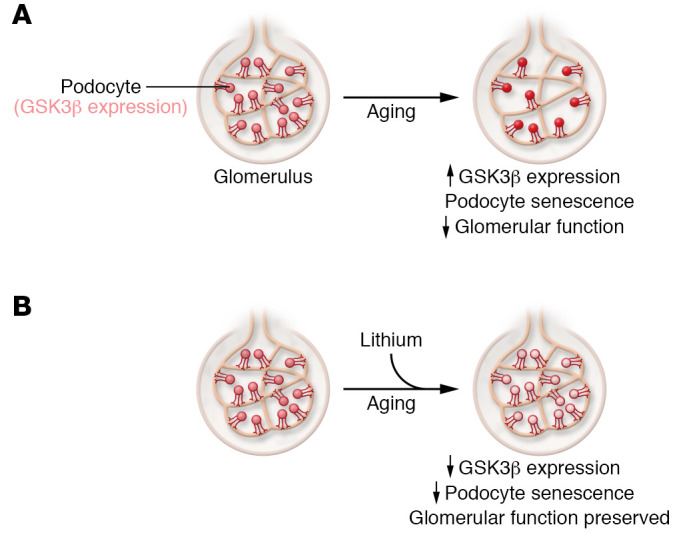
Kidney function decreases with age and may soon limit millions of lives as the proportion of the population over 70 years of age increases. Glycogen synthase kinase 3β (GSK3β) is involved with metabolism and may have a role in kidney senescence, positioning it as a target for complications from chronic kidney disease. However, different studies suggest GSK3 has contrasting effects. In this issue of the JCI, Fang et al. explored the function of GSK3β and the interplay with lithium using human tissue and mouse models. Notably, GSK3β was overexpressed and activated in aging mice, and depleting GSK3β reduced senescence and glomerular aging. In this Commentary, we explore the similarities and differences between Fang et al. and previous findings by Hurcombe et al. These findings should prompt further study of lithium and other GSK3β inhibitors as a means of extending glomerular function in individuals with chronic kidney disease.
肾功能随年龄增长而下降,随着 70 岁以上人口比例的增加,可能很快会限制数百万人的生命。糖原合成酶激酶 3β(GSK3β)参与代谢,可能在肾脏衰老中起作用,使其成为慢性肾脏病并发症的靶点。然而,不同的研究表明 GSK3 具有相反的作用。在本期 JCI 中,Fang 等人利用人体组织和小鼠模型探索了 GSK3β的功能及其与锂的相互作用。值得注意的是,GSK3β在衰老小鼠中过度表达和激活,而耗尽 GSK3β可减少衰老和肾小球老化。在这篇评论中,我们探讨了 Fang 等人的研究结果与 Hurcombe 等人之前的发现之间的异同。这些发现应该促使进一步研究锂和其他 GSK3β抑制剂,作为延长慢性肾脏病患者肾小球功能的一种手段。