Department of Oncology and Pathology, BioClinicum, Karolinska Institutet and Karolinska University Hospital, 17164 Stockholm, Sweden.
Kellogg Eye Center, Department of Ophthalmology and Visual Sciences, University of Michigan Medical School, Ann Arbor, MI 48105, USA.
J Clin Endocrinol Metab. 2022 Aug 8;107(Suppl_1):S1-S12. doi: 10.1210/clinem/dgac045.
Thyroid eye disease (TED) is a complex autoimmune disease process. Orbital fibroblasts represent the central orbital immune target. Involvement of the TSH receptor (TSHR) in TED is not fully understood. IGF-I receptor (IGF-IR) is overexpressed in several cell types in TED, including fibrocytes and orbital fibroblasts. IGF-IR may form a physical and functional complex with TSHR.
Review literature relevant to autoantibody generation in TED and whether these induce orbital fibroblast responses directly through TSHR, IGF-IR, or both.
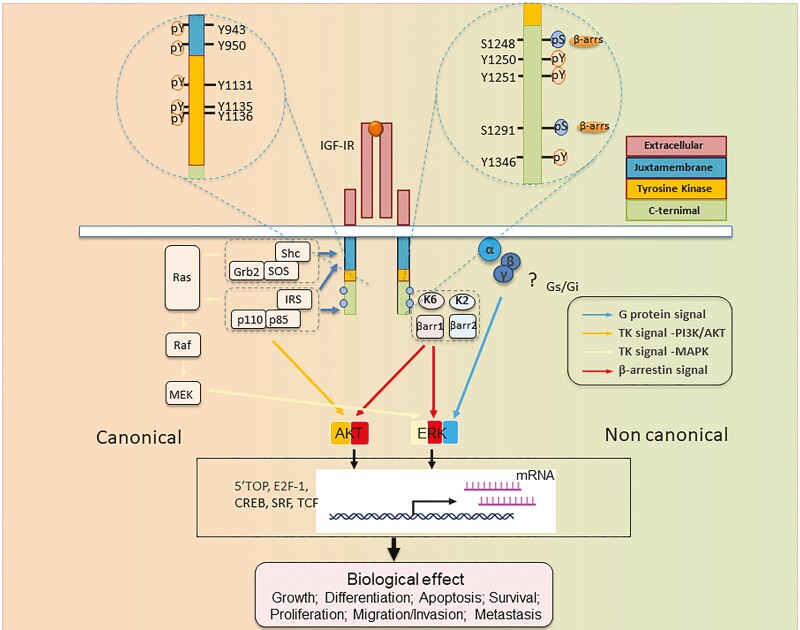
IGF-IR has traditionally been considered a typical tyrosine kinase receptor in which tyrosine residues become phosphorylated following IGF-I binding. Evidence has emerged that IGF-IR possesses kinase-independent activities and can be considered a functional receptor tyrosine kinase/G-protein-coupled receptor hybrid, using the G-protein receptor kinase/β-arrestin system. Teprotumumab, a monoclonal IGF-IR antibody, effectively reduces TED disease activity, proptosis, and diplopia. In addition, the drug attenuates in vitro actions of both IGF-I and TSH in fibrocytes and orbital fibroblasts, including induction of proinflammatory cytokines by TSH and TED IgGs.
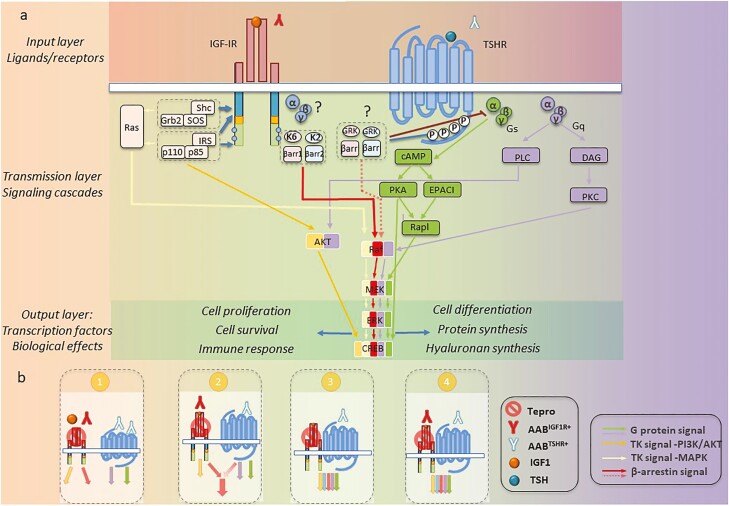
Although teprotumumab has been proven effective and relatively safe in the treatment of TED, many questions remain pertaining to IGF-IR, its relationship with TSHR, and how the drug might be disrupting these receptor protein/protein interactions. Here, we propose 4 possible IGF-IR activation models that could underlie clinical responses to teprotumumab observed in patients with TED. Teprotumumab is associated with several adverse events, including hyperglycemia and hearing abnormalities. Underpinning mechanisms of these are being investigated. Patients undergoing treatment with drug must be monitored for these and managed with best medical practices.
甲状腺眼病(TED)是一种复杂的自身免疫性疾病过程。眼眶成纤维细胞是眼眶内主要的免疫靶细胞。促甲状腺激素受体(TSHR)在 TED 中的作用尚未完全阐明。胰岛素样生长因子-I 受体(IGF-IR)在 TED 中的几种细胞类型中过度表达,包括纤维细胞和成纤维细胞。IGF-IR 可能与 TSHR 形成物理和功能复合物。
回顾与 TED 中自身抗体产生相关的文献,以及这些自身抗体是否通过 TSHR、IGF-IR 或两者直接诱导眼眶成纤维细胞反应。
IGF-IR 传统上被认为是一种典型的酪氨酸激酶受体,IGF-I 结合后酪氨酸残基发生磷酸化。有证据表明,IGF-IR 具有非激酶依赖性活性,可被视为功能性受体酪氨酸激酶/G 蛋白偶联受体杂合体,使用 G 蛋白受体激酶/β-抑制蛋白系统。特普罗鲁单抗是一种单克隆 IGF-IR 抗体,可有效降低 TED 疾病活动度、眼球突出度和复视。此外,该药物还可抑制纤维细胞和成纤维细胞中 IGF-I 和 TSH 的体外作用,包括 TSH 和 TED IgGs 诱导促炎细胞因子的产生。
尽管特普罗鲁单抗已被证明在 TED 的治疗中有效且相对安全,但关于 IGF-IR、它与 TSHR 的关系以及该药物如何破坏这些受体蛋白/蛋白相互作用仍有许多问题。在这里,我们提出了 4 种可能的 IGF-IR 激活模型,这些模型可能是 TED 患者对特普罗鲁单抗临床反应的基础。特普罗鲁单抗与多种不良反应相关,包括高血糖和听力异常。正在研究这些不良反应的潜在机制。正在接受药物治疗的患者必须对此类不良反应进行监测,并采用最佳的医疗实践进行管理。