Shrimp Jonathan H, Janiszewski John, Chen Catherine Z, Xu Miao, Wilson Kelli M, Kales Stephen C, Sanderson Philip E, Shinn Paul, Itkin Zina, Guo Hui, Shen Min, Klumpp-Thomas Carleen, Michael Samuel G, Zheng Wei, Simeonov Anton, Hall Matthew D
National Center for Advancing Translational Sciences, National Institutes of Health, Rockville, MD, 20850.
bioRxiv. 2022 Feb 7:2022.02.04.479134. doi: 10.1101/2022.02.04.479134.
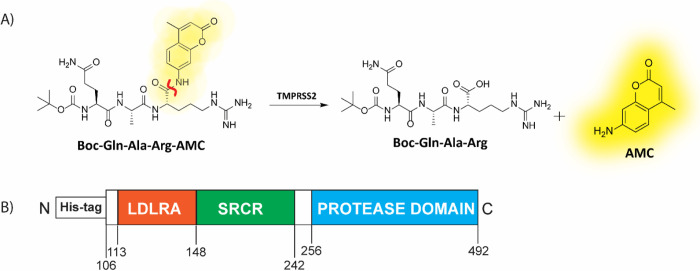
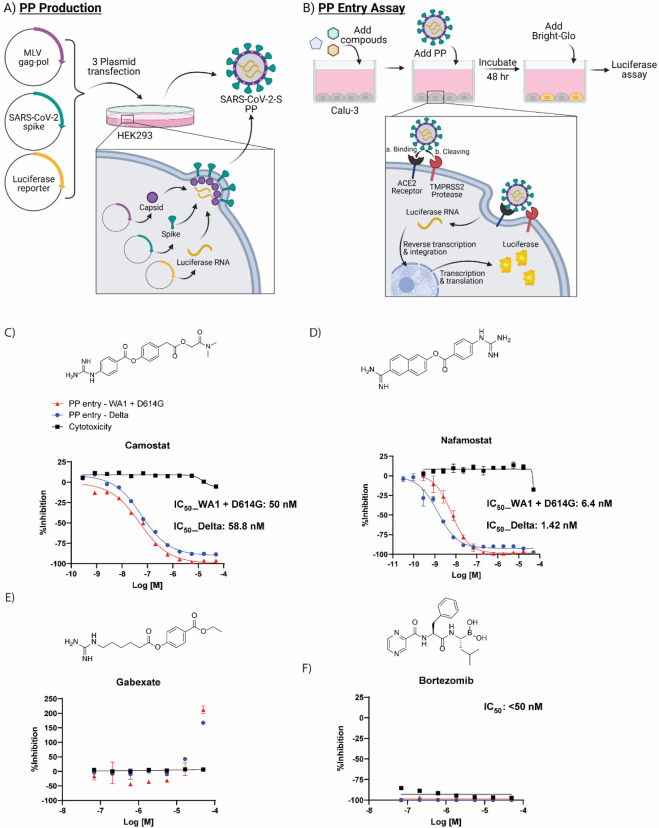
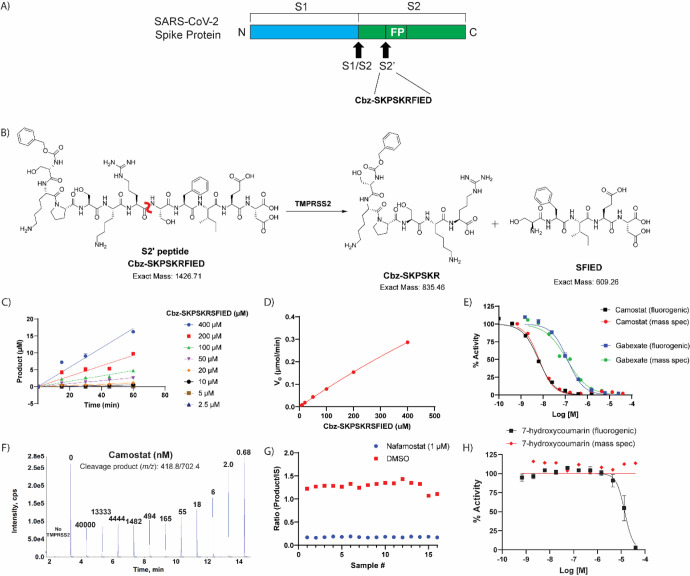
SARS-CoV-2 is the causative viral pathogen driving the COVID-19 pandemic that prompted an immediate global response to the development of vaccines and antiviral therapeutics. For antiviral therapeutics, drug repurposing allowed for rapid movement of existing clinical candidates and therapies into human clinical trials to be tested as COVID-19 therapies. One effective antiviral treatment strategy used early in symptom onset is to prevent viral entry. SARS-CoV-2 enters ACE2-expressing cells when the receptor-binding domain of the spike protein on the surface of SARS-CoV-2 binds to ACE2 followed by cleavage at two cut sites on the spike protein. TMPRSS2 has a protease domain capable of cleaving the two cut sites; therefore, a molecule capable of inhibiting the protease activity of TMPRSS2 could be a valuable antiviral therapy. Initially, we used a fluorogenic high-throughput screening assay for the biochemical screening of 6030 compounds in NCATS annotated libraries. Then, we developed an orthogonal biochemical assay that uses mass spectrometry detection of product formation to ensure that hits from the primary screen are not assay artifacts from the fluorescent detection of product formation. Finally, we assessed the hits from the biochemical screening in a cell-based SARS-CoV-2 pseudotyped particle entry assay. Of the six molecules advanced for further studies, two are approved drugs in Japan (camostat and nafamostat), two have entered clinical trials (PCI-27483 and otamixaban), while the other two molecules are peptidomimetic inhibitors of TMPRSS2 taken from the literature that have not advanced into clinical trials (compounds 92 and 114). This work demonstrates a suite of assays for the discovery and development of new inhibitors of TMPRSS2.
严重急性呼吸综合征冠状病毒2(SARS-CoV-2)是引发新型冠状病毒肺炎(COVID-19)大流行的致病性病毒病原体,这促使全球立即对疫苗和抗病毒疗法的研发做出反应。对于抗病毒疗法,药物重新利用使得现有的临床候选药物和疗法能够迅速进入人体临床试验,作为COVID-19疗法进行测试。症状出现早期使用的一种有效的抗病毒治疗策略是阻止病毒进入。当SARS-CoV-2表面刺突蛋白的受体结合结构域与血管紧张素转换酶2(ACE2)结合,随后在刺突蛋白的两个切割位点进行切割时,SARS-CoV-2进入表达ACE2的细胞。跨膜丝氨酸蛋白酶2(TMPRSS2)具有能够切割这两个切割位点的蛋白酶结构域;因此,一种能够抑制TMPRSS2蛋白酶活性的分子可能是一种有价值的抗病毒疗法。最初,我们使用荧光高通量筛选试验对美国国立转化医学推进中心(NCATS)注释文库中的6030种化合物进行生化筛选。然后,我们开发了一种正交生化试验,该试验使用质谱检测产物形成,以确保初次筛选中的命中结果不是产物形成荧光检测产生的检测假象。最后,我们在基于细胞的SARS-CoV-2假型颗粒进入试验中评估了生化筛选的命中结果。在推进进一步研究的六个分子中,两个是日本的获批药物(卡莫司他和那法莫司他),两个已进入临床试验(PCI-27483和奥他米班),而另外两个分子是从文献中获取的尚未进入临床试验的TMPRSS2拟肽抑制剂(化合物92和114)。这项工作展示了一套用于发现和开发TMPRSS2新抑制剂的试验方法。