Department of Gastroenterology, First People's Hospital Affiliated to Huzhou Normal College, Huzhou, Zhejiang, China (mainland).
Department of General Surgery, First People's Hospital Affiliated to Huzhou Normal College, Huzhou, Zhejiang, China (mainland).
Med Sci Monit. 2022 Feb 21;28:e935936. doi: 10.12659/MSM.935936.
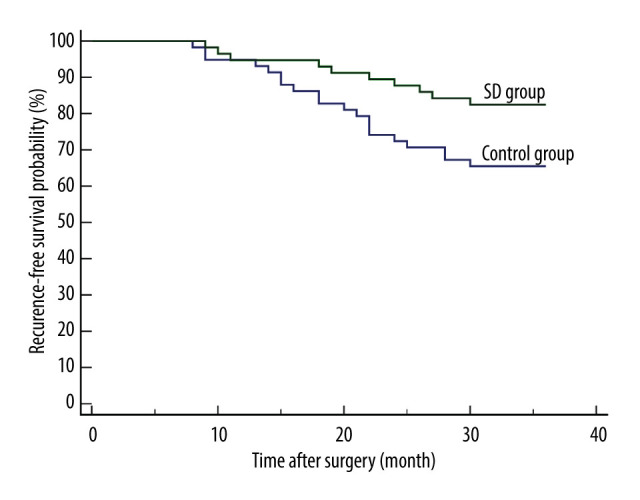
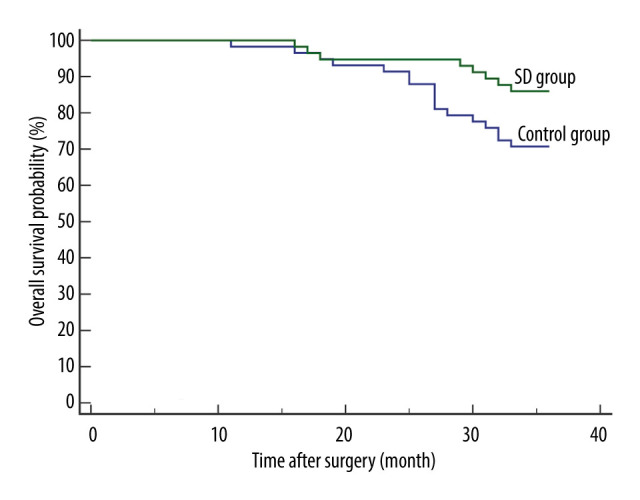
BACKGROUND Myelosuppression is one of the most common chemotherapy-induced adverse events and results in a series of clinical symptoms. This study aimed to evaluate the effect of Shengbai decoction (SD) on chemotherapy-induced myelosuppression and survival of gastric cancer (GC) patients after radical resection. MATERIAL AND METHODS We retrospectively analyzed data from 115 patients with stage II-III GC who underwent adjuvant chemotherapy after radical resection between May 2015 and June 2017 in our hospital. Among these patients, 57 received Shengbai decoction along with adjuvant chemotherapy (SD group), while 58 received adjuvant chemotherapy alone (control group). Medical records, including adverse events, the treatment completion rate of adjuvant chemotherapy, 3-year overall survival (OS), and 3-year recurrence-free survival (RFS), were compared. RESULTS Patient characteristics did not differ significantly between the 2 groups. No adverse events related to Shengbai decoction were reported in the SD group. Patients in the SD group had less neutropenia (P=0.0430), thrombocytopenia (P=0.0323), and anemia (P=0.0497). The SD group had a significantly lower probability of dose reduction (P=0.0448). The completion rate of adjuvant chemotherapy of the SD group was considerably higher than that of the control group (P=0.0398). The SD group had a significantly better 3-year RFS (P=0.0369) and 3-year OS (P=0.0455) than the control group. CONCLUSIONS Shengbai decoction effectively improved postoperative survival of patients with GC by alleviating chemotherapy-induced myelosuppression and improving the completion rate of adjuvant chemotherapy.
骨髓抑制是化疗最常见的不良反应之一,可导致一系列临床症状。本研究旨在评估生白汤(SD)对胃癌(GC)根治术后辅助化疗所致骨髓抑制及患者生存的影响。
我们回顾性分析了 2015 年 5 月至 2017 年 6 月期间我院收治的 115 例 II-III 期 GC 根治术后接受辅助化疗的患者数据。其中 57 例接受生白汤联合辅助化疗(SD 组),58 例接受单纯辅助化疗(对照组)。比较两组的不良反应、辅助化疗完成率、3 年总生存(OS)和 3 年无复发生存(RFS)等。
两组患者的特征无显著差异。SD 组未报告与生白汤相关的不良反应。SD 组患者中性粒细胞减少(P=0.0430)、血小板减少(P=0.0323)和贫血(P=0.0497)发生率较低,剂量减少的概率显著降低(P=0.0448)。SD 组辅助化疗完成率明显高于对照组(P=0.0398)。SD 组 3 年 RFS(P=0.0369)和 3 年 OS(P=0.0455)明显优于对照组。
生白汤可通过减轻化疗引起的骨髓抑制,提高辅助化疗完成率,有效改善 GC 患者的术后生存。