Unit of Infectious Diseases, Hospital Universitario "12 de Octubre", Instituto de Investigación Sanitaria Hospital "12 de Octubre" (imas12), Madrid, Spain.
Centro de Investigación Biomédica en Red (CIBER) de Enfermedades Infecciosas, Madrid, Spain.
Transpl Int. 2022 Jan 20;35:10273. doi: 10.3389/ti.2021.10273. eCollection 2021.
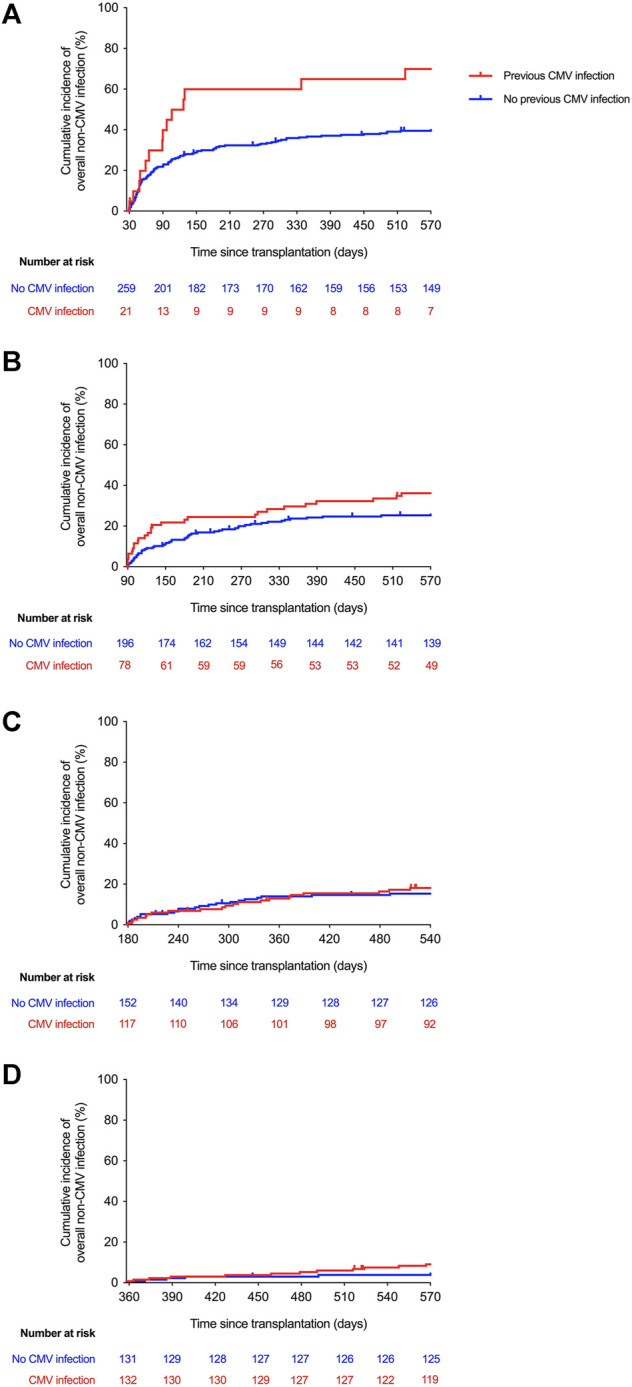
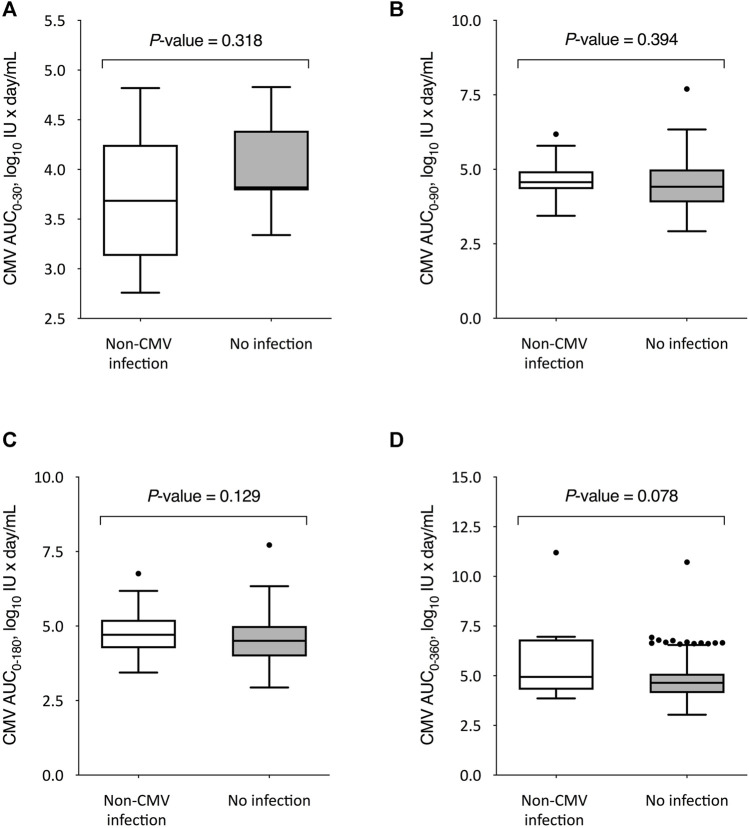
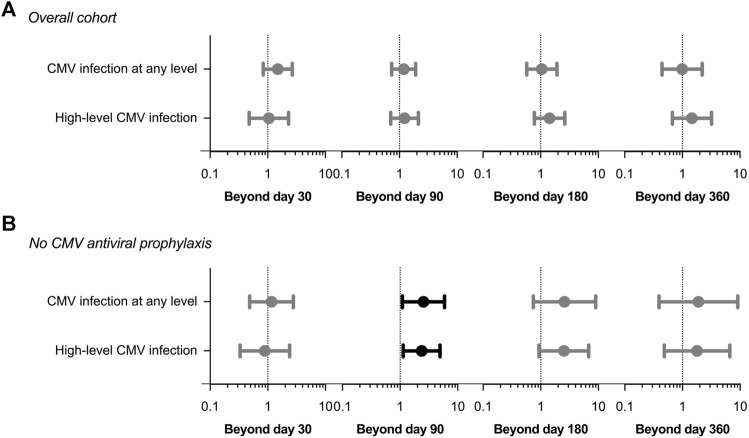
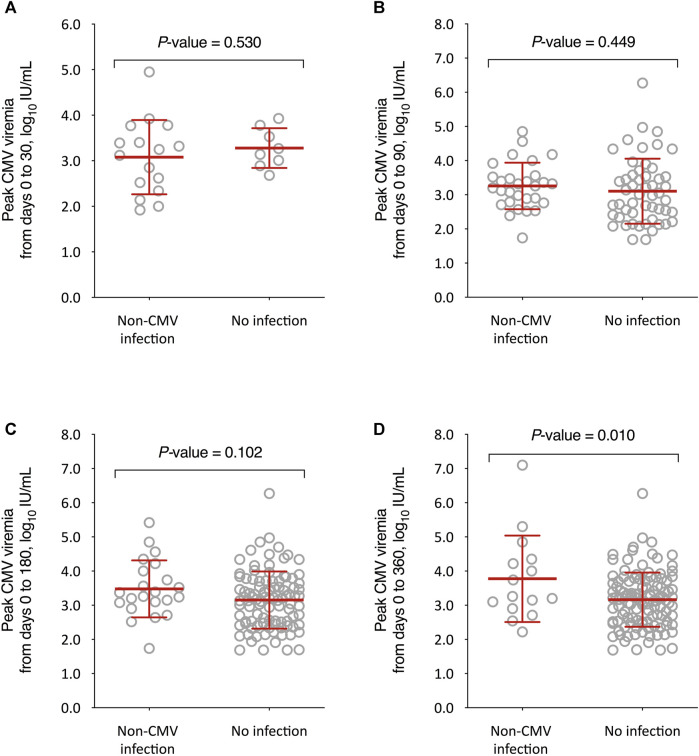
Previous reports hypothesized that cytomegalovirus (CMV) may predispose to non-CMV infection after kidney transplantation (KT). We analysed the incidence of non-CMV infection (overall, bacterial and opportunistic) in 291 KT recipients according to the previous development of any level or high-level (≥1,000 IU/ml) CMV viremia. Exposure to CMV replication was assessed throughout fixed intervals covering first the 30, 90, 180 and 360 post-transplant days (cumulative exposure) and non-overlapping preceding periods (recent exposure). Adjusted Cox models were constructed for each landmark analysis. Overall, 67.7 and 50.5% patients experienced non-CMV and CMV infection, respectively. Patients with cumulative CMV exposure had higher incidence of non-CMV infection beyond days 30 (-value = 0.002) and 90 (-value = 0.068), although these associations did not remain after multivariable adjustment. No significant associations were observed for the remaining landmark models (including those based on high-level viremia or recent CMV exposure), or when bacterial and opportunistic infection were separately analysed. There were no differences in viral kinetics (peak CMV viremia and area under curve of CMV viral load) either. Our findings do not support the existence of an independent association between previous CMV exposure and the overall risk of post-transplant infection, although results might be affected by power limitations.
先前的报告假设巨细胞病毒(CMV)可能使肾移植(KT)后发生非 CMV 感染的风险增加。我们根据任何水平或高水平(≥1,000 IU/ml)CMV 病毒血症的先前发展,分析了 291 例 KT 受者中非 CMV 感染(整体、细菌和机会性)的发生率。通过在移植后第 30、90、180 和 360 天(累积暴露)和非重叠的先前时期(最近暴露)的固定间隔内评估 CMV 复制的暴露情况。为每个里程碑分析构建了调整后的 Cox 模型。总体而言,分别有 67.7%和 50.5%的患者经历了非 CMV 和 CMV 感染。具有累积 CMV 暴露的患者在第 30 天(-值 = 0.002)和第 90 天(-值 = 0.068)之后发生非 CMV 感染的发生率更高,但这些关联在多变量调整后并不存在。对于其余的里程碑模型(包括基于高水平病毒血症或最近 CMV 暴露的模型),或当单独分析细菌和机会性感染时,没有观察到显著的关联。病毒动力学(CMV 病毒血症峰值和 CMV 病毒载量曲线下面积)也没有差异。我们的研究结果不支持先前的 CMV 暴露与移植后感染的总体风险之间存在独立关联,尽管结果可能受到功效限制的影响。