Fukaya Taizan, Konrad Andreas, Sato Shigeru, Kiyono Ryosuke, Yahata Kaoru, Yasaka Koki, Onuma Remi, Yoshida Riku, Nakamura Masatoshi
Institute for Human Movement and Medical Sciences, Niigata University of Health and Welfare, Niigata, Japan.
Department of Rehabilitation, Kyoto Kujo Hospital, Kyoto, Japan.
Front Physiol. 2022 Feb 4;12:764792. doi: 10.3389/fphys.2021.764792. eCollection 2021.
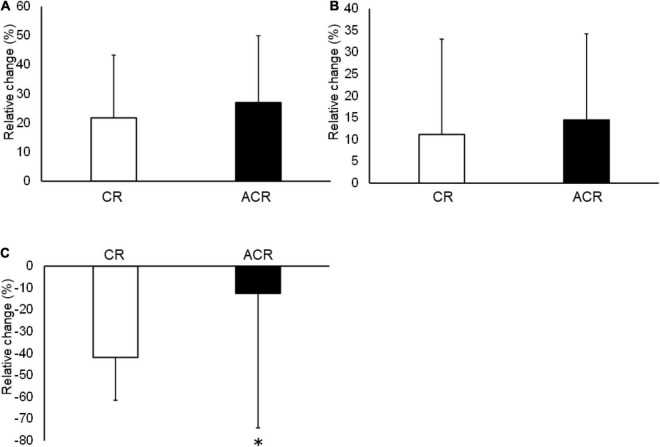
Antagonist contract-relax stretching and contract-relax stretching is commonly used in sports practice and rehabilitation settings. To date, no study has compared these modalities regarding muscle stiffness and stretch tolerance. This study aimed to investigate the effects of contract-relax and antagonist contract-relax stretching on dorsiflexion range of motion (ROM), stretch tolerance, and shear elastic modulus. Forty healthy participants (24 men and 16 women) took part in the study. Participants were randomly assigned to perform either contract-relax stretching or antagonist contract-relax stretching for 2 min. Outcomes were assessed on ROM, stretch tolerance, and shear elastic modulus before and after stretching. The ROM and stretch tolerance significantly increased after both contract-relax stretching (+ 5.4 ± 5.8°, < 0.05; + 3.5 ± 8.0 Nm, < 0.05) and antagonist contract-relax stretching (+ 6.1 ± 4.9°, < 0.05; + 4.2 ± 6.4 Nm, < 0.05); however, no significant difference was found between the two groups. Alternatively, the shear elastic modulus significantly decreased after both contract-relax (-31.1 ± 22.6 kPa, < 0.05) and antagonist contract-relax stretching (-11.1 ± 22.3 kPa, < 0.05); however, contract-relax stretching (-41.9 ± 19.6%) was more effective than antagonist contract-relax stretching (-12.5 ± 61.6%). The results of this study suggest that contract-relax stretching instead of antagonist contract-relax stretching should be conducted to decrease muscle stiffness. However, either contract-relax or antagonist contract-relax stretching can increase ROM.
拮抗肌收缩-放松拉伸和收缩-放松拉伸常用于运动实践和康复环境中。迄今为止,尚无研究比较这两种方式在肌肉僵硬度和拉伸耐受性方面的差异。本研究旨在探讨收缩-放松和拮抗肌收缩-放松拉伸对背屈活动度(ROM)、拉伸耐受性和剪切弹性模量的影响。40名健康参与者(24名男性和16名女性)参与了本研究。参与者被随机分配进行2分钟的收缩-放松拉伸或拮抗肌收缩-放松拉伸。在拉伸前后评估ROM、拉伸耐受性和剪切弹性模量等指标。收缩-放松拉伸(+5.4±5.8°,P<0.05;+3.5±8.0 Nm,P<0.05)和拮抗肌收缩-放松拉伸(+6.1±4.9°,P<0.05;+4.2±6.4 Nm,P<0.05)后,ROM和拉伸耐受性均显著增加;然而,两组之间未发现显著差异。另外,收缩-放松拉伸(-31.1±22.6 kPa,P<0.05)和拮抗肌收缩-放松拉伸(-11.1±22.3 kPa,P<0.05)后,剪切弹性模量均显著降低;然而,收缩-放松拉伸(-41.9±19.6%)比拮抗肌收缩-放松拉伸(-12.5±61.6%)更有效。本研究结果表明,应进行收缩-放松拉伸而非拮抗肌收缩-放松拉伸以降低肌肉僵硬度。然而,收缩-放松或拮抗肌收缩-放松拉伸均可增加ROM。