Department of Orthopedics and Rehabilitation, University of Iowa Hospitals and Clinics, Iowa City, IA, United States.
Orthopedic Biomechanics Laboratories, Department of Orthopedics and Rehabilitation, University of Iowa Hospitals and Clinics, Iowa City, IA, United States.
Front Endocrinol (Lausanne). 2022 Feb 4;13:827512. doi: 10.3389/fendo.2022.827512. eCollection 2022.
The aim of this review is to assess the current evidence regarding the impact of relaxin on incidence of soft tissue hip injuries in women.
A trained research librarian assisted with searches of PubMed, Embase, CINAHL, and SPORTDiscus, with a preset English language filter. The review was completed per the Joanna Briggs Institute (JBI) Manual for Evidence Synthesis methodology. Included studies required assessment of relaxin effects on musculoskeletal health, pelvic girdle stability, or hip joint structures in human subjects. Letters, texts, and opinion papers were excluded.
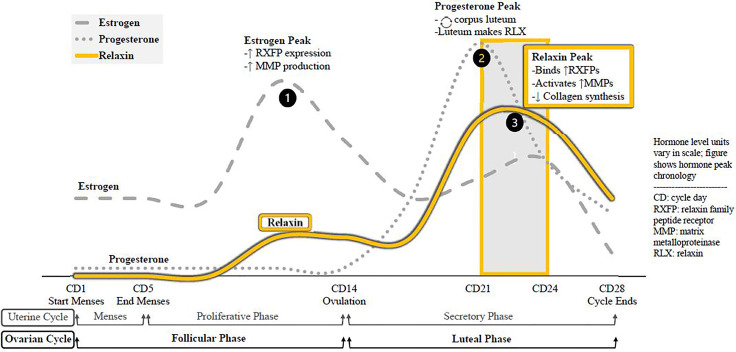
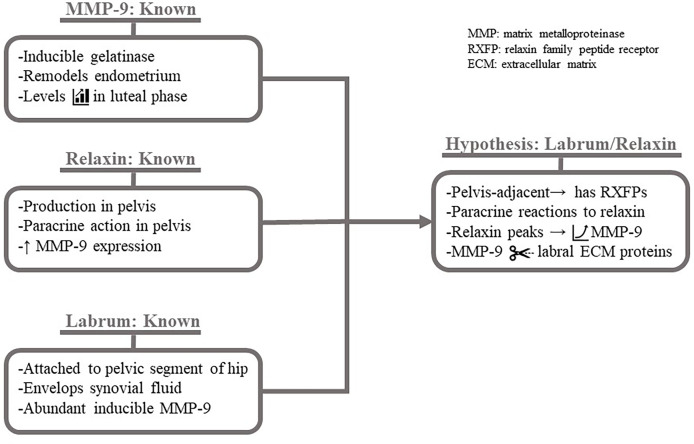
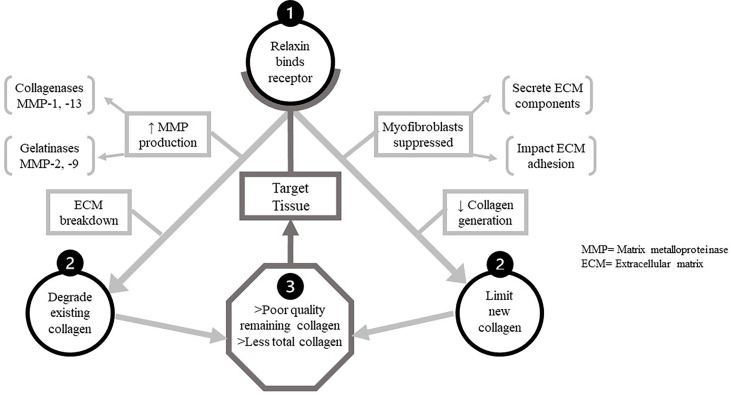
Our screen yielded 82 studies. Molecularly, relaxin activates matrix metalloproteinases (MMPs) including collagenases MMP-1/-13 and gelatinases MMP-2/-9 to loosen pelvic ligaments for parturition. However, relaxin receptors have also been detected in female periarticular tissues, such as the anterior cruciate ligament, which tears significantly more often during the menstrual cycle peak of relaxin. Recently, high concentrations of relaxin-activated MMP-9 receptors have been found on the acetabular labrum; their expression upregulated by estrogen.
Menstrual cycle peaks of relaxin activate MMPs, which locally degrade collagen and gelatine. Women have relaxin receptors in multiple joints including the hip and knee, and increased relaxin correlates with increased musculoskeletal injuries. Relaxin has paracrine effects in the female pelvis on ligaments adjacent to hip structures, such as acetabular labral cells which express high levels of relaxin-targeted MMPs. Therefore, it is imperative to investigate the effect of relaxin on the hip to determine if increased levels of relaxin are associated with an increased risk of acetabular labral tears.
本综述旨在评估松弛素对女性髋关节软组织损伤发生率影响的现有证据。
一名经过培训的研究图书管理员协助检索了 PubMed、Embase、CINAHL 和 SPORTDiscus,并使用了预设的英语语言过滤器。综述按照 Joanna Briggs 研究所(JBI)证据综合手册方法进行。纳入的研究需要评估松弛素对肌肉骨骼健康、骨盆带稳定性或人类髋关节结构的影响。信件、文本和意见论文被排除在外。
我们的筛选结果产生了 82 项研究。从分子水平上看,松弛素激活基质金属蛋白酶(MMPs),包括胶原蛋白酶 MMP-1/-13 和明胶酶 MMP-2/-9,以疏松骨盆韧带,为分娩做准备。然而,松弛素受体也已在女性关节周围组织中被检测到,例如前交叉韧带,在前交叉韧带在松弛素的月经周期高峰期撕裂的情况更为明显。最近,在髋臼唇上发现了大量松弛素激活的 MMP-9 受体;其表达受雌激素上调。
松弛素的月经周期高峰激活 MMPs,这些 MMPs可局部降解胶原蛋白和明胶。女性在多个关节中都有松弛素受体,包括髋关节和膝关节,而松弛素的增加与肌肉骨骼损伤的增加相关。松弛素在女性骨盆中的旁分泌作用影响邻近髋关节结构的韧带,例如髋臼唇细胞,这些细胞表达高水平的松弛素靶向 MMPs。因此,有必要研究松弛素对髋关节的影响,以确定松弛素水平的增加是否与髋臼唇撕裂的风险增加有关。