Stagliano David R, Kuo Huai-Ching, Fraser Jamie A, Mitra Indrani, Garges Eric C, Riddle Mark S, Tribble David R, Hickey Patrick W
Department of Pediatrics, Walter Reed National Military Medical Center, Bethesda, Maryland.
Department of Pediatrics, Uniformed Services University of the Health Sciences, Bethesda, Maryland.
Am J Trop Med Hyg. 2022 Feb 21;106(4):1156-1162. doi: 10.4269/ajtmh.21-1037. Print 2022 Apr 6.
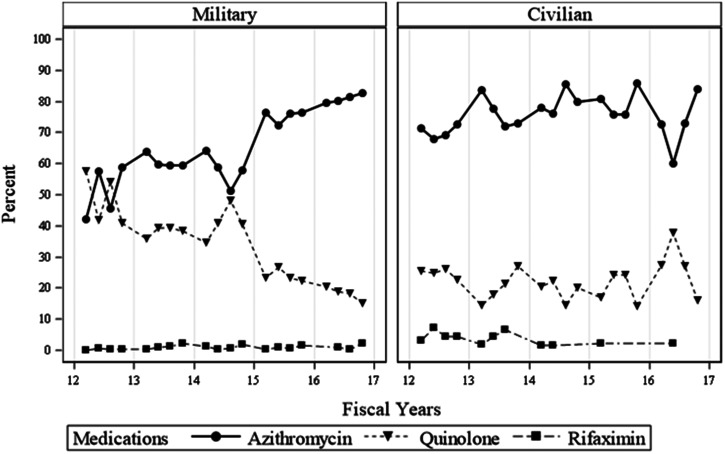
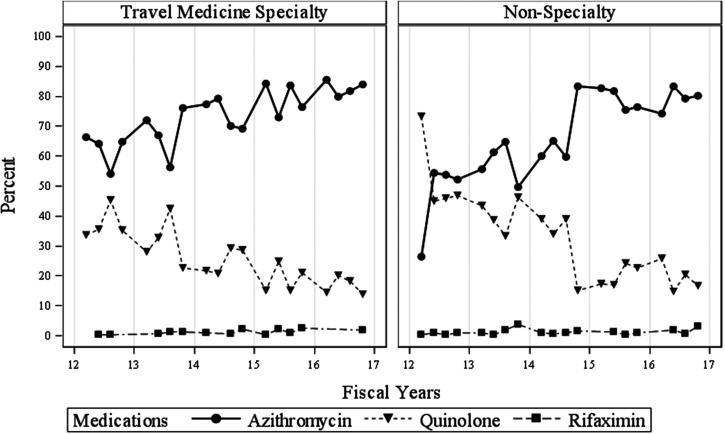
The Deployment and Travel Medicine Knowledge, Attitude, Practice and Outcomes Study investigates the various clinician and traveler contributions to medical outcomes within the U.S. Military Health System. Travelers' diarrhea is among the most common travel-related illnesses, making travelers' diarrhea self-treatment (TDST) important for traveler health. A cohort of 80,214 adult travelers receiving malaria chemoprophylaxis for less than 6 weeks of travel were identified within the U.S. Department of Defense Military Health System Data Repository. Associated prescriptions for TDST medications within 2 weeks of chemoprophylaxis prescriptions were identified. Prescription patterns were compared by service member versus beneficiary status and site of care, military facility versus civilian facility. At military facilities, medical provider demographics were analyzed by clinical specialty and categorized as travel medicine specialists versus nonspecialists. Overall, there was low prescribing of TDST, particularly among civilian providers and military nonspecialists, despite guidelines recommending self-treatment of moderate to severe travelers' diarrhea. This practice gap was largest among service member travelers, but also existed for beneficiaries. Compared with nonspecialists, military travel medicine specialists were more likely to prescribe a combination of an antibiotic and antimotility agent to beneficiaries, more likely to provide any form of TDST to service members, and more likely to prescribe azithromycin than quinolones when using antibiotics. Our study suggests that enhancing provider knowledge and use of travelers' diarrhea treatment recommendations combined with improved access to formal travel medicine services may be important to increase the quality of care.
部署与旅行医学知识、态度、实践及结果研究调查了美国军事卫生系统内临床医生和旅行者对医疗结果的各种贡献。旅行者腹泻是最常见的与旅行相关的疾病之一,因此旅行者腹泻自我治疗(TDST)对旅行者健康至关重要。在美国国防部军事卫生系统数据存储库中,确定了一组80214名成年旅行者,他们接受了少于6周旅行期的疟疾化学预防。确定了在化学预防处方开出后2周内开具的TDST药物相关处方。按军人与受益人的身份以及护理地点(军事设施与民用设施)对处方模式进行了比较。在军事设施中,按临床专业对医疗服务提供者的人口统计学特征进行了分析,并分为旅行医学专家和非专家。总体而言,TDST的处方率较低,尤其是在民用医疗服务提供者和军事非专家中,尽管指南建议对中度至重度旅行者腹泻进行自我治疗。这种实践差距在军人旅行者中最大,但在受益人中也存在。与非专家相比,军事旅行医学专家更有可能为受益人开具抗生素和抗动力药物的组合,更有可能为军人提供任何形式的TDST,并且在使用抗生素时更有可能开具阿奇霉素而非喹诺酮类药物。我们的研究表明,提高医疗服务提供者对旅行者腹泻治疗建议的认识和应用,以及改善获得正规旅行医学服务的机会,可能对提高医疗质量很重要。