Departments of Medicine and Surgery, Duke Cancer Institute, Duke University, Durham, NC, USA.
Huntsman Cancer Institute, University of Utah, Salt Lake City, UT, USA.
Prostate Cancer Prostatic Dis. 2022 Feb;25(2):306-313. doi: 10.1038/s41391-021-00488-0. Epub 2022 Feb 21.
The real-world EPIX study was conducted to gather information about the characteristics of patients with metastatic castration-resistant prostate cancer (mCRPC) who survived ≥2 years after treatment with the alpha-emitter radium-223.
This retrospective study of electronic health records in the US Flatiron database (NCT04516161) included patients with mCRPC treated with radium-223 between January 2013 and June 2019. Median overall survival (OS) and prostate-specific antigen (PSA) response (≥50% reduction) from start of radium-223 treatment were the primary and secondary endpoints, respectively. Patient characteristics were compared between those who survived ≥2 years versus <2 years, including a subgroup who survived <6 months.
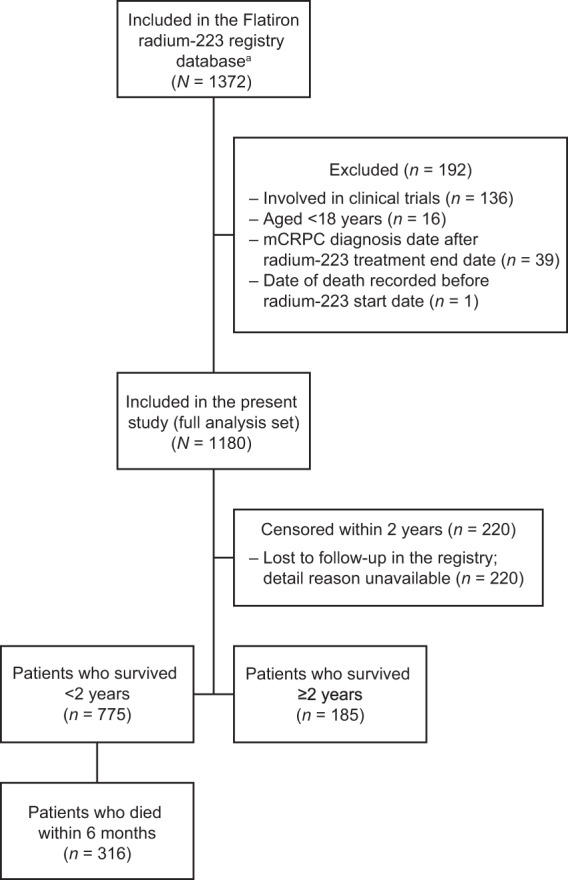
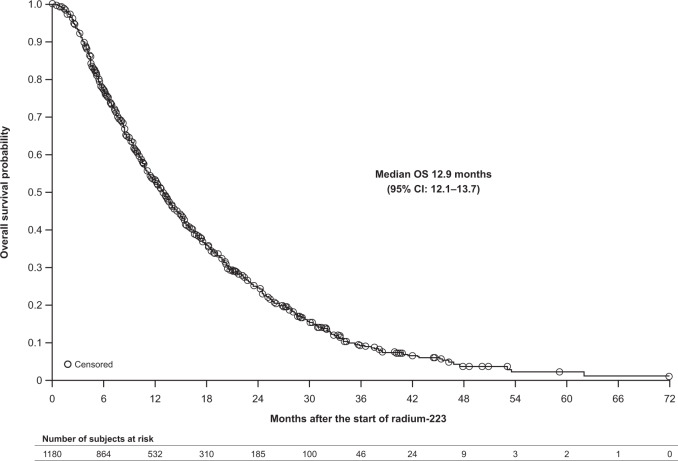
In the 1180 patients identified, median OS was 12.9 months (95% CI: 12.1-13.7), and 13% of patients with data at 6 months had a PSA response. The survival groups included 775 patients (65.7%) who survived <2 years (including 264 (22.4%) who survived <6 months) and 185 patients (15.7%) who survived ≥2 years; 220 patients (18.6%) had incomplete follow-up data and were censored. On multivariate analysis, age >75 years, Eastern Cooperative Oncology Group performance status (ECOG PS) 2-4, visceral metastases, prior symptomatic skeletal events (SSEs), and prior chemotherapy were independently prognostic of reduced OS. For patients with survival ≥2 years versus <2 years, median age was 71 versus 75 years, 4% versus 14% had ECOG PS 2-4, 4% versus 10% had visceral metastases, 38% versus 44% had prior SSEs, and 16% versus 32% had prior chemotherapy.
In this study of men with mCRPC treated in real-world clinical practice, median OS was consistent with that seen in the phase 3 ALSYMPCA trial. Patients who survived ≥2 years after the start of radium-223 were younger and had better ECOG PS, lower disease burden, and less use of prior chemotherapy than those who survived <2 years.
真实世界 EPIX 研究旨在收集接受α发射体镭-223 治疗后生存≥2 年的转移性去势抵抗性前列腺癌(mCRPC)患者特征的信息。
这项在美国 Flatiron 数据库(NCT04516161)中进行的回顾性电子健康记录研究纳入了 2013 年 1 月至 2019 年 6 月期间接受镭-223 治疗的 mCRPC 患者。主要终点为中位总生存期(OS)和前列腺特异性抗原(PSA)应答(≥50%下降),次要终点为开始镭-223 治疗后的中位 OS 和 PSA 应答(≥50%下降)。分别比较了生存≥2 年和<2 年患者的特征,包括生存<6 个月的亚组。
在确定的 1180 名患者中,中位 OS 为 12.9 个月(95%CI:12.1-13.7),6 个月时 PSA 应答率为 13%。生存组包括 775 名(65.7%)生存<2 年(包括 264 名(22.4%)生存<6 个月)和 185 名(15.7%)生存≥2 年;220 名(18.6%)患者随访数据不完整,被删失。多变量分析显示,年龄>75 岁、东部肿瘤协作组体能状态(ECOG PS)2-4、内脏转移、既往有症状性骨骼事件(SSEs)和既往化疗是 OS 降低的独立预后因素。与生存<2 年相比,生存≥2 年的患者中位年龄为 71 岁(71 岁)比 75 岁(75 岁),4%(4%)ECOG PS 2-4,4%(4%)有内脏转移,38%(38%)有既往 SSEs,16%(16%)有既往化疗。
在这项真实世界临床实践中接受 mCRPC 治疗的男性中,中位 OS 与 III 期 ALSYMPCA 试验一致。与生存<2 年的患者相比,开始接受镭-223 治疗后生存≥2 年的患者年龄较小,ECOG PS 较好,疾病负担较低,且较少使用既往化疗。