Department of Biology, University of Winnipeg, Winnipeg, MB, R3B 2E9, Canada.
BMC Ecol Evol. 2022 Feb 23;22(1):20. doi: 10.1186/s12862-022-01975-1.
The rapid evolution of seminal fluid proteins (SFPs) has been suggested to be driven by adaptations to postcopulatory sexual selection (e.g. sperm competition). However, we have recently shown that most SFPs evolve rapidly under relaxed selective pressures. Given the role of SFPs in competition for fertilization phenotypes, like the ability to transfer and store sperm and the modulation of female receptivity and ovulation, the prevalence of selectively relaxed SFPs appears as a conundrum. One possible explanation is that selection on SFPs might be relaxed in terms of protein amino acid content, but adjustments of expression are essential for post-mating function. Interestingly, there is a general lack of systematic implementation of gene expression perturbation assays to monitor their effect on phenotypes related to sperm competition.
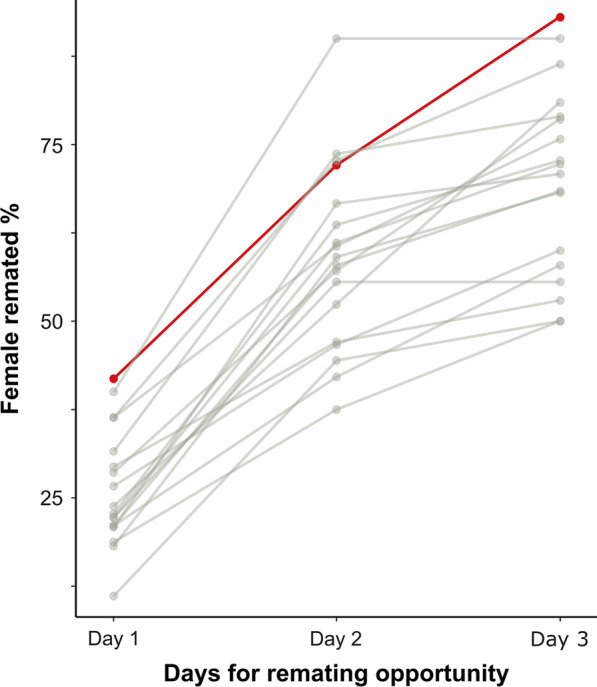
We successfully manipulated the expression of 16 SFP encoding genes using tissue-specific knockdowns (KDs) and determined the effect of these genes' perturbation on three important post-mating phenotypes: female refractoriness to remating, defensive (P1), and offensive (P2) sperm competitive abilities in Drosophila melanogaster. Our analyses show that KDs of tested SFP genes do not affect female refractoriness to remating and P2, however, most gene KDs significantly decreased P1. Moreover, KDs of SFP genes that are selectively constrained in terms of protein-coding sequence evolution have lower P1 than KDs of genes evolving under relaxed selection.
Our results suggest a more predominant role, than previously acknowledged, of variation in gene expression than coding sequence changes on sperm competitive ability in D. melanogaster.
精液蛋白(SFPs)的快速进化被认为是由适应交配后性选择(如精子竞争)驱动的。然而,我们最近表明,在放松的选择压力下,大多数 SFPs 进化得很快。鉴于 SFPs 在竞争受精表型中的作用,如转移和储存精子的能力以及调节雌性接受度和排卵的能力,选择性放松的 SFPs 的普遍性似乎是一个难题。一种可能的解释是,SFPs 的选择可能在蛋白质氨基酸含量方面放松,但表达的调整对于交配后的功能是必要的。有趣的是,缺乏系统地实施基因表达扰动测定来监测它们对与精子竞争相关的表型的影响。
我们成功地使用组织特异性敲低(KDs)来操纵 16 个 SFP 编码基因的表达,并确定了这些基因的扰动对三个重要的交配后表型的影响:雌性对再交配的抗性、防御性(P1)和攻击性(P2)在黑腹果蝇中的精子竞争能力。我们的分析表明,测试的 SFP 基因的 KDs 不会影响雌性对再交配的抗性和 P2,但大多数基因的 KDs 显著降低了 P1。此外,在蛋白质编码序列进化方面受到选择性约束的 SFP 基因的 KDs 比在放松选择下进化的基因的 KDs 具有更低的 P1。
我们的结果表明,在黑腹果蝇的精子竞争能力中,基因表达的变化比编码序列变化起着更为重要的作用,这比以前的认识更为重要。