Mrohs Tim B, Weichold Oliver
Institute of Building Materials Research, RWTH Aachen University, Schinkelstraße 3, 52062 Aachen, Germany.
Gels. 2022 Feb 8;8(2):100. doi: 10.3390/gels8020100.
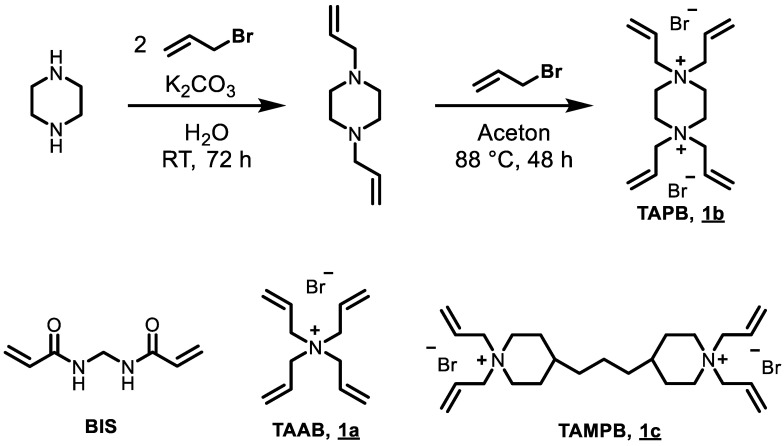
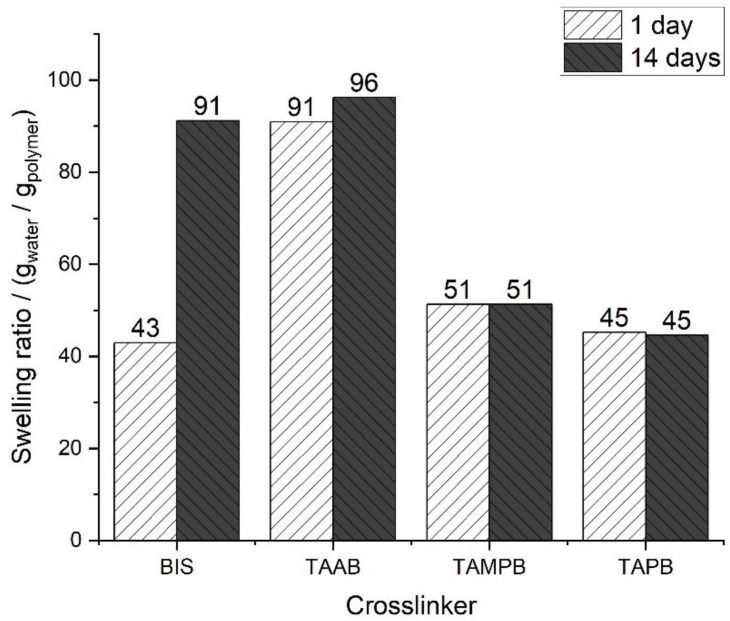
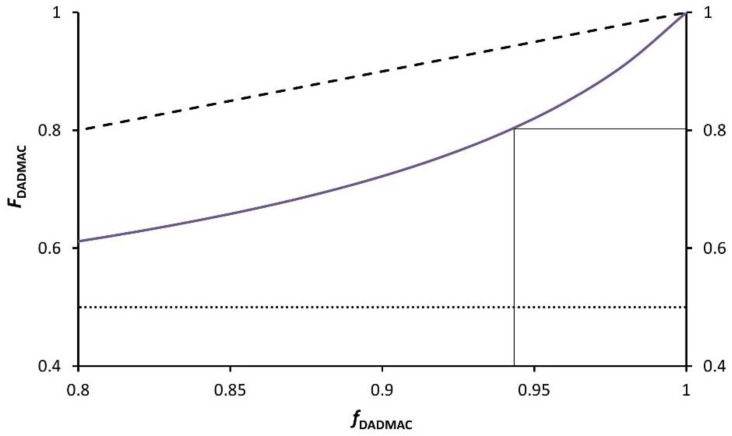
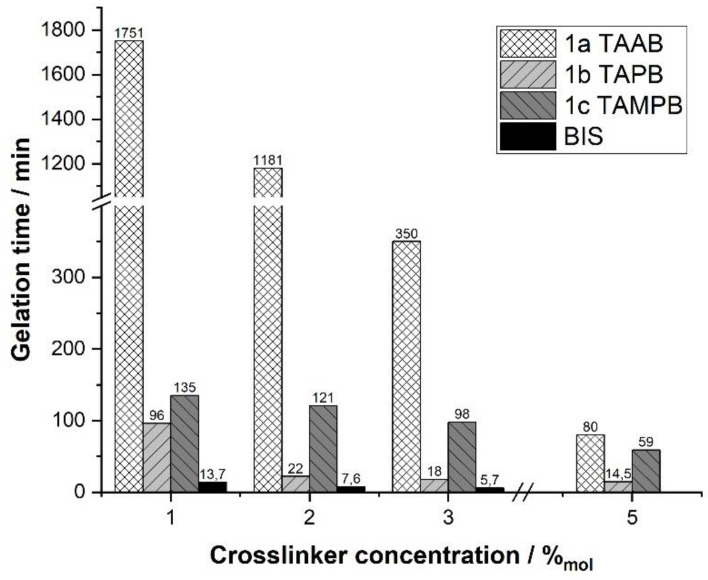
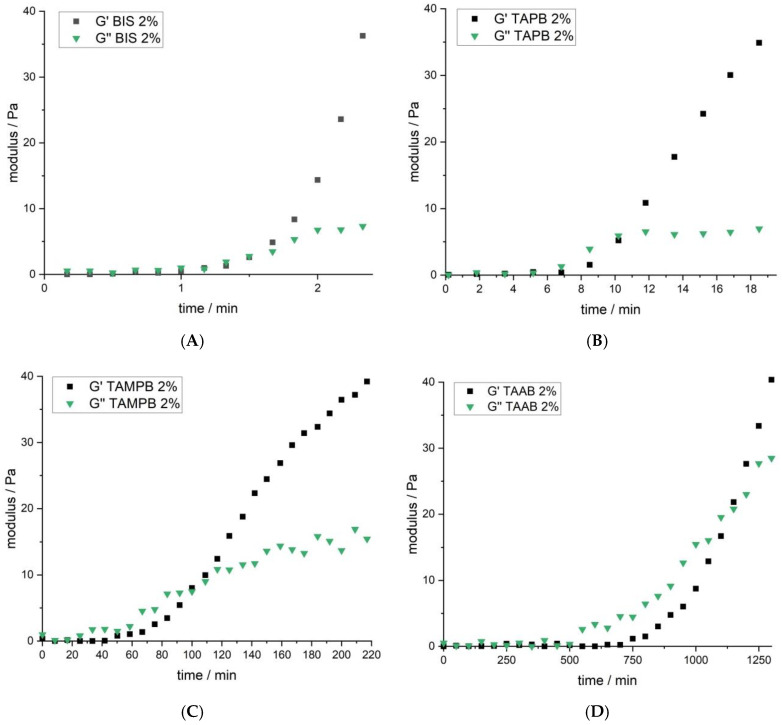
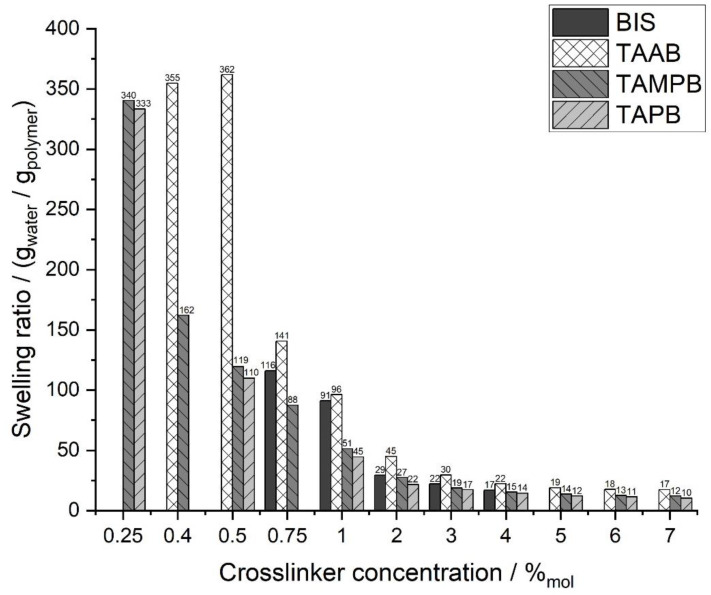
,-methylenebisacrylamide (BIS) is a very popular cross-linker for the radical polymerisation in water. It is highly reactive but prone to alkaline hydrolysis and suffers from a low solubility. This study shows that with slow polymerising systems such as ,-diallyldimethylammonium chloride, only inhomogeneous networks are formed. As a consequence, gels with very low cross-linking densities, i.e., high swelling capacities, disintegrate during the swelling test and firm, coherent gels are not accessible due to the solubility limit. A promising alternative are multivalent tetraallyl-based compounds, of which tetraallylammonium bromide (TAAB), ,,','-tetraallylpiperazinium dibromide (TAPB) and ,,','-tetraallyltrimethylene dipiperidine dibromide (TAMPB) are the subject of this study. With these, the cross-linking polymerisation appears to be statistical, as gels formed at low monomer conversion have essentially the same swelling properties as those formed at high conversions. This is not observed with BIS. However, gelation with the tetraallyl cross-linkers is much slower than with BIS and follows the order TAPB < TAMPB < TAAB, but the differences become significantly smaller with increasing content. At low contents, all three allow the preparation of gels with high swelling capacities of up to 360 g/g.
N,N'-亚甲基双丙烯酰胺(BIS)是一种在水中进行自由基聚合时非常常用的交联剂。它具有高反应活性,但易于发生碱性水解且溶解度较低。本研究表明,对于诸如二烯丙基二甲基氯化铵之类的缓慢聚合体系,只能形成非均相网络。因此,交联密度非常低(即溶胀能力高)的凝胶在溶胀测试过程中会分解,并且由于溶解度限制,无法得到坚固、连贯的凝胶。一种有前景的替代物是多价的基于四烯丙基的化合物,其中四烯丙基溴化铵(TAAB)、N,N,N',N'-四烯丙基哌嗪二溴化物(TAPB)和N,N,N',N'-四烯丙基三亚甲基二哌啶二溴化物(TAMPB)是本研究的对象。使用这些化合物时,交联聚合似乎是统计性的,因为在低单体转化率下形成的凝胶与在高转化率下形成的凝胶具有基本相同的溶胀性能。而使用BIS时未观察到这种情况。然而,与四烯丙基交联剂的凝胶化过程比与BIS的要慢得多,且遵循TAPB < TAMPB < TAAB的顺序,但随着含量增加,差异会显著变小。在低含量时,所有这三种都能制备出溶胀能力高达360 g/g的凝胶。