State Key Laboratory of Advanced Design and Manufacturing for Vehicle Body, College of Mechanical and Vehicle Engineering, Hunan University, 410082 Changsha, China.
Department of Microstructure Physics and Alloy Design, Max-Planck-Institut für Eisenforschung GmbH, 40237 Düsseldorf, Germany
Proc Natl Acad Sci U S A. 2022 Mar 1;119(9). doi: 10.1073/pnas.2110139119.
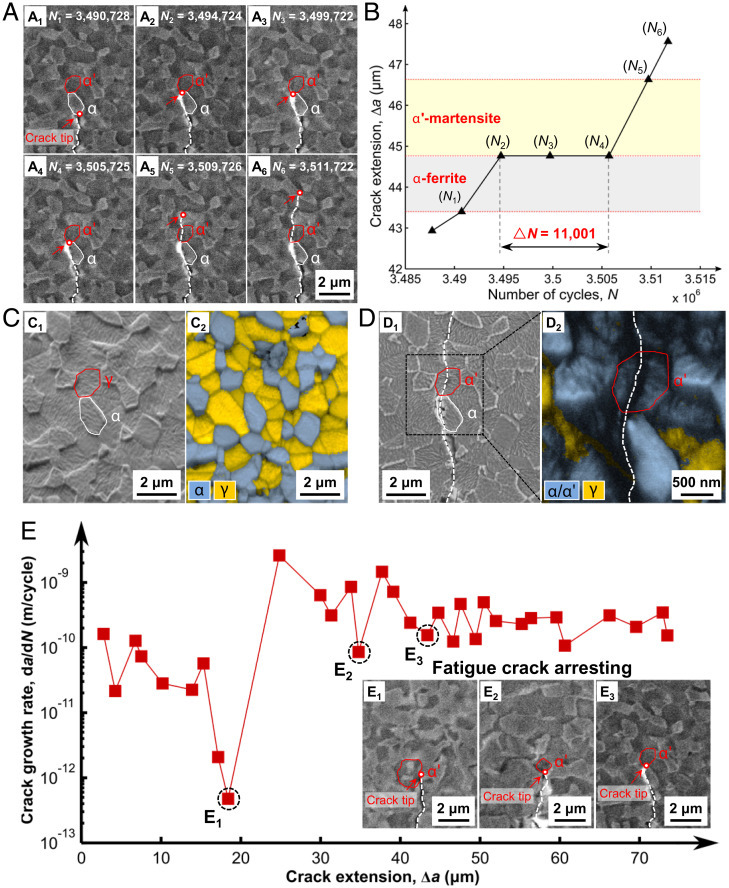
Deformation-induced martensitic transformation (DIMT) has been used for designing high-performance alloys to prevent structural failure under static loads. Its effectiveness against fatigue, however, is unclear. This limits the application of DIMT for parts that are exposed to variable loads, although such scenarios are the rule and not the exception for structural failure. Here we reveal the dual role of DIMT in fatigue crack growth through in situ observations. Two antagonistic fatigue mechanisms mediated by DIMT are identified, namely, transformation-mediated crack arresting, which prevents crack growth, and transformation-mediated crack coalescence, which promotes crack growth. Both mechanisms are due to the hardness and brittleness of martensite as a transformation product, rather than to the actual transformation process itself. In fatigue crack growth, the prevalence of one mechanism over the other critically depends on the crack size and the mechanical stability of the parent austenite phase. Elucidating the two mechanisms and their interplay allows for the microstructure design and safe use of metastable alloys that experience fatigue loads. The findings also generally reveal how metastable alloy microstructures must be designed for materials to be fatigue-resistant.
形变诱发马氏体相变(DIMT)已被用于设计高性能合金,以防止在静态负载下发生结构失效。然而,其在抗疲劳方面的效果尚不清楚。这限制了 DIMT 在承受变载部件中的应用,尽管这种情况对于结构失效来说是常态而非例外。在此,我们通过原位观察揭示了 DIMT 在疲劳裂纹扩展中的双重作用。确定了两种由 DIMT 介导的拮抗疲劳机制,即转变介导的裂纹止裂,其阻止裂纹扩展,以及转变介导的裂纹聚合,其促进裂纹扩展。这两种机制都归因于马氏体作为相变产物的硬度和脆性,而不是实际的相变过程本身。在疲劳裂纹扩展中,一种机制相对于另一种机制的优势取决于裂纹尺寸和母相奥氏体的机械稳定性。阐明这两种机制及其相互作用,可以为经历疲劳载荷的亚稳合金的微观结构设计和安全使用提供指导。这些发现还普遍揭示了为使材料具有抗疲劳性,必须如何设计亚稳合金的微观结构。