Wang Xin-Yu, Lin Jin-Jia, Lu Ming-Kun, Jang Fong-Lin, Tseng Huai-Hsuan, Chen Po-See, Chen Po-Fan, Chang Wei-Hung, Huang Chih-Chun, Lu Ke-Ming, Tan Hung-Pin, Lin Sheng-Hsiang
Institute of Clinical Medicine, College of Medicine, National Cheng Kung University, Tainan, Taiwan.
Department of Psychiatry, Chi Mei Medical Center, Tainan, Taiwan.
Schizophrenia (Heidelb). 2022 Feb 24;8(1):4. doi: 10.1038/s41537-021-00198-5.
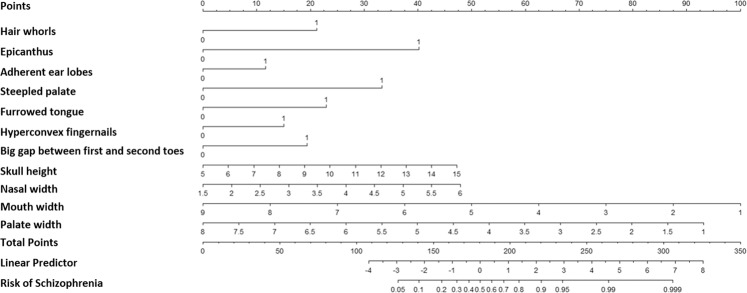
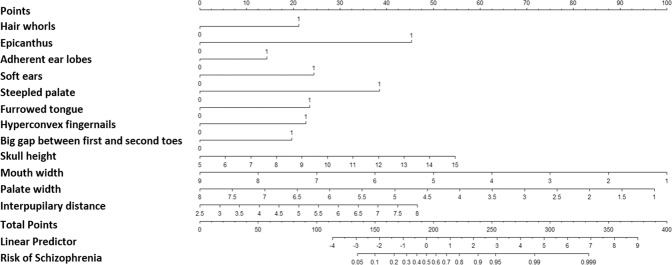
In support of the neurodevelopmental model of schizophrenia, minor physical anomalies (MPAs) have been suggested as biomarkers and potential pathophysiological significance for schizophrenia. However, an integrated, clinically useful tool that used qualitative and quantitative MPAs to visualize and predict schizophrenia risk while characterizing the degree of importance of MPA items was lacking. We recruited a training set and a validation set, including 463 schizophrenia patients and 281 healthy controls to conduct logistic regression and the least absolute shrinkage and selection operator (Lasso) regression to select the best parameters of MPAs and constructed nomograms. Two nomograms were built to show the weights of these predictors. In the logistic regression model, 11 out of a total of 68 parameters were identified as the best MPA items for distinguishing between patients with schizophrenia and controls, including hair whorls, epicanthus, adherent ear lobes, high palate, furrowed tongue, hyperconvex fingernails, a large gap between first and second toes, skull height, nasal width, mouth width, and palate width. The Lasso regression model included the same variables of the logistic regression model, except for nasal width, and further included two items (interpupillary distance and soft ears) to assess the risk of schizophrenia. The results of the validation dataset verified the efficacy of the nomograms with the area under the curve 0.84 and 0.85 in the logistic regression model and lasso regression model, respectively. This study provides an easy-to-use tool based on validated risk models of schizophrenia and reflects a divergence in development between schizophrenia patients and healthy controls ( https://www.szprediction.net/ ).
为支持精神分裂症的神经发育模型,轻微身体异常(MPAs)已被提议作为精神分裂症的生物标志物和潜在病理生理学意义。然而,缺乏一种综合的、临床可用的工具,该工具使用定性和定量的MPAs来可视化和预测精神分裂症风险,同时表征MPA项目的重要程度。我们招募了一个训练集和一个验证集,包括463名精神分裂症患者和281名健康对照,进行逻辑回归和最小绝对收缩和选择算子(Lasso)回归,以选择MPAs的最佳参数并构建列线图。构建了两个列线图以显示这些预测因子的权重。在逻辑回归模型中,总共68个参数中的11个被确定为区分精神分裂症患者和对照的最佳MPA项目,包括发旋、内眦赘皮、附着耳垂、高腭、舌面沟纹、指甲高凸、第一和第二脚趾之间的大间隙、颅骨高度、鼻宽、口宽和腭宽。Lasso回归模型包括与逻辑回归模型相同的变量,但不包括鼻宽,并且进一步包括两个项目(瞳孔间距和软耳)以评估精神分裂症风险。验证数据集的结果分别在逻辑回归模型和Lasso回归模型中验证了列线图的有效性,曲线下面积分别为0.84和0.85。本研究基于经过验证的精神分裂症风险模型提供了一种易于使用的工具,并反映了精神分裂症患者与健康对照之间的发育差异(https://www.szprediction.net/)。