Department of Medical Imaging, Hematology, and Oncology, Ribeirao Preto Medical School, University of Sao Paulo, Ribeirao Preto, Brazil.
Department of Pharmacology, Ribeirao Preto Medical School, University of Sao Paulo, Ribeirao Preto, Brazil.
Front Immunol. 2022 Feb 8;13:826577. doi: 10.3389/fimmu.2022.826577. eCollection 2022.
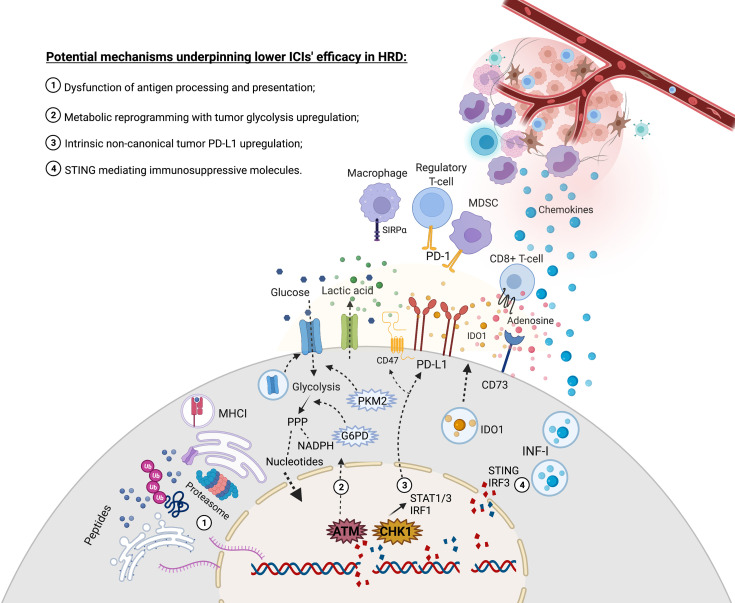
Cancer cells harbor genomic instability due to accumulated DNA damage, one of the cancer hallmarks. At least five major DNA Damage Repair (DDR) pathways are recognized to repair DNA damages during different stages of the cell cycle, comprehending base excision repair (BER), nucleotide excision repair (NER), mismatch repair (MMR), homologous recombination (HR), and non-homologous end joining (NHEJ). The unprecedented benefits achieved with immunological checkpoint inhibitors (ICIs) in tumors with mismatch repair deficiency (dMMR) have prompted efforts to extend this efficacy to tumors with HR deficiency (HRD), which are greatly sensitive to chemotherapy or PARP inhibitors, and also considered highly immunogenic. However, an in-depth understanding of HRD's molecular underpinnings has pointed to essential singularities that might impact ICIs sensitivity. Here we address the main molecular aspects of HRD that underlie a differential profile of efficacy and resistance to the treatment with ICIs compared to other DDR deficiencies.
癌细胞由于积累的 DNA 损伤而具有基因组不稳定性,这是癌症的标志之一。至少有五种主要的 DNA 损伤修复 (DDR) 途径被认为可以在细胞周期的不同阶段修复 DNA 损伤,包括碱基切除修复 (BER)、核苷酸切除修复 (NER)、错配修复 (MMR)、同源重组 (HR) 和非同源末端连接 (NHEJ)。免疫检查点抑制剂 (ICIs) 在错配修复缺陷 (dMMR) 的肿瘤中取得了前所未有的疗效,这促使人们努力将这种疗效扩展到同源重组缺陷 (HRD) 的肿瘤中,这些肿瘤对化疗或 PARP 抑制剂非常敏感,也被认为具有高度免疫原性。然而,对 HRD 分子基础的深入了解指出了一些可能影响 ICI 敏感性的基本特征。在这里,我们将讨论 HRD 的主要分子方面,这些方面导致了与其他 DDR 缺陷相比,ICI 治疗的疗效和耐药性的差异。