Department of Surgery, Division of Urology, NorthShore University HealthSystem, Evanston, Illinois.
Arbor Research Collaborative for Health, Ann Arbor, Michigan.
J Urol. 2022 Jul;208(1):155-163. doi: 10.1097/JU.0000000000002493. Epub 2022 Feb 25.
The impact of nonurological factors on male lower urinary tract symptoms (LUTS) remains unclear. We investigated cross-sectional and longitudinal associations among anxiety, depression, physical function, sleep quality and urinary symptom subdomains.
Data from 518 men in the LURN (Symptoms of Lower Urinary Tract Dysfunction Research Network) study were analyzed to identify associations between Patient-Reported Outcomes Measurement Information System® (PROMIS®) depression, anxiety, sleep disturbance and physical function measures and LUTS subdomains, as derived from the American Urological Association Symptom Index and LUTS Tool. Multivariable linear regression was used to assess the relationships between PROMIS measures and LUTS subdomains at baseline and at 3- and 12-month followup.
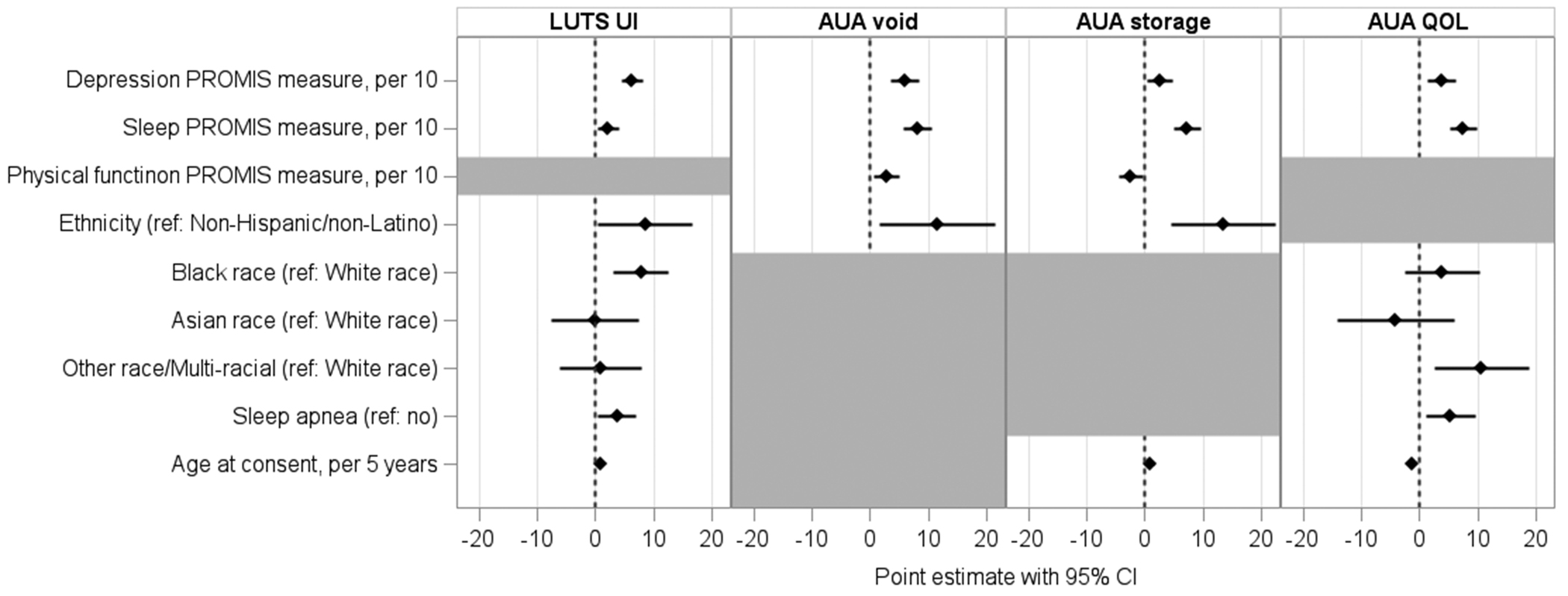
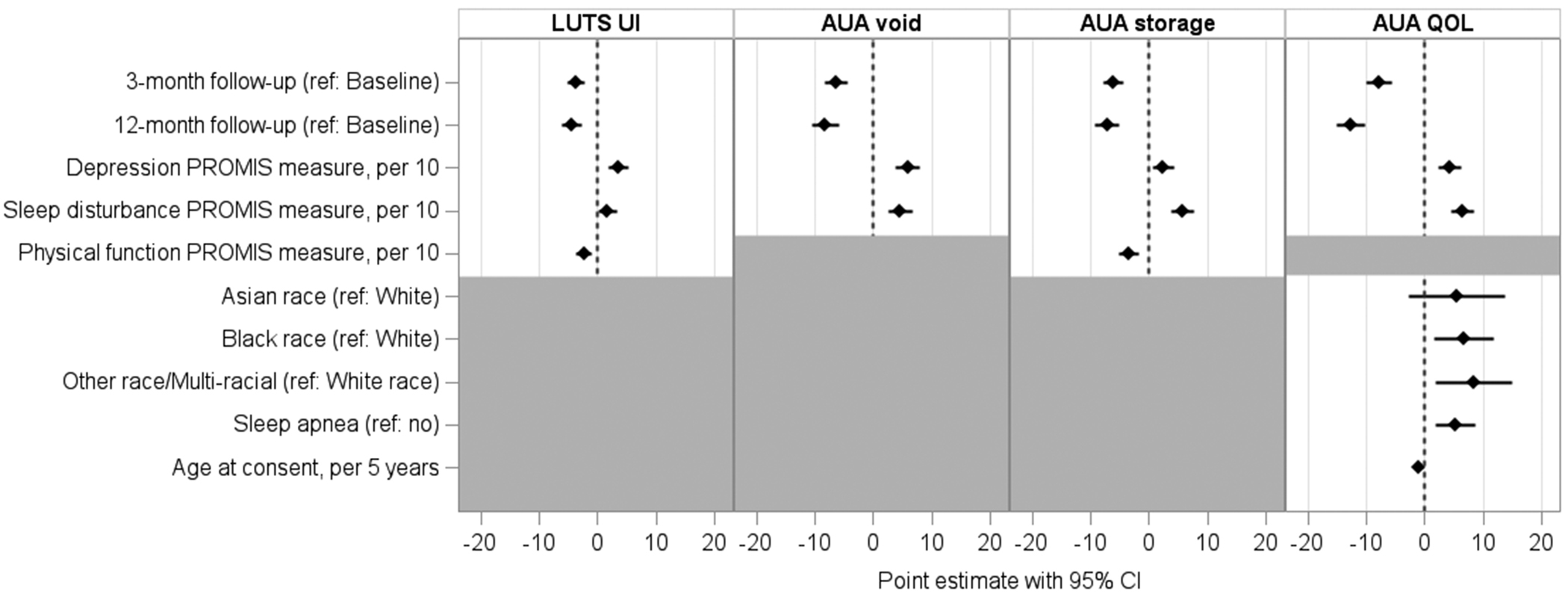
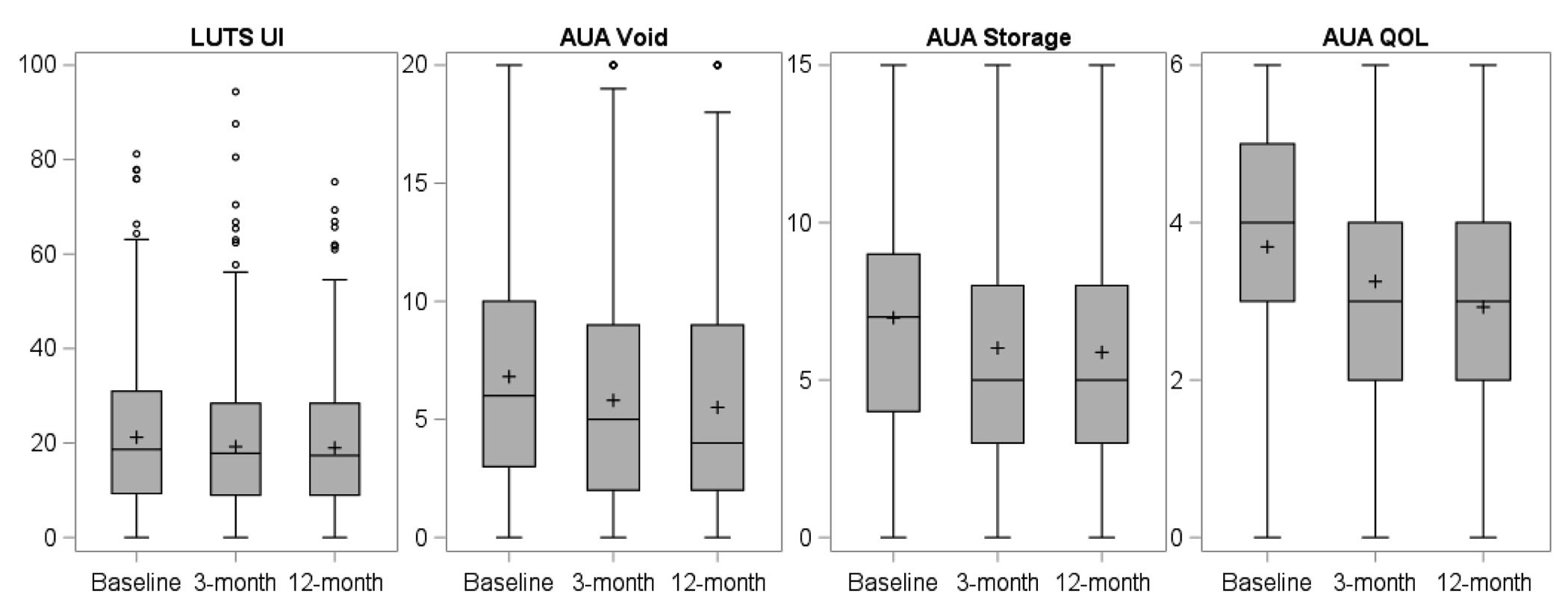
Baseline depression and anxiety were associated with urinary incontinence (p <0.001), voiding symptoms (p <0.001) and quality of life (p=0.002), whereas baseline sleep disturbance was associated with voiding and storage symptoms and quality of life (p <0.001 for all). Urinary symptom severity improved in all subdomains at 3 and 12 months. Similar associations between PROMIS measures and LUTS subdomains were observed at all time points, but baseline depression, anxiety, sleep disturbance and physical function measures were not associated with longitudinal trajectories of LUTS.
Urinary symptom subdomains are independently associated with modifiable clinical variables including sleep quality and depression at all time points, but these variables do not predict the degree of improvement in LUTS following urological evaluation and treatment over the medium term. Bidirectional assessment and randomized experiments may improve our understanding of these relationships.
非神经因素对男性下尿路症状(LUTS)的影响尚不清楚。我们调查了焦虑、抑郁、身体功能、睡眠质量和尿症状子领域之间的横断面和纵向关联。
分析了来自 LURN(下尿路功能障碍症状研究网络)研究的 518 名男性的数据,以确定患者报告的结果测量信息系统(PROMIS®)抑郁、焦虑、睡眠障碍和身体功能测量与 LUTS 子领域之间的关联,这些子领域源自美国泌尿协会症状指数和 LUTS 工具。多变量线性回归用于评估 PROMIS 测量与基线以及 3 个月和 12 个月随访时 LUTS 子领域之间的关系。
基线时的抑郁和焦虑与尿失禁(p <0.001)、排尿症状(p <0.001)和生活质量(p=0.002)有关,而基线时的睡眠障碍与排尿和存储症状以及生活质量有关(p <0.001)。在所有时间点,所有子领域的尿症状严重程度均得到改善。在所有时间点,PROMIS 测量与 LUTS 子领域之间均存在相似的关联,但基线时的抑郁、焦虑、睡眠障碍和身体功能测量与 LUTS 的纵向轨迹无关。
尿症状子领域与可改变的临床变量独立相关,包括所有时间点的睡眠质量和抑郁,但这些变量不能预测泌尿系统评估和治疗后 LUTS 改善的程度。双向评估和随机试验可能会提高我们对这些关系的理解。