Doctoral Program in Health Sciences, University of Seville, Seville, Spain.
Centre of Precision Rehabilitation for Spinal Pain (CPR Spine), School of Sport, Exercise and Rehabilitation Sciences, University of Birmingham, Birmingham, UK.
Pain Med. 2022 Aug 31;23(9):1529-1535. doi: 10.1093/pm/pnac038.
Several factors such as neck pain intensity, disability, anxiety, depression, female sex, or a previous history of headache are associated with post-whiplash headache. However, the possible role of psychosocial factors contributing to the presence of headache or worsening of headache after a whiplash trauma remains unclear. To address this gap in knowledge, there is the need to assess psychosocial factors concerning headache shortly after a whiplash injury.
To evaluate psychological features, pain and disability in people with acute whiplash associated disorders (WAD) and compare these features between those with and without headache.
Case-control study.
A secondary care traumatology center.
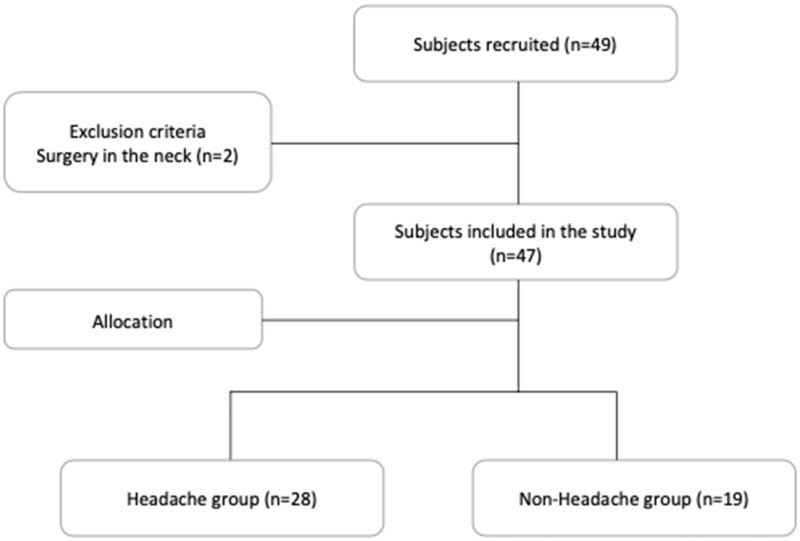
Forty-seven people with acute WAD were recruited; 28 with headache, and 19 without. All participants completed self-reported questionnaires including Visual Analogue Scale (VAS) for neck pain intensity, the Neck Disability Index (NDI), Pain Catastrophizing Scale (PCS), Tampa Scale Kinesiophobia-11 (TSK-11), and State-Trait Anxiety Inventory.
Neck pain intensity (P < .001), neck disability (P < 0.001), pain catastrophizing (P < .001), kinesiophobia (P < .001), and anxiety state (P = .007) and trait (P = .05) were higher in those with headache when compared to those without. In addition, high levels of neck pain (P = .025), moderate levels of neck disability (P < .001), moderate levels of pain catastrophizing (P = .015), and moderate (P = .002) and severe (P = .016) levels of kinesiophobia were related to the presence of headache.
The level of neck pain intensity and disability, kinesiophobia, catastrophizing, and anxiety were all greater in people with acute WAD who presented with a headache compared to those without headache.
颈痛强度、残疾、焦虑、抑郁、女性性别或头痛既往史等多种因素与挥鞭样损伤后头痛相关。然而,导致挥鞭样损伤后头痛出现或加重的心理社会因素的可能作用仍不清楚。为了填补这一知识空白,需要在挥鞭样损伤后不久评估与头痛相关的心理社会因素。
评估急性颈挥鞭样损伤相关障碍(WAD)患者的心理特征、疼痛和残疾,并比较头痛患者与无头痛患者之间的这些特征。
病例对照研究。
二级创伤中心。
共招募了 47 名急性 WAD 患者,其中 28 名有头痛,19 名无头痛。所有参与者均完成了自我报告问卷,包括颈痛视觉模拟评分(VAS)、颈部残疾指数(NDI)、疼痛灾难化量表(PCS)、坦帕运动恐惧调查表-11 版(TSK-11)和状态特质焦虑问卷。
与无头痛患者相比,有头痛患者的颈痛强度(P<0.001)、颈部残疾(P<0.001)、疼痛灾难化(P<0.001)、运动恐惧(P<0.001)和状态焦虑(P=0.007)及特质焦虑(P=0.05)更高。此外,高水平的颈痛(P=0.025)、中度颈部残疾(P<0.001)、中度疼痛灾难化(P=0.015)、中度(P=0.002)和重度(P=0.016)运动恐惧与头痛的存在相关。
与无头痛的急性 WAD 患者相比,有头痛的急性 WAD 患者的颈痛强度和残疾程度、运动恐惧、灾难化和焦虑程度更高。