Fitzgerald Timothy, Near Aimee M, Kim Hyunchung, Teeple Amanda, Olurinde Mobolaji, Rowland Katelyn
Janssen Scientific Affairs, LLC, Titusville, NJ, USA.
Real World Evidence Solutions, IQVIA, 4280 Emperor Blvd, Durham, NC, 27703, USA.
Dermatol Ther (Heidelb). 2022 Mar;12(3):741-752. doi: 10.1007/s13555-022-00691-4. Epub 2022 Feb 24.
Biologics have expanded the treatment options in the management of patients with moderate-to-severe psoriasis. The objective of this study was to describe patient characteristics and previous treatments in psoriasis patients newly treated with guselkumab, secukinumab, or ixekizumab.
This retrospective study included patients ≥ 18 years old with psoriasis in the USA who were newly treated with guselkumab, secukinumab, or ixekizumab between 1 July 2017 and 31 March 2019 in the Modernizing Medicine Data Services database (MMDS). Patients were indexed on their first prescription or injection record of guselkumab, secukinumab, or ixekizumab, and three mutually exclusive cohorts were created. Patients were required to have evidence of moderate-to-severe psoriasis, defined as Physician Global Assessment (PGA) score of 3 or 4, or body surface area (BSA) ≥ 10% on index date or within 12 months before index. Baseline characteristics, including treatment history, were reported for each cohort.
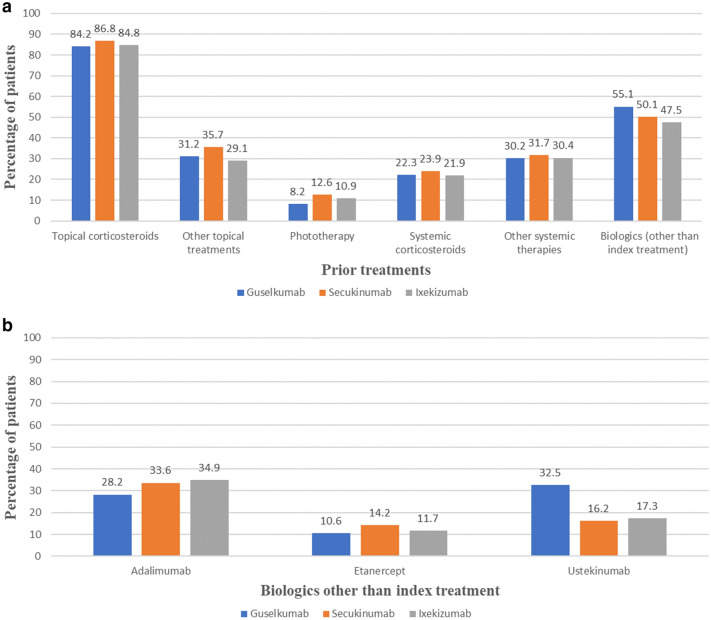
The study population included 461 guselkumab, 619 secukinumab, and 375 ixekizumab patients. The median age across cohorts was 51-52 years. Median baseline BSA ranged from 15% to 20%; 16.1-29.3% of patients had a PGA of 4 and over half of patients were obese prior to index. Approximately 40% of patients had comorbid cardiovascular disease and 20.8-24.2% of patients had a psychiatric disorder. About half of patients in each cohort had prior biologic use, of which adalimumab was most common (28.2-34.9%) across the cohorts.
This real-world study describes the characteristics of patients with moderate-to-severe psoriasis receiving biologic treatments.
生物制剂扩大了中重度银屑病患者的治疗选择范围。本研究的目的是描述接受古塞库单抗、司库奇尤单抗或依奇珠单抗新治疗的银屑病患者的特征及既往治疗情况。
这项回顾性研究纳入了美国年龄≥18岁的银屑病患者,这些患者于2017年7月1日至2019年3月31日期间在Modernizing Medicine数据服务数据库(MMDS)中接受了古塞库单抗、司库奇尤单抗或依奇珠单抗的新治疗。患者以其首次使用古塞库单抗、司库奇尤单抗或依奇珠单抗的处方或注射记录为索引,创建了三个相互排斥的队列。患者需有中重度银屑病的证据,定义为在索引日期或索引前12个月内医师整体评估(PGA)评分为3或4,或体表面积(BSA)≥10%。报告了每个队列的基线特征,包括治疗史。
研究人群包括461例使用古塞库单抗、619例使用司库奇尤单抗和375例使用依奇珠单抗的患者。各队列的中位年龄为51 - 52岁。基线BSA中位数范围为15%至20%;16.1% - 29.3%的患者PGA为4,超过一半的患者在索引前肥胖。约40%的患者患有合并心血管疾病,20.8% - 24.2%的患者患有精神障碍。每个队列中约一半的患者既往使用过生物制剂,其中阿达木单抗在各队列中最为常见(28.2% - 34.9%)。
这项真实世界研究描述了接受生物治疗的中重度银屑病患者的特征。