Department of Neurology, University of Wisconsin School of Medicine and Public Health, Madison, Wisconsin, USA.
Division of Geriatrics, Department of Medicine, University of Wisconsin School of Medicine and Public Health, Madison, Wisconsin, USA.
Alzheimers Dement. 2022 Oct;18(10):1969-1979. doi: 10.1002/alz.12620. Epub 2022 Feb 25.
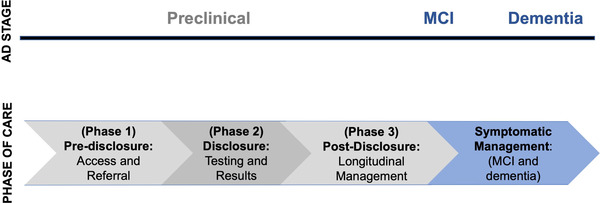
Alzheimer's disease (AD) begins with an asymptomatic "preclinical" phase, in which abnormal biomarkers indicate risk for developing cognitive impairment. Biomarker information is increasingly being disclosed in research settings, and is moving toward clinical settings with the development of cheaper and non-invasive testing. Limited research has focused on the safety and psychological effects of disclosing biomarker results to cognitively unimpaired adults. However, less is known about how to ensure equitable access and robust counseling for decision-making before testing, and how to effectively provide long-term follow-up and risk management after testing. Using the framework of Huntington's disease, which is based on extensive experience with disclosing and managing risk for a progressive neurodegenerative condition, this article proposes a conceptual model of pre-disclosure, disclosure, and post-disclosure phases for AD biomarker testing. Addressing research questions in each phase will facilitate the transition of biomarker testing into clinical practice.
阿尔茨海默病(AD)始于无症状的“临床前”阶段,在此期间,异常的生物标志物表明有认知障碍的风险。生物标志物信息越来越多地在研究环境中披露,并随着更廉价、非侵入性检测手段的发展,逐渐走向临床环境。有限的研究集中在向认知未受损的成年人披露生物标志物结果的安全性和心理影响上。然而,在检测前如何确保公平获得和有力的咨询以做出决策,以及在检测后如何有效地提供长期随访和风险管理方面,了解得较少。本文利用亨廷顿病的框架,该框架基于对进行性神经退行性疾病进行风险披露和管理的丰富经验,为 AD 生物标志物检测提出了一个预披露、披露和披露后阶段的概念模型。解决每个阶段的研究问题将有助于将生物标志物检测转化为临床实践。