Meggiolaro Angela, Sane Schepisi Monica, Nikolaidis Georgios F, Mipatrini Daniele, Siddu Andrea, Rezza Giovanni
Italian Ministry of Health, General Directorate for Health Prevention, Viale Ribotta 5, 00144 Rome, Italy.
IQVIA, 210 Pentonville Rd, London N1 9JB, UK.
Vaccines (Basel). 2022 Jan 21;10(2):157. doi: 10.3390/vaccines10020157.
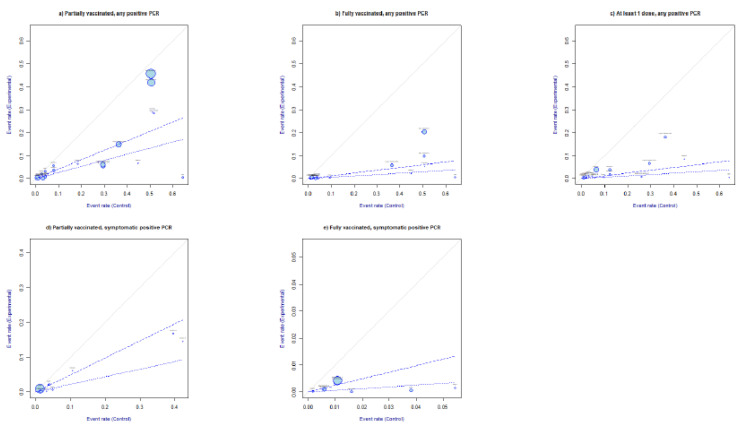
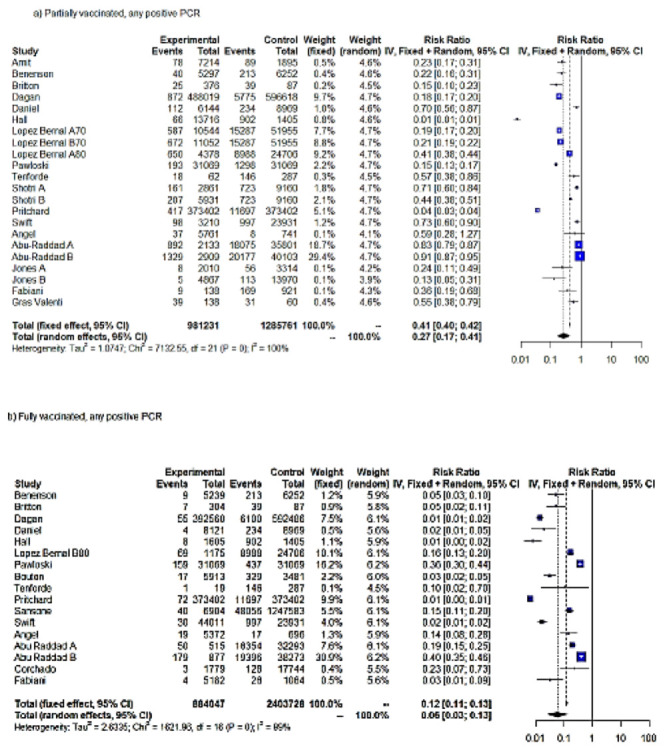
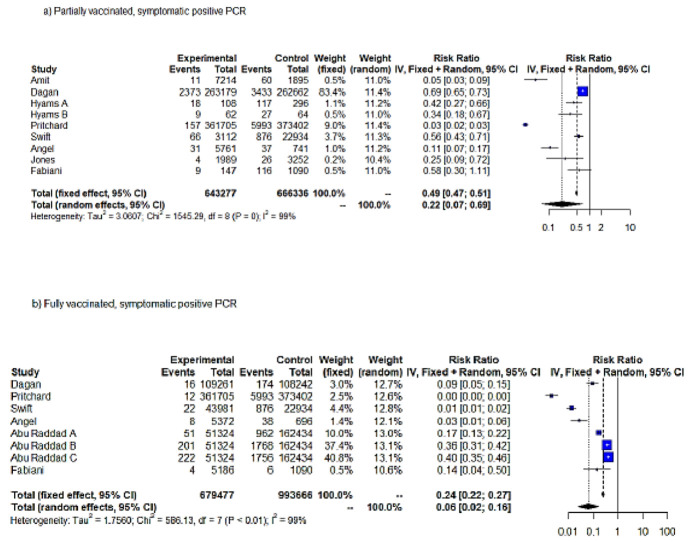
(1) Background: The objective of this study was to assess the effectiveness of SARS-CoV-2 vaccines in terms of prevention of disease and transmission in the pre-Delta era. The evaluation was narrowed to two mRNA vaccines and two modified adenovirus-vectored vaccines. (2) Methods: The overall risk of any SARS-CoV-2 infection confirmed by positive real-time Polymerase Chain Reaction (PCR) test was estimated in partially and fully vaccinated individuals. The evidence synthesis was pursued through a random-effects meta-analysis. The effect size was expressed as relative risk (RR) and RRR (RR reduction) of SARS-CoV-2 infection following vaccination. Heterogeneity was investigated through a between-study heterogeneity analysis and a subgroup meta-analysis. (3) Results: The systematic review identified 27 studies eligible for the quantitative synthesis. Partially vaccinated individuals presented a RRR = 73% (95%CI = 59-83%) for positive SARS-CoV-2 PCR (RR = 0.27) and a RRR=79% (95%CI = 30-93%) for symptomatic SARS-CoV-2 PCR (RR = 0.21). Fully vaccinated individuals showed a RRR = 94% (95%CI = 88-98%) for SARS-CoV-2 positive PCR (RR = 0.06) compared to unvaccinated individuals. The full BNT162b2 vaccination protocol achieved a RRR = 84-94% against any SARS-CoV-2-positive PCR and a RRR = 68-84% against symptomatic positive PCR. (4) Conclusions: The meta-analysis results suggest that full vaccination might block transmission. In particular, the risk of SARS-CoV-2 infection appeared higher for non-B.1.1.7 variants and individuals aged ≥69 years. Considering the high level of heterogeneity, these findings must be taken with caution. Further research on SARS-CoV-2 vaccine effectiveness against emerging SARS-CoV-2 variants is encouraged.
(1) 背景:本研究的目的是评估严重急性呼吸综合征冠状病毒2(SARS-CoV-2)疫苗在德尔塔变异株出现之前预防疾病和传播方面的有效性。评估范围缩小到两种信使核糖核酸(mRNA)疫苗和两种修饰腺病毒载体疫苗。(2) 方法:通过实时聚合酶链反应(PCR)检测确诊的任何SARS-CoV-2感染的总体风险在部分接种和完全接种疫苗的个体中进行了估计。通过随机效应荟萃分析进行证据综合。效应大小表示为接种疫苗后SARS-CoV-2感染的相对风险(RR)和RRR(RR降低)。通过研究间异质性分析和亚组荟萃分析研究异质性。(3) 结果:系统评价确定了27项符合定量综合分析的研究。部分接种疫苗的个体中,SARS-CoV-2 PCR阳性的RRR = 73%(95%置信区间[CI] = 59 - 83%)(RR = 0.27),有症状的SARS-CoV-2 PCR的RRR = 79%(95%CI = 30 - 93%)(RR = 0.21)。与未接种疫苗的个体相比,完全接种疫苗的个体中SARS-CoV-2 PCR阳性的RRR = 94%(95%CI = 88 - 98%)(RR = 0.06)。完整的BNT162b2疫苗接种方案对任何SARS-CoV-2阳性PCR的RRR = 84 - 94%,对有症状阳性PCR的RRR = 68 - 84%。(4) 结论:荟萃分析结果表明,完全接种疫苗可能会阻断传播。特别是,非B.1.1.7变异株和年龄≥69岁的个体感染SARS-CoV-2的风险似乎更高。考虑到高度的异质性,这些发现必须谨慎对待。鼓励对SARS-CoV-2疫苗针对新出现的SARS-CoV-2变异株的有效性进行进一步研究。