Frau Roberto, Pardu Alessandra, Godar Sean, Bini Valentina, Bortolato Marco
Department of Biomedical Sciences, Division of Neuroscience and Clinical Pharmacology, University of Cagliari, 09042 Monserrato, Italy.
Guy Everett Laboratory, Department of Biomedical Sciences, Division of Neuroscience and Clinical Pharmacology, University of Cagliari, 09042 Monserrato, Italy.
Pharmaceuticals (Basel). 2022 Feb 10;15(2):213. doi: 10.3390/ph15020213.
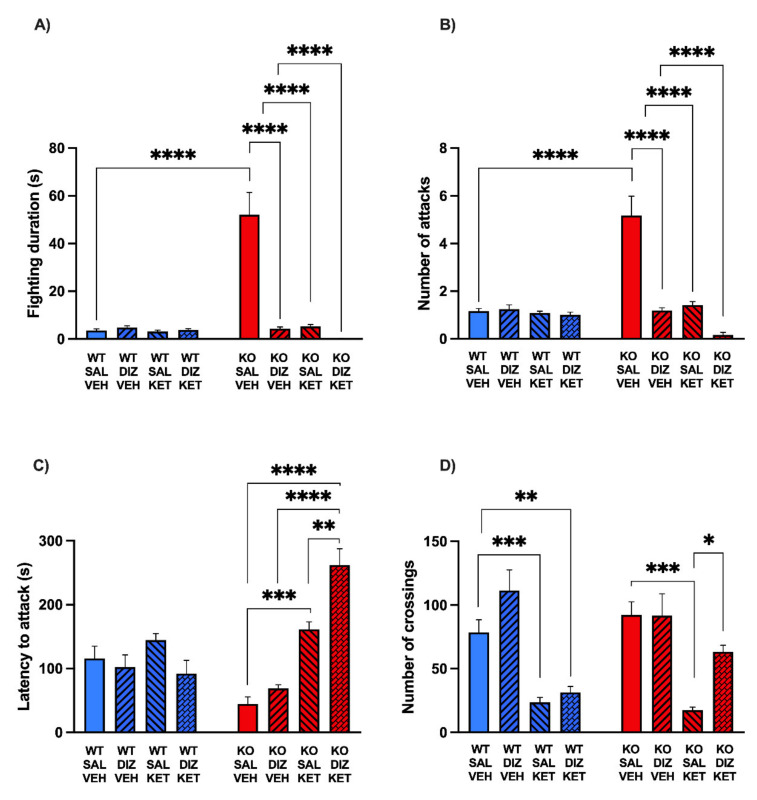
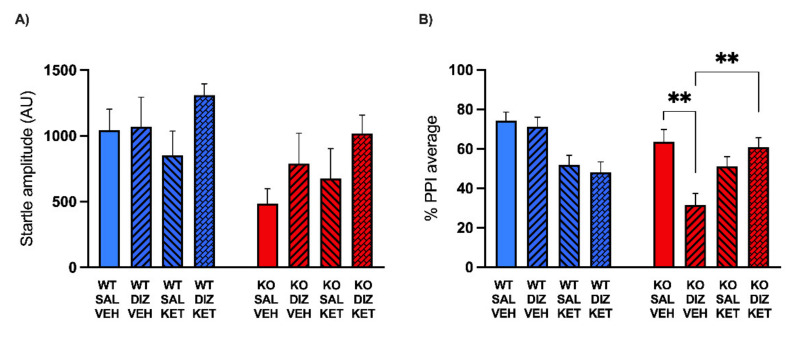
The enzyme monoamine oxidase A (MAOA) catalyzes the degradation of several neurotransmitters, including serotonin. A large body of evidence has shown that genetic MAOA deficiency predisposes humans and mice to aggression and antisocial behavior. We previously documented that the aggression of male MAOA-deficient mice is contributed by serotonin 5-HT and glutamate N-methyl-D-aspartate (NMDA) receptors in the prefrontal cortex (PFC). Indeed, blocking either receptor reduces the aggression of MAOA knockout (KO) mice; however, 5-HT receptor antagonists, such as ketanserin (KET), reduce locomotor activity, while NMDA receptor blockers are typically associated with psychotomimetic properties. To verify whether NMDA receptor blockers induce psychotomimetic effects in MAOA KO mice, here we tested the effects of these compounds on prepulse inhibition (PPI) of the acoustic startle reflex. We found that male MAOA KO mice are hypersensitive to the PPI-disrupting properties of NMDA receptor antagonists, including the non-competitive antagonist dizocilpine (DIZ; 0.1, 0.3 mg/kg, IP) and the NR2B subunit-specific blocker Ro-256981 (5, 10 mg/kg, IP). Since KET has been previously shown to counter the PPI deficits caused by NMDA receptor antagonists, we tested the behavioral effects of the combination of KET (2 mg/kg, IP) and these drugs. Our results show that the combination of KET and DIZ potently reduces aggression in MAOA KO mice without any PPI deficits and sedative effects. While the PPI-ameliorative properties of KET were also observed after infusion in the medial PFC (0.05 μg/side), KET did not counter the PPI-disruptive effects of Ro-256981 in MAOA KO mice. Taken together, these results point to the combination of non-subunit-selective NMDA and 5-HT receptor antagonists as a potential therapeutic approach for aggression and antisocial behavior with a better safety and tolerability profile than each monotherapy.
单胺氧化酶A(MAOA)催化包括血清素在内的多种神经递质的降解。大量证据表明,MAOA基因缺陷使人类和小鼠易出现攻击性和反社会行为。我们之前记录了雄性MAOA缺陷小鼠的攻击性是由前额叶皮质(PFC)中的血清素5-HT和谷氨酸N-甲基-D-天冬氨酸(NMDA)受体所致。确实,阻断任一受体都会降低MAOA基因敲除(KO)小鼠的攻击性;然而,5-HT受体拮抗剂,如酮色林(KET),会降低运动活性,而NMDA受体阻滞剂通常与拟精神病特性相关。为了验证NMDA受体阻滞剂是否在MAOA KO小鼠中诱导拟精神病效应,在此我们测试了这些化合物对听觉惊吓反射的前脉冲抑制(PPI)的影响。我们发现雄性MAOA KO小鼠对NMDA受体拮抗剂的PPI破坏特性高度敏感,包括非竞争性拮抗剂地佐环平(DIZ;0.1、0.3毫克/千克,腹腔注射)和NR2B亚基特异性阻滞剂Ro-256981(5、10毫克/千克,腹腔注射)。由于之前已表明KET可对抗NMDA受体拮抗剂引起的PPI缺陷,我们测试了KET(2毫克/千克,腹腔注射)与这些药物联合使用的行为效应。我们的结果表明,KET和DIZ联合使用可有效降低MAOA KO小鼠的攻击性,且无任何PPI缺陷和镇静作用。虽然在内侧PFC注射(0.05微克/侧)后也观察到了KET改善PPI的特性,但KET并未对抗MAOA KO小鼠中Ro-256981的PPI破坏效应。综上所述,这些结果表明非亚基选择性NMDA和5-HT受体拮抗剂联合使用是一种针对攻击性和反社会行为的潜在治疗方法,其安全性和耐受性优于每种单一疗法。