Division of Cell Matrix Biology and Regenerative Medicine, Faculty of Biology, Medicine and Health, University of Manchester, 3721 Stopford Building, Oxford Road, Manchester M13 9PT, UK.
Division of Immunology, Immunity to Infection and Respiratory Medicine, The Lydia Becker Institute of Immunology and Inflammation, Manchester Collaborative Centre for Inflammation Research, Faculty of Biology, Medicine and Health, University of Manchester, Manchester Academic Health Science Centre, Manchester M13 9PT, UK.
Int J Mol Sci. 2022 Feb 11;23(4):1999. doi: 10.3390/ijms23041999.
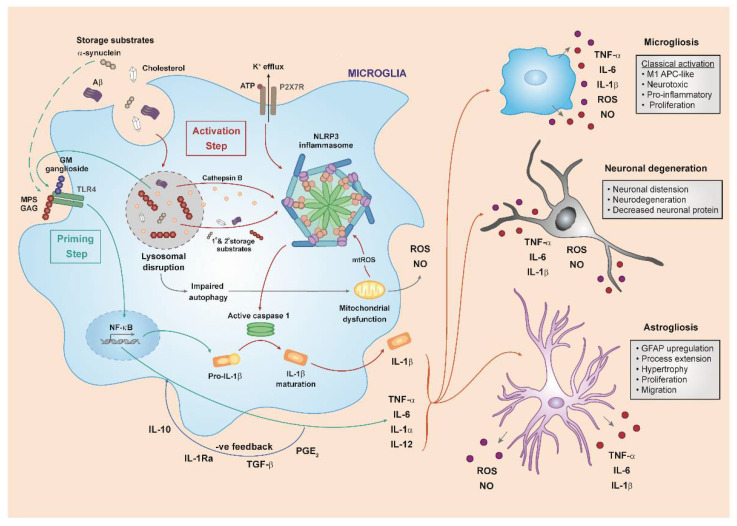
Mucopolysaccharidoses are rare paediatric lysosomal storage disorders, characterised by accumulation of glycosaminoglycans within lysosomes. This is caused by deficiencies in lysosomal enzymes involved in degradation of these molecules. Dependent on disease, progressive build-up of sugars may lead to musculoskeletal abnormalities and multi-organ failure, and in others, to cognitive decline, which is still a challenge for current therapies. The worsening of neuropathology, observed in patients following recovery from flu-like infections, suggests that inflammation is highly implicated in disease progression. This review provides an overview of the pathological features associated with the mucopolysaccharidoses and summarises current knowledge regarding the inflammatory responses observed in the central nervous system and periphery. We propose a model whereby progressive accumulation of glycosaminoglycans elicits an innate immune response, initiated by the Toll-like receptor 4 pathway, but also precipitated by secondary storage components. Its activation induces cells of the immune system to release pro-inflammatory cytokines, such as TNF-α and IL-1, which induce progression through chronic neuroinflammation. While TNF-α is mostly associated with bone and joint disease in mucopolysaccharidoses, increasing evidence implicates IL-1 as a main effector of innate immunity in the central nervous system. The (NOD)-like receptor protein 3 inflammasome is therefore implicated in chronic neuroinflammation and should be investigated further to identify novel anti-inflammatory treatments.
黏多糖贮积症是一种罕见的儿科溶酶体贮积症,其特征是溶酶体内糖胺聚糖的积累。这是由于参与这些分子降解的溶酶体酶的缺乏所致。根据疾病的不同,糖的逐渐积累可能导致肌肉骨骼异常和多器官衰竭,而在其他疾病中,则可能导致认知能力下降,这仍然是当前治疗方法的一个挑战。流感样感染后患者神经病理学恶化的观察结果表明,炎症在疾病进展中高度涉及。本综述提供了与黏多糖贮积症相关的病理特征概述,并总结了目前关于中枢神经系统和外周炎症反应的知识。我们提出了一个模型,即糖胺聚糖的逐渐积累引发了先天免疫反应,该反应由 Toll 样受体 4 途径引发,但也由继发性贮存成分引发。其激活诱导免疫系统细胞释放促炎细胞因子,如 TNF-α 和 IL-1,从而通过慢性神经炎症诱导疾病进展。虽然 TNF-α在黏多糖贮积症中主要与骨骼和关节疾病相关,但越来越多的证据表明 IL-1 是中枢神经系统固有免疫的主要效应因子。因此,核苷酸结合寡聚化结构域样受体蛋白 3 炎性小体与慢性神经炎症有关,应进一步研究以确定新的抗炎治疗方法。