Genetic Unit and Thalassemia Center, San Luigi Gonzaga University Hospital, Regione Gonzole 10, 10043, Orbassano, TO, Italy.
Medical Genetics Unit, AOU Città della Salute e della Scienza, Turin, Italy.
J Nephrol. 2022 Apr;35(3):841-850. doi: 10.1007/s40620-022-01258-4. Epub 2022 Feb 26.
Primary hyperoxalurias (PHs) are rare autosomal recessive diseases of the glyoxylate metabolism; PH1 is caused by mutations in the AGXT gene, PH2 in GRHPR and PH3 in HOGA1.
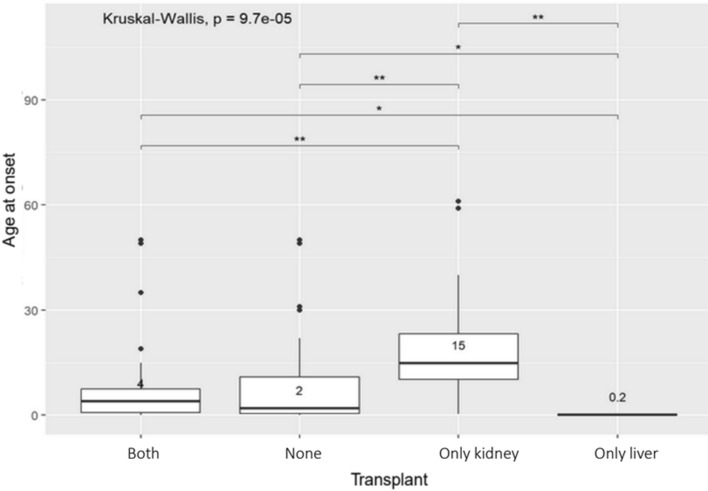
Here we report the first large multi-center cohort of Italian PH patients collected over 30 years (1992-2020 median follow-up time 8.5 years). Complete genotype was available for 94/95 PH1 patients and for all PH2 (n = 3) and PH3 (n = 5) patients. Symptoms at onset were mainly nephrolithiasis (46.3%) and nephrocalcinosis (33.7%). Median age at onset of symptoms and diagnosis were 4.0 years and 9.9 years, respectively.
Fifty-four patients (56.8%) were diagnosed after chronic kidney disease. Sixty-three patients (66.3%) developed end stage kidney disease (median age 14.0 years). Twenty-one patients had a kidney-only transplant and, among them, seven had a second kidney transplant combined with liver transplant. A combined kidney-liver transplant was carried out in 29 patients and a sequential kidney-liver transplant was performed in two. In five cases a preemptive liver transplant was performed. Those receiving a liver-only transplant tended to have lower kidney function at last follow-up.
Our study of PHs in Italy underlines a considerable diagnostic delay, which has only slightly decreased in recent years. Therefore, we suggest a more extensive use of both metabolic screening among patients with recurrent kidney stones and genotyping, including unambiguous assignment of minor/major allele status in order to promptly begin appropriate treatment. This will be fundamental in order to have access to the new therapies, which are mainly focused on substrate reduction for the oxalate-producing enzymes using RNA-interference.
原发性高草酸尿症(PHs)是一种罕见的糖异生代谢缺陷的常染色体隐性遗传病;PH1 是由 AGXT 基因突变引起,PH2 是由 GRHPR 基因突变引起,PH3 是由 HOGA1 基因突变引起。
本研究报告了意大利 PH 患者的第一个大型多中心队列,该队列收集时间超过 30 年(1992 年至 2020 年,中位随访时间为 8.5 年)。94/95 例 PH1 患者和所有 PH2(n=3)和 PH3(n=5)患者的基因型均完整。发病时的主要症状为肾结石(46.3%)和肾钙质沉着症(33.7%)。症状和诊断的中位发病年龄分别为 4.0 岁和 9.9 岁。
54 例患者(56.8%)在慢性肾脏病后被诊断。63 例患者(66.3%)发展为终末期肾病(中位年龄 14.0 岁)。21 例患者进行了肾脏单器官移植,其中 7 例患者在进行了肝脏移植的同时也进行了肾脏移植。29 例患者接受了肝肾联合移植,2 例患者接受了序贯肝肾移植,5 例患者进行了预防性肝移植。那些仅接受肝脏移植的患者在最后一次随访时的肾功能往往较低。
意大利 PH 研究强调了诊断的显著延迟,尽管近年来这一情况略有改善。因此,我们建议更广泛地开展代谢筛查,包括对复发性肾结石患者进行基因检测,明确区分次要/主要等位基因状态,以便及时开始适当的治疗。这对于获得新的治疗方法至关重要,新的治疗方法主要侧重于使用 RNA 干扰减少产草酸酶的底物。